mobile Ansicht, to the English Version tap the flag

- Fürstentum Andorra
- nominelles Fürstentum mit parlamentarischer Regierungsform
- ehemaliger Lehensstaat des Bischofs von Urgel (Spanien) und des französischen Präsidenten
- Eigenbezeichnungen: Principauté d' Andorre (Fr.), Principado de Andorra (Sp.)
• Flagge
• historische Flaggen
• Bedeutung/Ursprung der Flagge
• Wappen
• Bedeutung/Ursprung des Wappens
• Landkarte
• Zahlen und Fakten
• Geschichte
• Ursprung des Landesnamens
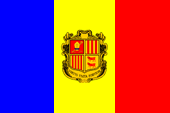
Nationalflagge,
Seitenverhältnis = 2:3,
Quelle, nach:
Flags of the World,
Wikipedia (D),
Flaggen Enzyklopädie


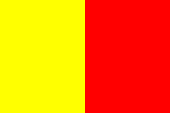
1806–1866,
Nationalflagge,
Quelle, nach: Flags of the World,
Wikipedia (D)

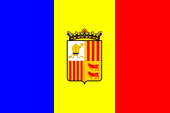
1866–1993,
Nationalflagge,
Quelle, nach: Flaggen und Wappen
Die Flagge Andorras wurde in ihrer heutigen Gestalt – drei senkrechte Streifen in Blau, Gelb und Rot im Verhältnis von 8:9:8, im gelben Streifen das Wappen – im Jahre 1866 gehisst. Angeblich wurde sie von Kaiser Napoleon III. entworfen. Die Flagge vereinigt die Farben Blau und Rot, zwei Farben der französischen Trikolore, und die Farben Gelb und Rot, die spanischen Farben. Die Gestaltung dieser Flagge sollte den französischen Einfluss auf das Land mehr zur Geltung bringen. Jedenfalls ersetzte diese Trikolore die Flagge Andorras von 1806, welche die traditionellen Landesfarben Gelb und Rot in senkrechter Anordnung zeigte, die Farben der Grafen von Foix und auch des Bischofs von Urgel.
Quelle: Flaggen-Atlas Erde
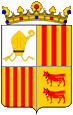
bis 1993,
Wappen von Andorra,
Quelle, nach:
Flaggen und Wappen
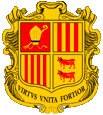
seit 1993,
Wappen von Andorra,
Quelle, nach:
Corel Draw 4,
Wikipedia (D)
Das Wappen Andorras ist viergeteilt, und zeigt in den einzelnen Feldern eine Bischofsmütze (Urgel), drei rote Pfähle (Foix), vier rote Pfähle (Roussillon) und zwei Kühe (Béarn). Im Land sind verschiedene Varianten der Flagge zu sehen, auch teils mit und teils ohne Wappen. Im Jahr 1993 wurde eine neue Verfassung angenommen, welche Andorra volle Souveränität garantierte. Vorher war Andorra eine Art französisch-spanischer Lehensstaat. Möglicherweise wurde die bisher oberhalb des Wappens verwendete Krone in diesem Zusammenhang entfernt.
Quelle: Wikipedia (D),
Flaggen-Atlas Erde,
Volker Preuss
Lage:
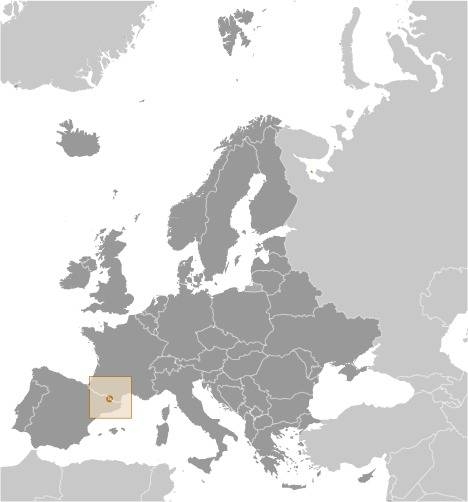
Quelle: CIA World Factbook
Landkarte des Landes:
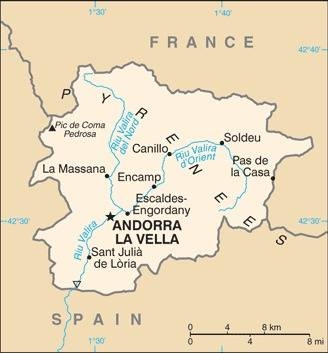
Quelle: CIA World Factbook
Fläche: 468 km²
Einwohner: 77.000 (2018), davon Andorraner 48.8%, Spanier (Katalanen) 25.1%, Portugiesen 12%, Franzosen 4.4%, andere 9.7%
Religionen: 89% Römisch-Katholisch, 4% andere Christen
Bevölkerungsdichte: 165 Ew./km²
Hauptstadt: Andorra la Vella, 23.214 Ew. (2019)
Amtssprache: Katalanisch
sonstige Sprachen: Französisch, Spanisch
Währung: 1 Euro (EUR, €) = 100 Cent
Zeitzone: MEZ
Quelle: Wikipedia (D),
World Statesmen,
CIA World Factbook
1278 · Errichtung der gemeinsamen Schutzherrschaft des Bischofs von Urgel und der Grafen von Foix
1993 · neue Verfassung, volle Souveränität
Quelle: Wikipedia (D)
Der Name "Andorra" ist der Gegend wahrscheinlich von Navarra aus gegeben worden, und geht auf das baskische Wort "andurrial" zurück, was "Buschland" heißt.
Quelle: Handbuch der geographischen Namen