mobile Ansicht, to the English Version tap the flag

- Republik Angola
- präsidiale Republik
- Eigenbezeichnung: República de Angola
• Flagge
• historische Flaggen
• Bedeutung/Ursprung der Flagge
• Wappen
• Bedeutung/Ursprung des Wappens
• Flugzeugkokarde
• Landkarte
• Zahlen und Fakten
• Geschichte
• Ursprung des Landesnamens
• Cabinda
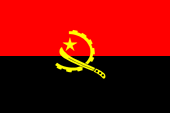
Nationalflagge,
Seitenverhältnis = 2:3,
Quelle, nach: Wikipedia (D),
Corel Draw 4


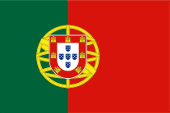
Nationalflagge Portugal,
Seitenverhältnis = 2:3,
Quelle, nach: Corel Draw 4
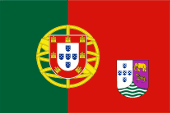
60-er Jahre 19. Jhd.,
geplante Flagge für Angola,
Seitenverhältnis = 2:3,
Quelle, nach:
Wikipedia (D)

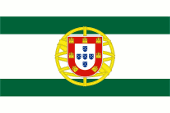
bis 1935,
Flagge eines Oberkommissars,
Seitenverhältnis = 2:3,
Quelle, nach: Flaggenbuch 1939
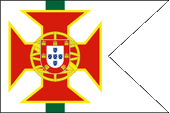
1935–1961,
Flagge eines Distriktskommandanten,
Seitenverhältnis = 2:3,
Quelle, nach: Flaggenbuch 1939
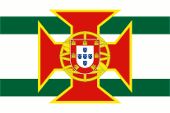
1935–1975,
Flagge des Generalgouverneurs,
Seitenverhältnis = 2:3,
Quelle, nach: Die Welt im bunten Flaggenbild

Die Nationalflagge wurde am 11.11.1975 nach der Erlangung der Unabhängigkeit von Portugal eingeführt. Sie basiert auf der Flagge der MPLA, der erfolgreichen Befreiungsbewegung, welche seit 1964 eine rot-schwarze Flagge mit einem gelben Stern führte. Nun zeigt die Flagge, zentral angeordnet, ein halbiertes Zahnrad, einen Stern und ein Buschmesser. Rot steht für das im Befreiungskampf vergossene Blut, Schwarz steht für Afrika, den dunklen Erdteil und Gold (Gelb) weist auf die natürlichen Reichtümer des Landes hin. Das Zahnrad symbolisiert die Arbeiterklasse, das Buschmesser die Bauern, der Stern Fortschritt und Internationalismus. In der Zeit als portugiesische Kolonie wurde ausschließlich die portugiesische Nationalflagge verwendet, da man die Kolonien als fester Bestandteil des Mutterlandes betrachtete, und nicht als Außenbesitzungen. Das bedeutete, das portugiesische Kolonien nie eigene Flaggen hatten, auch wenn es in den sechziger Jahren des 20. Jahrhunderts Bestrebungen gab Flaggen für die Kolonien einzuführen, indem man das Wappen der Kolonie in das fliegende Ende der portugiesischen Nationalflagge platzierte. Diese Pläne wurden jedoch nie realisiert.
Quelle: Flags of the World,
Die Welt der Flaggen,
Flaggen Wappen Hymnen
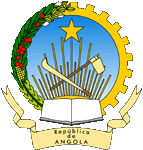
seit 2010,
Wappen von Angola,
Quelle, nach:
Wikipedia (EN),
Corel Draw 4
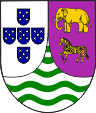
1935–1975,
Wappen von Angola,
Quelle, nach:
Wikipedia (D)
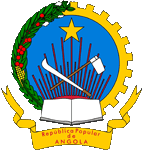
1975–1992,
Wappen von Angola,
Quelle, nach:
Wikipedia (EN),
Corel Draw 4
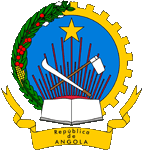
1992–2010,
Wappen von Angola,
Quelle, nach:
Wikipedia (EN),
Corel Draw 4
Das Wappen von Angola wurde, wie die Flagge, 1975 eingeführt. Es zeigt ebenfalls das Buschmesser überkreuzt mit einer Hacke, die Arbeit und den Beginn des bewaffneten Kampfes symbolisierend. Darüber der gelbe Stern. Dessen fünf Zacken stehen für Einheit, Freiheit, Gerechtigkeit, Demokratie und Fortschritt. Die aufgehende Sonne unterhalb der Werkzeuge verkörpert die Entstehung der neuen Nation. Das aufgeschlagene Buch ist Symbol für Ausbildung und Kultur. Das Wappen wird umkränzt von einem schwarzen, halben Zahnrad, sowie Maispflanzen und Kaffee- und Baumwollzweigen. Es wurde 1992 leicht abgeändert, als sich die Staatsbezeichnung im goldenen Band unterhalb des Wappens von "Repúblika Popular de Angola" in "República de Angola" änderte.
Quelle: Flags of the World,
Die Welt der Flaggen,
Flaggen Wappen Hymnen

Flugzeugkokarde,
Quelle, nach: Wikipedia (EN)

1975–1980,
Flugzeugkokarde,
Quelle, nach: Wikipedia (EN)
Lage:
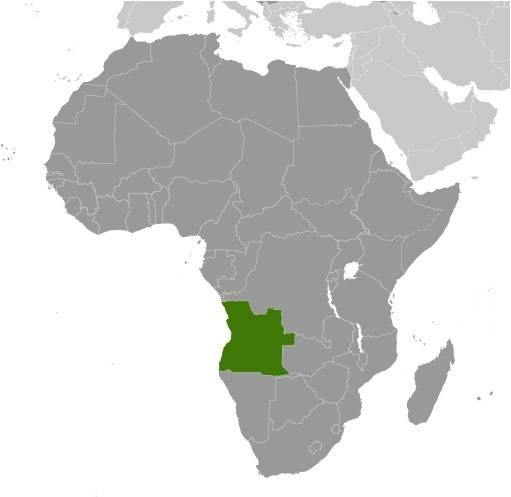
Quelle: CIA World Factbook
Landkarte des Landes:
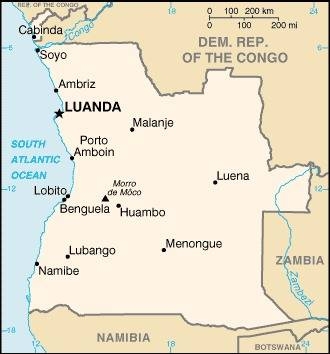
Quelle: CIA World Factbook
Fläche: 1.246.700 km², davon Exklave Cabinda 7.823 km²
Einwohner: 25.789.000 (2014), davon 37% Ovimbundu, 25% Kimbundu, 13% Bakongo, 2% Mestico (europäisch-afrikanische Mischlinge), 1% Europäer (davon 170.000 Portugiesen), 22% andere
Religionen: 41,1% Römisch-Katholisch, 38,1% Protestanten, 8,6% andere, 12,3% Nicht-Religiöse
Bevölkerungsdichte: 21 Ew./km²
Hauptstadt: Luanda, 6.945.400 Ew. (2014)
Amtssprache: Portugiesisch
sonstige Sprachen: Umbundu, Kimbundu, Kikongo, TuChokwe, Ngangela, Oshivambo
Währung: 1 Kwanza (AOA, Kz) = 100 Cêntimos
Zeitzone: MEZ
Quelle: Wikipedia (D),
CIA World Factbook
13. Jahrhundert · die ursprünglich in der Region lebenden Khoisan-Völker werden durch zuwandernde Bantu-Volksgruppen verdrängt
1482 · Entdeckung durch den portugiesischen Seefahrer Diego Cao
1483 · Portugal errichtet Handelsposten an der Küste
1576 · Gründung von Luanda
19. Jahrhundert · Portugal beginnt mit der systematischen Eroberung und Besetzung der Region des heutigen Angola
1885 bis 1894 · Grenzverträge mit Belgien, Festlegung der Grenze zu Belgisch-Kongo
1886 · Grenzvertrag mit dem Deutschen Reich, Festlegung der Grenze zu Deutsch-Südwestafrika
1905 · Grenzvertrag mit Großbritannien, Festlegung der Grenze zu Rhodesien
1951 · Portugal wandelt die Kolonie Angola zu einer Überseeprovinz (Bestandteil des Mutterlandes)
1959 · antikolonialer Aufstand
1960 · Beginn des Unabhängigkeitskrieges unter Beteiligung von vier Unabhängigkeitsbewegungen (FNLA, MPLA, FLEC und UNITA)
1964 · die Unabhängigkeitsbewegungen werden militärisch zurückgedrängt
1973 · die Guerillaaktivitäten der Unabhängigkeitsbewegungen werden eingestellt, faktisches Ende des Unabhängigkeitskrieges
25.04.1974 · Revolution in Portugal, Sturz des Salazar-Regimes, Einleitung einer unverzüglichen Entkolonialisierung der abhängigen Gebiete, in Angola kommt es zu militärischen Auseinandersetzungen zwischen den Unabhängigkeitsbewegungen
11.11.1975 · die sozialistische MPLA verkündet in Luanda die Unabhängigkeit Angolas (Volksrepublik Angola), die FNLA und UNITA tun dies in Huambo (Republik Angola), Beginn des Bürgerkriegs, die FNLA erleidet empfindliche Verluste und zieht sich nach Zaire zurück
1983 · Truppen aus Südafrika dringen 250 km tief in den Süden Angolas ein und zerstören Stützpunkte der Rebellenbewegung SWAPO aus Südwestafrika (heute Namibia), sie werden von kubanischen Truppen zurückgeschlagen
1991 · die MPLA löst sich vom Marxismus-Leninismus, MPLA und UNITA verständigen sich auf die Einrichtung eines Mehrparteiensystems
1992 · erste freie Wahlen, die MPLA geht als Sieger hervor und gewinnt auch die Präsidentschaftswahl, die UNITA unterstellt Wahlbetrug, der Bürgerkrieg flammt erneut auf
1994 · Friedensvertrag zwischen Regierung und UNITA, Integration der UNITA
1997 · Bildung einer nationalen Einheitsregierung unter Beteiligung der UNITA
1998 · der Bürgerkrieg flammt erneut auf
2002 · Jonas Savimbi – der Führer der UNITA – kommt bei den Kämpfen ums Leben, Waffenstillstand, die UNITA gibt den bewaffneten Kampf auf und übernimmt die Rolle der führenden Oppositionspartei
Quelle: Atlas zur Geschichte,
Wikipedia (D),
Der Name von Angola geht auf den Titel des Königs des alten Kongoreiches zurück. Er lautete "N'gola".
Quelle: Handbuch der geographischen Namen