mobile Ansicht, to the English Version tap the flag


- Republik Argentinien
- Eigenbezeichnung: República Argentina
• heutige Flaggen
• historische Flaggen
• Bedeutung/Ursprung der Flagge
• Wappen
• Bedeutung/Ursprung des Wappens
• Flugzeugkokarde
• Landkarten
• Zahlen und Fakten
• Geschichte
• Ursprung des Landesnamens

National- und Handelsflagge,
(bis 1985 ausschließlich),
Seitenverhältnis = 2:3,
Quelle, nach:
Corel Draw 4, Flaggen und Wappen, Das farbige Flaggenlexikon, Wikipedia (EN)


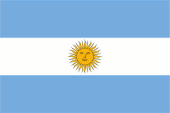
Staats- und Marineflagge,
(bis 1985 ausschließlich, heute auch National- und Handelsflagge),
Seitenverhältnis = 2:3,
Quelle, nach:
Corel Draw 4, Flaggen und Wappen, Das farbige Flaggenlexikon, Wikipedia (EN)


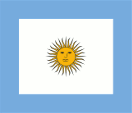
Gösch,
Seitenverhältnis = 6:7,
Quelle, nach:
Corel Draw 4, Flaggen und Wappen, Das farbige Flaggenlexikon, Wikipedia (EN)
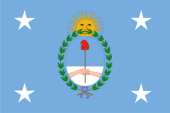
Flagge des Präsidenten,
Seitenverhältnis = 3:4,
Quelle/Source:
Corel Draw 4, Flaggen und Wappen, Flags of the World


bis 1785,
Flagge Vizekönigreich Peru und Marine- und Kriegsflagge
Quelle, nach:
Wikipedia (EN)

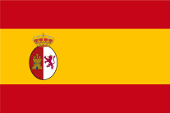
1785–1810,
Flagge von Spanien und des Vizekönigreichs Peru,
Quelle, nach:
World Statesmen
1810–1812,
Nationalflagge,
Seitenverhältnis = 2:3,
Quelle, nach:
World Statesmen
Die Flagge wurde am 27.02.1812 offiziell eingeführt. Sie ist ein Entwurf von General Manuel Belgrano und zeigt drei waagrerechte Streifen in Hellblau, Weiß und Hellblau, und seit dem 25. Februar 1818 zeigt die Staatsflagge die "Maisonne" in der Mitte des weißen Streifens. Die "Maisonne" ist ein Nationalsymbol, das daran erinnern soll, dass es am 25.05.1810 zu einer großen Demonstration auf dem Markt der Hauptstadt kam, auf der Forderungen an den Vizekönig gestellt wurden. Zunächst war der Himmel bedeckt, nach dem Verkünden der Forderungen öffenete sich die Wolkendecke und die Sonne begann zu scheinen. Nach anderen Quellen sei General Belgrano anlässlich der Schlacht von Paraná zu diesem Bild inspiriert worden, als er zum Himmel und in die Sonne schaute. In Wirklichkeit ist das Sonnensymbol viel älter. Es ist die Inkasonne, sie steht für Inti, den Sohn des Schöpfers Viracocha. Zur Entstehung der Flagge und zur Bedeutung der Farben gibt es im Prinzip zwei Theorien, wobei die Erste als offiziell gilt, und die zweite aber wahrscheinlich ist.
1.) Die Farben gehen auf die blau-weißen Kokarden zurück, die zu Beginn des Freiheitskampfes am 25.05.1810 verteilt wurden. An diesen Tag erinnert auch die "Maisonne", welche in die Staats- und Marineflagge, in die Gösch und in das Staatswappen aufgenommen wurde. Die Farbe Blau steht für den Himmel, das Weiß für die schneebedeckten Gipfel der Anden. Die Gestaltung der Flagge soll die Lage des südamerikanischen Festlandes zwischen den beiden großen Ozeanen darstellen.
2.) Die Flagge Argentiniens ist bis ins Detail hinein das Abbild eines Schurzes, wie ihn Freimaurer der "blauen" Logen in den ersten drei Graden (Lehrling, Geselle, Meister) bei ihren rituellen Arbeiten tragen: Weiß mit himmelblauem Rand und aufgenähten ein bis drei Sonnen, je nach Grad. General Belgrano war Freimaurer, so wie in diesen Jahren alle Freiheitshelden in Nord- und Südamerika (z.B. die Generale San Martin, Washington, Simon Bolivar und Steuben). Die wichtigsten Zentren des anti-feudalen Wirkens der Freimaurer waren damals die Pariser Loge "Les Neuf Soeurs" und die Loge "Lautaro" in Buenos Aires. Der Verdacht liegt nahe, das Belgrano von Anfang an nichts anderes wollte, als das Abbild seines Schurzes als Flagge des freien La Plata (ab 1826 Argentinien genannt) einzuführen.
Ursprünglich wurde die Version Flagge mit der Sonne in der Mitte nur als Kriegsflagge (Marineflagge) verwendet. Ab 1884 war sie auch auf öffentlichen Gebäuden zu verwenden und wurde so auch zur Staatsflagge. Die Version Flagge ohne die Sonne in der Mitte war National- und Handelsflagge. Seit 1985 dürfen auch Bürger die Flagge mit der Sonne verwenden. Die Einteilung zwischen Staats- und Marineflagge einerseits und National- und Handelsflagge andererseits ist somit obsolet.
Die Farbtöne der Farben der Flagge sind definiert, zuletzt mit dem IRAM-Standard / Dekret 1650/10 vom November 2010. Der gibt Werte vor, unter anderem als LAB oder auch als Pantone-Farben: Gelb/Gold = Pantone 1235 c, Hellblau = Pantone 284 c und auch Braun = Pantone 1685 c.
Quelle, nach:
1) Die Welt der Flaggen,
Flaggen Wappen Hymnen,
Flaggen und Wappen der Welt,
Alle Flaggen alle Staaten
2) Hans-Peter Meinzer, Translator of the English text: Joachim Nuthack
3) Wikipedia (D)
4) Wikipedia (EN)
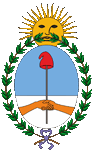
Wappen von Argentinien,
Quelle:
Corel Draw 4
Das Staatswappen von Argentinien wurde 1813 angenommen, und mit dem Dekret vom 24.04.1944 in der heutigen Form bestätigt. Es hat seinen Ursprung in dem Siegel, welches vom Parlament der Vereinigten Provinzen von Rio de la Plata am 13.03.1813 verwendet wurde. Es zeigt auf Blau über Silber (Weiß) eine braune Stange mit roter Freiheitsmütze (Jakobinermütze, phrygische Mütze), von zwei zum Händedruck vereinten Armen im Schildfuß gehalten, umgeben von einem Lorbeerkranz mit einem blauem Band, überhöht von der goldenen Maisonne. Diese steht für die Freiheit, genauso wie die Freiheitsmütze.
Quelle, nach: Die Welt der Flaggen,
Flaggen Wappen Hymnen,
Flaggen und Wappen der Welt, Translator of the English text: Joachim Nuthack

Flugzeugkokarde,
Quelle, nach: Wikipedia (EN)
Lage:
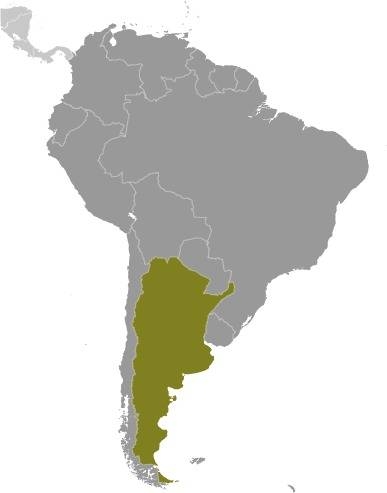
Quelle/Source: CIA World Factbook
Landkarte des Landes:
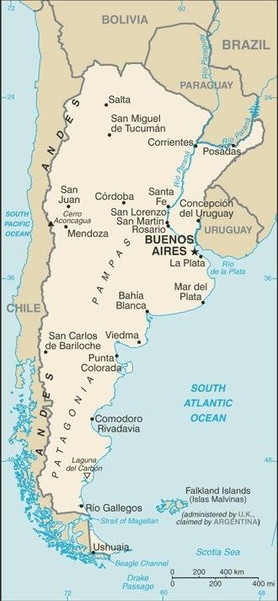
Quelle/Source: CIA World Factbook
Fläche: 2.776.889 km²
Einwohner: 44.694.200 (2018), davon 90% europäischer Abstammung (einschl. ca. 1.250.000 Deutsche und Deutschstämmige), 3% Indianer und Mestizen, 2% Araber
Bevölkerungsdichte: 16 Ew./km²
Religionen: 80% Katholiken, 5% Protestanten, 2% Moslems, 1% Juden
Hauptstadt: Buenos Aires, 2.890.151 Ew. (2010)
Amtssprache: Spanisch
sonstige Sprachen: Italienisch, Deutsch, Walisisch, Quechua, Guaraní, Baskisch und Arabisch
Währung: 1 Argentinischer Peso = 100 Centavos
Zeitzone: MEZ – 4 h
Quelle/Source:
Wikipedia (D)
1516 · Entdeckung des Rio de La Plata
1536 · Beginn der spanischen Kolonisierung, zum Vizekönigreich Peru
1776 · Vizekönigreich La Plata
25.05.1810 · Sturz des Vizekönigs
09.07.1816 · Unabhängigkeit
24.12.1826 · Gründung der Republik Argentinen
1852–1861 · Bürgerkrieg
1865–1870 · Krieg gegen Paraguay
1982 · Falklandkrieg gegen Großbritannien
Quelle, nach: Wikipedia (D),
Atlas zur Geschichte
Dieses Land hieß zunächst "La Plata", und war ein spanisches Vizekönigreich. Der Name wurde vom gleichnamigen Fluss "Rio de la Plata – Der Silberfluss" auf das Land übertragen. Später wurde der Fluss jedoch in "Rio Paraná" umbenannt, und das Land wurde nun "Argentinien" genannt. Das heißt übersetzt "Das Silberland", denn er leitet sich vom lateinischen Wort "Argentum" ab, was "Silber" heißt. Dieser Name wurde aber erst 1826 offiziell.
Quelle, nach: Handbuch der geographischen Namen

Mit freundlicher Untersützung von: Hans-Peter Meinzer