mobile Ansicht, to the English Version tap the flag

- Volksrepublik Bangladesch
- präsidiale Republik mit Mehrparteiensystem
- Eigenbezeichnung: Gana Prajatantri Bangladesh
- frühere Namen: Ost-Bengalen, Ost-Pakistan
• Flaggen
• historische Flagge
• Bedeutung/Ursprung der Flagge
• Wappen
• Bedeutung/Ursprung des Wappens
• Flugzeugkokarde
• Landkarte
• Zahlen und Fakten
• Geschichte
• Ursprung des Landesnamens
• Sezessionsstaat Chittagong-Bergland
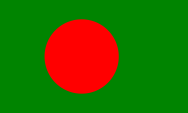
Nationalflagge,
Seitenverhältnis = 3:5,
Quelle, nach:
Wikipedia (EN)



Handelsflagge,
Seitenverhältnis = 1:2,
Quelle, nach:
Wikipedia (EN)


Marineflagge,
Seitenverhältnis = 1:2,
Quelle, nach:
Wikipedia (EN)

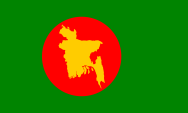
1971–1972,
Nationalflagge,
Seitenverhältnis = 3:5,
Quelle, nach:
Wikipedia (EN)
Die heutige Flagge von Bangladesch wurde am 25.01.1972 eingeführt. Sie zeigt auf dunkelgrünem Grund eine rote Scheibe, die etwas nach links versetzt ist. Am 26.03.1971, dem Tag der Unabhängigkeit, war zunächst eine ähnliche Flagge gehisst worden. Die rote Scheibe befand sich genau in der Mitte der Flagge, und enthielt in ihrer Mitte eine vereinfachte goldene Landkarte von Bangladesch. Am 25.01.1972, nach anderen Quellen am 13.01.1972, wurde die Flagge aus wahrscheinlich herstellungstechnischen Problemen heraus in ihre heutige Form gebracht. Die Flagge wurde von Seradschul Alam ("Licht der Flagge") entworfen. Grün ist die Farbe des Islam, steht aber auch für die grüne Landschaft, Rot symbolisiert das zur Erlangung der Unabhängigkeit vergossene Blut. Die Scheibe ist die Sonne der Freiheit. Die Farben Grün und Rot gehen wahrscheinlich eine während eines Aufstandes in Chittagong in den Dreißigern gezeigte Flagge zurück. Bangladesh orientiert sich am britschen Ensign-System. Das weist auf die Verbindung zu Großbritannien hin. Großbritannien hatte in Jahr 1864 ein Flaggensystem eingeführt, in dem:
• Kriegsschiffe einen sogenannten "White Ensign" (Marineflagge), eine weiße Flagge oft mit durchgehendem roten Georgskreuz und mit dem Union Jack in der Oberecke,
• Handelsschiffe einen "Red Ensign" (auch "Civil Ensign" => Bürgerflagge genannt, die eigentl. Handelsflagge), eine rote Flagge mit dem Union Jack in der Oberecke, und
• Dienstschiffe einen "Blue Ensign" (Regierungsflagge => die eigentl. Staatsflagge), eine blaue Flagge mit dem Union Jack in der Oberecke führten.
Bangladesh verwendet als Handelsflagge einen Red Ensign und als Marineflagge einen White Ensign (anstelle des Union Jack mit der eigenen Nationalflagge in der Oberecke).
Quelle: Die Welt der Flaggen,
Flaggen Wappen Hymnen,
Flaggen und Wappen der Welt,
Wikipedia (EN)
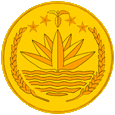
seit 1972,
Wappen von Bangladesch,
Quelle:
Corel Draw 4,
Die Welt der Flaggen
Am Tage der Unabhängigkeit wurde ein der damaligen Staatsflagge ähnelndes Wappen eingeführt. Es enthielt ebenfalls die goldene Landkarte in einer roten Scheibe. Die Scheibe hatte einen silbernen Rand mit vier Sternen, sowie eine Inschrift. Das 1972 eingeführte Wappen ist ebenfalls rund, jedoch einfarbig golden. Innerhalb eines Kreises erscheint oberhalb von Wellenlinien, sie stehen für das Wasser der Flüsse Ganges und Brahmaputra, die stilisierte Darstellung einer Seerose (bzw. Wasserlilie). Es ist die Nationalpflanze. Oberhalb der Seerosenblüte sind vier fünfzackige Sterne zu sehen, sowie Blätter des Jutebaums (bzw. Teeblätter), an den Seiten je eine Reisähre (bzw. Padi-Ähre). Die vier Sterne stehen für die Prinzipien der Politik des Landes: Nationalismus, Demokratie, islamischer Sozialismus sowie Bekenntnis zum Islam. Nach anderen Quellen stehen sie für: Nationalismus, Demokratie, Sozialismus und Säkularisation.
Quelle: Die Welt der Flaggen,
Flaggen Wappen Hymnen,
Flaggen und Wappen der Welt

Flugzeugkokarde,
Quelle, nach: Wikipedia (EN)

Flugzeugkokarde für Marineflieger,
Quelle, nach: Wikipedia (EN)
Lage:
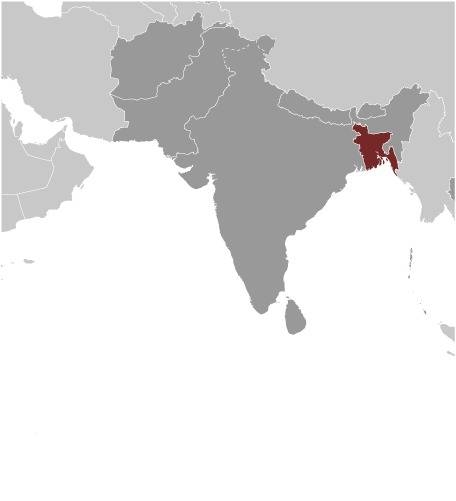
Quelle: CIA World Factbook
Landkarte des Landes:
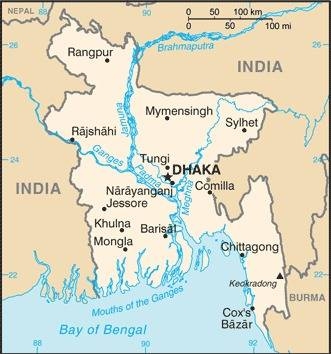
Quelle: CIA World Factbook
Fläche: 147.570 km²
Einwohner: 164.700.000 (2020), davon 98% Bengalen, 2% Biharis, Assamesen u.a.
Religionen: 90% Moslems (meist Sunniten), 9% Hindus, 0,9% Buddhisten und Christen
Bevölkerungsdichte: 1.116 Ew./km²
Hauptstadt: Dacca (Dhaka), 8.906.000 Ew. (2011)
Amtssprache: Bengali
sonstige Sprachen: Urdu, Englisch
Währung: 1 Taka (BDT, Tk) = 100 Poisha
Zeitzone: MEZ + 5 h
Quelle: Wikipedia (D),
CIA World Factbook
14.08.1947 · Teilung von Britisch-Indien in Pakistan und Indien
26.03.1971 · Unabhängigkeit Bangladeschs von Pakistan
1988 · Islam wird Staatsreligion
Quelle: Wikipedia (D)
Das Gangesdelta wurde in der Altindschen Sprache "Banga" genannt. Der Name der Landschaft hat sich auf das hier lebende Volk übertragen => "Bangla", die "Bengalen". "Bangla" ist Hindustanisch (Hindi) und meint nichts anderes als "bengalisch". "Bangladesch" heißt daher: "Land der Bengalen".
Quelle: Handbuch der geographischen Namen

Flagge des Chittagong-Berglands,
Quelle, nach: UNPO

Im Jahre 1974 begannen Angehörige der Chakma, einer buddhistischen Volksgruppe, im Chittagong-Bergland einen bewaffneten Kampf für Autonomie und gegen die überfremdung durch bengalische Siedler. Im Verlauf der Kämpfe wurde ein eigener Staat proklamiert. 1993 trafen die Chakma und Bangladesch ein übereinkommen zur Rückkehr der Flüchtlinge, und 1997 folgte ein Friedensvertrag, der dem Chittagong-Bergland weitgehende Autonomie zubillgte. Die Kämpfe sind zwar abgeflaut, jedoch bleibt die Lage angespannt.
Quelle: UNPO