mobile Ansicht, to the English Version tap the flag

- autonome Region in Belgien
- Eigenbezeichnungen: französisch: Wallonie, wallonisch: Waloneye, flämisch: Waal, deutsch: Wallonien
• Flagge
• Bedeutung/Ursprung der Flagge
• Landkarte
• Zahlen und Fakten
• Geschichte
• Ursprung des Landesnamens
• Deutschsprachige Gemeinschaft
• Parti Rattachiste France
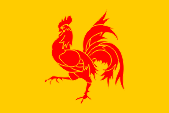
Flagge von Wallonien,
Seitenverhältnis = 2:3,
Quelle, nach: Flags of the World


Der Hahn ist der "Gallische Hahn". Dahinter verbirgt sich ein Wortspiel: Auf Latein heißt Hahn "Gallus". Das gleiche Wort wurde auch für die "Gallier" verwendet. Die französischsprachigen Romanen sehen sich als Nachfahren der Gallier an, und so bot sich der Hahn als Symbol an, und wurde als Nationalsymbol seit der Zeit der Rennaissance verwendet. Für Wallonien wurde der rote Hahn auf Gold im Jahre 1913 eingeführt, jedoch nicht offiziell. Erst im Jahre 1975 wurde er auch offziell verwendet, und am 15.07.1998 offiziell eingeführt.
Quelle: Wikipedia (EN),
Flags of the World

Lage in Belgien:
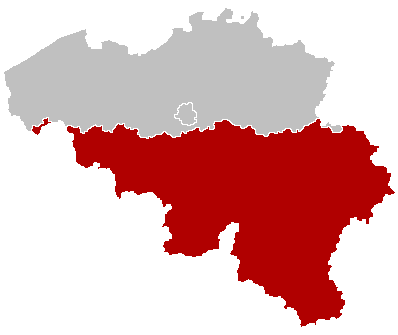
Quelle: LennartBolks, Public domain, via Wikimedia Commons
Fläche: 16.844 km²
Einwohner: 3.633.795 (2019), meist Wallonen, ferner Flamen und Deutsche
Bevölkerungsdichte: 216 Ew./km²
Hauptstadt: Namur (flämisch: Namen), 110.779 Ew. (2019)
Amtssprachen: Französisch (Wallonisch), regional Deutsch
Währung: 1 Euro (EUR, €) = 100 Cents
Zeitzone: MEZ
Quelle: Wikipedia (D)
58–51 v.Chr. · römische Eroberung
481–843 · zum Frankenreich
880 · im Herzogtum Lothringen zum Ostfrankenreich (Deutsches Reich), Flandern verbleibt beim Frankenreich
12. bis 14. Jhd. · als Kleinstaaten beim Deutschen Reich
1384 · durch Heirat an das Herzogtum Burgund und an das Deutsche Reich
1555 · Das Haus Habsburg erbt Burgund
1714 · die Habsburgischen Besitzungen kommen an die Österreichische Linie des Hauses Habsburg
1795 · Eroberung und Annexion durch Frankreich
1815–1830 · zu den Vereinigten Niederlanden
1830 · Gründung von Belgien mit dem Ziel ein französischprachiger Staat zu werden, Wallonien wird Belgien angeschlossen
ca. 1840 · Gründung der „Flämischen Bewegung“ zum Erhalt der Flämischen Sprache und Kultur
ca. 1880 · Gründung der „Wallonischen Bewegung“ als Widerpart
1898 · „Gleichheitsgesetz“, Belgien wird offiziell ein zweisprachiger Staat
1962–1963 · Festlegung der Sprachgrenze zwischen den Kulturgemeinschaften, Brüssel wird zweisprachig, Anerkennung der Deutschen Sprache als Regionalsprache in Ostbelgien
1970 · erste belgische Staatsreform, die Kulturgemeinschaften erhalten Verfassungsrang
1980 · zweite belgische Staatsreform, Schaffung der Wallonischen Region mit Autonomiestatus
1983 · Schaffung der Deutschsprachigen Gemeinschaft in Ostbelgien als Teil Walloniens
1988 · dritte belgische Staatsreform, Ausbau der Autonomie der Regionen, Schaffung der Region Brüssel-Hauptstadt
1994 · vierte belgische Staatsreform, Teilung der ehemaligen Provinz Brabant, weiterer Ausbau der Autonomie der Regionen, Belgien wird föderaler Bundesstaat
2001 · fünfte belgische Staatsreform, weiterer Ausbau der Autonomie der Regionen
Quelle: Atlas zur Geschichte,
Wikipedia (D)
Der Name "Wallonien", oder auch die Bezeichnung "Wallonen" für die französischsprachigen Belgier geht auf das germanische Wort "welsch" zurück, was "fremd" heißt. So wurde alles bezeichnet, was nicht-germanisch war. Die Wallonen sprechen heute umgangssprachlich Wallonisch, was meist als französischer Dialekt angesehen wird, manchmal auch als eigenständige romanische Sprache. Amtssprache ist jedoch Französisch.
Quelle:
Handbuch der geographischen Namen,
Wikipedia (D)
mehr Info => hier klicken
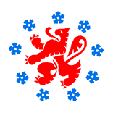
Flagge der Deutschsprachigen Gemeinschaft in Belgien
Seitenverhältnis = 1:1,
Quelle, nach: Wikipedia (EN)

Diese politische Bewegung bestrebt die Abspaltung Walloniens von Belgien und dessen Anschluss an Frankreich.
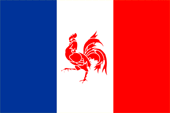
Flagge der Bewegung,
Seitenverhältnis = 2:3,
Quelle, nach: Flags of the World