mobile Ansicht, to the English Version tap the flag

- Republik Benin
- präsidiale Republik
- Eigenbezeichnung: République du Bénin
- früherer Landesname: Dahomey
• Flagge
• historische Flaggen
• Bedeutung/Ursprung der Flagge
• Wappen
• historische Wappen
• Bedeutung/Ursprung des Wappens
• Flugzeugkokarde
• Landkarte
• Zahlen und Fakten
• Geschichte
• Ursprung des Landesnamens
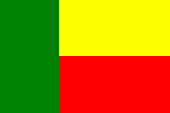
Nationalflagge,
Seitenverhältnis – ratio = 2:3,
Quelle, nach: Corel Draw 4


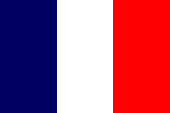
1894–1959
Flagge von Frankreich,
Seitenverhältnis = 2:3,
Quelle, nach: Corel Draw 4

1959–1975,
Nationalflagge,
Seitenverhältnis = 2:3,
Quelle, nach: Flags of the World
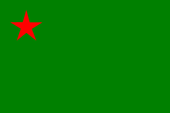
1975–1990,
Nationalflagge,
Seitenverhältnis = 2:3,
Quelle, nach:
Flaggen und Wappen,
Wikipedia (DE)

Vom November 1959 bis 30.11.1975 war die heutige Flagge bereits die Nationalflagge von Dahomey. Am 30.11.1975 wurde das Land in Benin umbenannt. Die an diesem Tag eingeführte, und bis zum 01.08.1990 beibehaltene grüne Flagge mit dem roten Stern, entsprach der farblichen Umkehrung der roten Fahne der Revolutionären Volkspartei von Benin. Das Grün stand auf dieser Flagge für die Landwirtschaft, das Rot für die Revolution und Sozialismus, und der rote Stern selbst für die nationale Einheit. Die Flagge von Dahomey ist seit dem 01.08.1990 wieder eingeführt. Sie besteht aus einem senkrechten grünen Streifen am Mast und zwei waagerechte Streifen in Gelb und Rot im fliegenden Ende der Flagge.
Die Farben Grün, Gelb und Rot sind die panafrikanischen Farben. Etwa 1900 setzte die Panafrika-Bewegung ein, die Gemeinsamkeiten aller Menschen mit schwarzer Hautfarbe hervorheben wollte. Der Farbendreiklang Grün-Gelb-Rot, den viele afrikanische und auch amerikanische Staaten nach Erlangung ihrer Unabhängigkeit in ihre Flaggen übernahmen, steht für die politische Einheit Afrikas, ja aller Schwarzen. Das erste Land war Ghana im Jahr 1957. Als Ursprung gelten die Landesfarben von Athiopien (Abessinien), dem ältesten unabhängigen Staat Afrikas.
Die Farben Gelb und Grün symbolisieren die Trennung zwischen dem trockenen, nördlichen Teil der Savannen und dem südlichen, feuchteren Teil Benins mit seinen Palmenwäldern. Die beiden Teile sind mit Rot verbunden, das vergossene Blut. Rot steht auch für nationale Einheit.
Quelle:
Die Welt der Flaggen,
Flaggen und Wappen der Welt
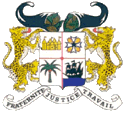
seit 1990,
Wappen von Benin,
Quelle:
Corel Draw 4,
Wikipedia (D)
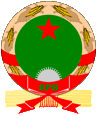
1975–1990,
Wappen von Benin,
Quelle:
Wikipedia (D),
Flaggen und Wappen
1964–1975,
Wappen von Dahomey,
Quelle:
Corel Draw 4,
Wikipedia (D)
Der Schild des Wappens von Benin ist gevierteilt. Im ersten silbernen Feld sind typische Wohngebäude abgebildet, im zweiten silbernen Feld der höchste Orden des Landes, im dritten silbernen Feld eine Kokospalme, und im vierten silbernen Feld ein schwarzes dreimastiges Segelschiff auf blauen Meereswellen. Die Viertel des Wappens stehen somit für das Volk, ruhmreiche Vergangenheit, gewerbliche Produktion und Handel. In der Mitte des Schildes befindet sich eine kleine rote Raute. Schildhalter sind zwei goldene Panther. über dem Schild sind zwei schwarze Füllhörner zu sehen, aus denen Maiskolben hervorschauen. Auf einem silbernen Spruchband unterhalb des Wappens steht das Motto: "Fraternité, Justice, Travail" => "Brüderlichkeit, Gerechtigkeit, Arbeit". Das heutige Wappen wurde bereits im Jahre 1964 für Dahomey eingeführt und, wie die Flagge von Dahomey, am 01.08.1990 bestätigt. In den Jahren 1975–1990 zeigte das Wappen eine grüne Scheibe, umgeben von einem Kranz aus Maiskolben die mit einem roten Band verbunden waren. Im oberen Teil der grünen Scheibe befand sich ein roter fünfzackiger Stern und im unteren Teil, unmittelbar am Rand der Scheibe, das Blatt einer Kreissäge.
Quelle:
Die Welt der Flaggen,
Flaggen und Wappen der Welt
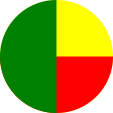
Flugzeugkokarde,
Quelle, nach: Wikipedia (EN)
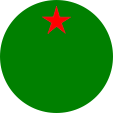
1975–1990,
Flugzeugkokarde,
Quelle, nach: Wikipedia (EN)
Lage:
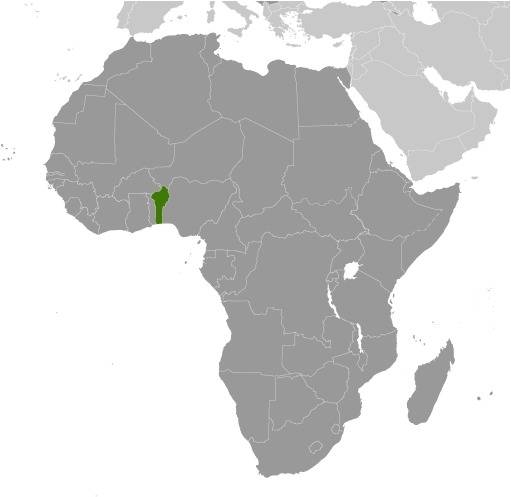
Quelle: CIA World Factbook
Landkarte des Landes:
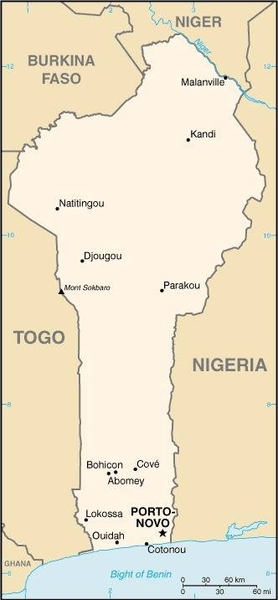
Quelle: CIA World Factbook
Fläche: 112.622 km²
Einwohner: 11.485.000 (2018), davon 39% Fon, 15% Adja, 9% Bariba, 7% Fulbe, 6% Otamari
Religionen: 42% Christen (meist Katholiken), 28% Muslime, 17% Voodoo
Bevölkerungsdichte: 102 Ew./km²
Hauptstadt: Porto Novo, 264.320 Ew. (2013)
Amtssprache: Französisch
sonstige Sprachen: Fon, Adja, Bariba, Yoruba, Aizo ...
Währung: CFA-Franc (FCFA) = 100 Centimes
Zeitzone: MEZ
Quelle: Wikipedia (D)
1625 · Königreich Dahomey
1650 · Gründung des britischen Stützpunktes Fort William bei Ouidah (Whydah, Ajudá)
1671 · Gründung des französischen Stützpunktes Fort St. Louis bei Ouidah
1680 · Gründung des portugiesischen Stützpunktes Forte de São João Baptista de Ajudá bei Ouidah
1721 · das portugiesische Fort São João Baptista wird Brasilien unterstellt
1797 · Frankreich gibt den Stützpunkt Fort St. Louis auf
1807 · Großbritannien gibt den Stützpunkt Fort William auf
1844 · Das Fort São João Baptista wird verlassen
1865 · Portugal nimmt das Fort São João Baptista wieder in Besitz
1868–1893 · Frankreich errichtet Protektorate und Kolonien an der Küste (Cotonou, Porto-Novo, Ouidah)
22.06.1894 · Gründung der französischen Kolonie Dahomey
1899 · Dahomey wird Bestandteil der Kolonie Französisch-Westafrika
04.12.1958 · Frankreich gewährt der Republik Dahomey Autonomie
01.08.1960 · Frankreich gewährt der Republik Dahomey die Unabhängigkeit
1961 · Dahomey besetzt das Fort São João Baptista
1972 · Militärputsch unter Oberstleutnant Kérékou
1975 · Portugal erkennt die Inbesitznahme von Fort São João Baptista durch Dahomey an
30.11.1975 · Umbenennung in Volksrepublik Benin
1980 · Oberst Kérékou wird Präsident
1989–1990 · Unruhen
01.03.1990 · Rückbenennung in Republik Benin, Einleitung politischer Reformen
Quelle:
Wikipedia (D),
World Statesmen,
Länder der Erde
Der Name des Landes geht auf die langgestreckte Bucht von Benin und das alte Königreich Benin zurück. Dieses existierte zwischen dem 13. und dem 19. Jahrhundert, und lag allerdings größtenteils auf dem Gebiet des heutigen Nigeria. Der alte Name "Dahomey" (oder auch "Dahome"), geht auf das Königreich Dahome zurück, das ohne Zugang zur Küste zwischen den Königreichen Aschanti und Joruba im Gebiet des heutigen Benin lag. Es existierte zwischen dem 17. und dem 20. Jahrhundert, war extrem autoritär geführt und äußerst aggressiv. Vielleicht hat man deshalb im Jahre 1990 auf ein Rückbenennung in Dahomey verzichtet.
Quelle:
Wikipedia (D),
Meyers Konversationslexikon via
RetroBib Retrobibliothek,
Volker Preuß