mobile Ansicht, to the English Version tap the flag

- Plurinationaler Staat Bolivien
- präsidiale Republik
- Eigenbezeichnung: Estado Plurinacional de Bolívia
• Flaggen
• historische Flaggen
• Bedeutung/Ursprung der Flagge
• Wappen
• historische Wappen
• Bedeutung/Ursprung des Wappens
• Flugzeugkokarde
• Landkarte
• Zahlen und Fakten
• Geschichte
• Ursprung des Landesnamens
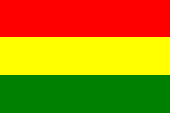
National- und Handelsflagge,
Seitenverhältnis = 2:3,
Quelle, nach:
Wikipedia (ES)


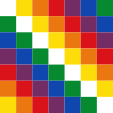
seit 2009,
Wiphala-Flagge, = Nationalsymbol
Seitenverhältnis = 1:1,
Quelle, nach:
Wikipedia (ES)
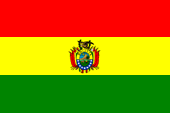
Staatsflagge
Seitenverhältnis = 2:3,
Quelle, nach:
Wikipedia (ES)


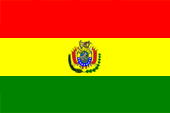
Kriegsflagge
Seitenverhältnis = 2:3,
Quelle, nach:
Wikipedia (ES)
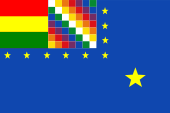
seit 2013,
Marineflagge
Seitenverhältnis = 2:3,
Quelle, nach:
Wikipedia (ES)
Gösch
Seitenverhältnis = 1:1,
Quelle, nach:
Wikipedia (EN)

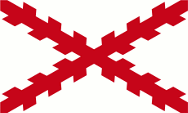
1548–1776,
Die Region gehört zum Spanischen Vizekönigreich Peru,
Quelle, nach: Wikipedia (EN)

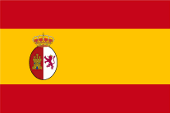
1776–1825,
Die Region gehört zum Spanischen Vizekönigreich Río de la Plata,
Quelle, nach: Wikipedia (EN)
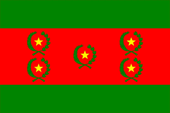
1825–1826,
Staatsflagge,
Quelle, nach:
World Statesmen,
FOTW
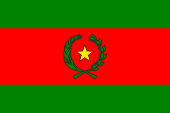
1825–1826,
National- und Handelsflagge,
Quelle, nach:
World Statesmen,
FOTW
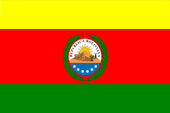
1831–1851,
Staatsflagge,
Quelle, nach:
Wikipedia (ES)
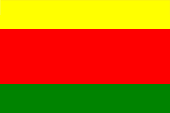
1831–1851,
National- und Handelsflagge,
Quelle, nach:
Wikipedia (ES)
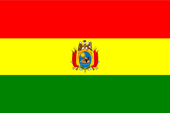
1851–1888,
Staatsflagge,
Quelle, nach:
Wikipedia (ES)
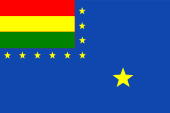
1966-2013,
Marineflagge,
Seitenverhältnis = 2:3,
Quelle, nach:
Wikipedia (EN)
Das heutige Design der Flagge von Bolivien stammt vom 1851. Die heutige Variante wurde am 14.07.1888 eingeführt. Sie besteht aus drei waagerechten Streifen in Rot, Gelb und Grün. Rot steht für die Tierwelt, Gelb für den Mineralreichtum und Grün für die Vegetation und die Landwirtschaft. Rot symbolisiert aber auch den Mut und die Tapferkeit der bolivianischen Soldaten. Die Farben der Flagge gehen auf den ersten Präsidenten des Landes, Antonio José de Sucre (1795–1830) zurück. Er hatte 1826 eine Flagge in den Farben Gelb, Rot und Grün eingeführt, die sich an der Gestaltung der Flagge Großkolumbiens orientierte. Im Jahre 1851 wurde eine neue, bis heute beibehaltene, Reihenfolge der Farben festgelegt.
Quelle: Wikipedia (ES), Translator of the English text: Joachim Nuthack
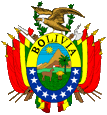
Wappen von Bolivien,
Quelle, nach:
Corel Draw 4,
Wikipedia (ES)
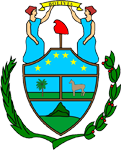
1825–1826,
Wappen von Bolivien,
Quelle, nach: Wikipedia (ES)
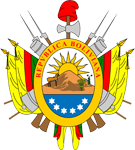
1826–1851,
Wappen von Bolivien,
Quelle, nach: Wikipedia (ES)
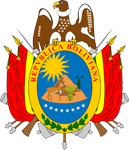
1851–1888,
Wappen von Bolivien,
Quelle, nach: Wikipedia (ES)
Das heutige Staatswappen Boliviens wurde 1888 eingeführt, und geht im Wesentlichen auf das Wappen von 1825 zurück. Die Anzahl der Sterne im Wappen variierte immer mit der Anzahl der Departements/Provinzen. Es zeigte zuletzt neun Sterne. Im Jahre 1963 wurde der zehnte Stern zum Gedenken an das Departement Cobija hinzugefügt, welches Bolivien im Pazifischen Krieg (1879–1884) an Chile verlor. Das ovale Wappenschild zeigt den Berg von Potosí, er steht für Reichtum an Mineralien und Erzen, und eine Landschaft mit einem Alpaka, eine Garbe und eine Palme, welche für Naturreichtum stehen. Die Sonne ist ein Symbol der Inka, und der Kondor oberhalb des Schildes symbolisiert die Freiheit. Das erste Wappen Boliviens wurde 1825 eingeführt und zeigte bereits die Elemente des heutigen Wappens: den Berg von Potosí, ein Alpaka, und eine Palme, umgeben von einem Palmen- und einem Ölzweig. Oberhalb des Schildes erschien eine Phrygische Mütze (ein Freiheitssymbol), und zwei allegorische Figuren die ein Band mit den Namen des Landes halten. Das zweite Wappen Boliviens wurde 1826 eingeführt und ähnelte bereits stark dem heutigen Wappen. Die Phrygische Mütze wurde 1851 durch einen Condor ersetzt.
Quelle:
Wikipedia (ES)
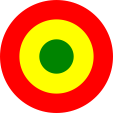
Flugzeugkokarde,
Quelle, nach: Wikipedia (EN)
Lage:
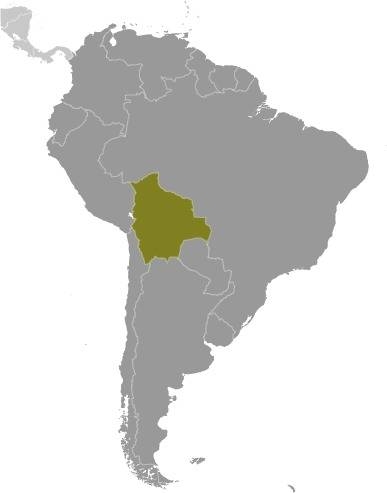
Quelle: CIA World Factbook
Landkarte des Landes:
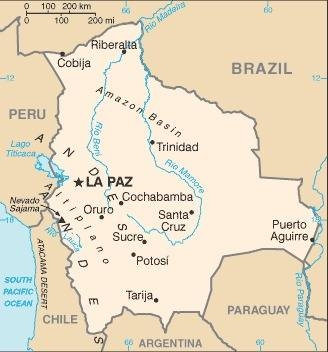
Quelle: CIA World Factbook
Fläche: 1.098.581 km²
Einwohner: 11.080.649 (2018), davon 68% Mestizen, 20% Indianer (Quechua, Aymara), 5% Europäer (davon ca. 30.000 Deutsche)
Religionen: 78% Katholiken, 19% Protestanten, 3% Nicht-Religiöse
Bevölkerungsdichte: 10 Ew./km²
Hauptstadt: Sucre, 237.480 Ew. (2012)
Regierungssitz: La Paz, 757.184 Ew. (2012)
Amtssprachen: Spanisch, Quechua, Aimara, Guaraní
sonstige Sprachen: 33 verschiedene indigene Sprachen
Währung: 1 Boliviano (BOB, Bs) = 100 Centavos
Zeitzone: MEZ – 5 h
Quelle:
Wikipedia (D),
CIA World Factbook
1471–1538 · der Westen des heutigen Landes ist Teil des Inkareiches
1538–1545 · Eroberung durch Spanien, die Region erhält den Namen Oberperu (Alto Perú)
1548 · Teil des Vizekönigreiches Peru
1776 · Teil des Vizekönigreiches Río de la Plata
1809 · Beginn des Befreiungskampfes
1816 · Oberperu wird wieder an Peru angegliedert
1825 · Oberperu wird Peruanischer Militärverwaltung unterstellt
06.08.1825 · Oberperu erklärt seine Unabhängigkeit
11.08.1825 · Proklamation der Bolivarischen Republik (República Bolívar)
18.05.1826 · Peru erkennt die Unabhängigkeit Boliviens an
1836–1839 · Konföderation Peru-Bolivien
1879–1884 · Pazifischer Krieg, Bolivien verliert seine Küstenprovinz, das Departement Cobija, an Chile
1899–1903 · Krieg gegen die abtrünnige Provinz Acre
1903 · Peru muss große Teile von Acre an Brasilien und Peru abtreten
1932–1935 · Krieg gegen Paraguay
18.03.2009 · die Republik Bolivien wird umbenannt in "Plurinationaler Staat Bolivien"
Quelle:
Atlas zur Geschichte,
Wikipedia (D),
World Statesmen
Die Region des heutigen Bolivien wurde in spanischer Zeit Oberperu, Charcas oder auch Chuquisaca genannt. Zu Ehren des Freiheitskämpfers Simón Bolívar wurde die 1825 unabhängig gewordene Republik "Bolivien" genannt. In der Indianerbevölkerung (Quechua und Aymara) wird das Land häufig "Qullasuyu" genannt.
Quelle:
World Statesmen,
Handbuch der geographischen Namen