mobile Ansicht, to the English Version tap the flag

- Republik Burkina Faso
- autoritäre präsidiale Republik unter Militärherrschaft
- Eigenbezeichnung: République de Burkina Faso
- ehemaliger Name: Obervolta
• Flaggen
• historische Flaggen
• Bedeutung/Ursprung der Flagge
• Wappen
• Bedeutung/Ursprung des Wappens
• Flugzeugkokarde
• Landkarte
• Zahlen und Fakten
• Geschichte
• Ursprung des Landesnamens
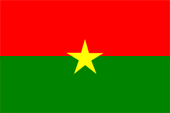
Nationalflagge,
Seitenverhältnis = 2:3,
Quelle, nach: Wikipedia (D)


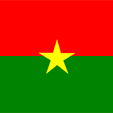
Flagge des Präsidenten,
Seitenverhältnis = 1:1,
Quelle, nach: Flags of the World


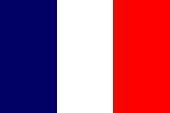
1895–1959,
Flagge von Frankreich,
Seitenverhältnis = 2:3,
Quelle, nach: World Statesmen
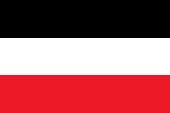
1959–1984,
Nationalflagge,
Seitenverhältnis = 2:3,
Quelle, nach:
Die Welt der Flaggen,
Flags of the World
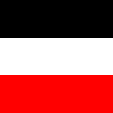
1959–1984,
Flagge des Präsidenten,
Seitenverhältnis = 1:1,
Quelle, nach: Flags of the World
Die Flagge von Obervolta wurde am 09.12.1959 eingeführt, und für das unabhängige Obervolta übernommen. Sie zeigte drei horizontale Streifen in Schwarz, Weiß und Rot. Die drei Farben standen für die drei Arme des Flusses Volta (Roter Volta, Weißer Volta und Schwarzer Volta). Nach dem Sankara-Putsch (04.08.1983) wurde Obervolta genau ein Jahr später in Burkina Faso umbenannt, und die bisherige Flagge als angeblich neokolonialistisches Symbol abgeschafft. Die neue Flagge wurde also am 04.08.1984 eingeführt. Sie zeigt die panafrikanischen Farben, zwei waagerechte Streifen in Rot und Grün mit einem gelben Stern in der Mitte. Der Stern soll den revolutionären Charakter der neuen Machthaber versinnbildlichen. Grün steht für die Fruchtbarkeit des Landes, und Rot für das im Unabhängigkeitskampf vergossene Blut. Die Farbkombination von Grün, Gelb und Rot sind die panafrikanischen Farben: Etwa 1900 setzte die Panafrika-Bewegung ein, die Gemeinsamkeiten aller Menschen mit schwarzer Hautfarbe hervorheben wollte. Für die politische Einheit Afrikas steht der Farbendreiklang Grün-Gelb-Rot, den viele afrikanische Staaten nach Erlangung ihrer Unabhängigkeit in ihre Flaggen übernahmen. Das erste Land war Ghana im Jahr 1957. Als Ursprung gelten die Landesfarben von Athiopien (Abessinien), dem ältesten unabhängigen Staat Afrikas.
Quelle: Die Welt der Flaggen
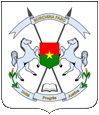
seit 1997
Wappen von Burkina Faso,
Quelle: Wikipedia (D)
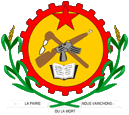
1984–1997,
Wappen von Burkina Faso,
Quelle:
Corel Draw 4,
Wikipedia (D)
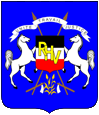
1958-1984,
Wappen von Obervolta,
Quelle: Wikipedia (FR)
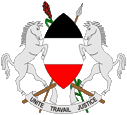
Wappen von Obervolta,
unbekannte Version
Am 04.05.1961 wurde offiziell das Staatswappen der ehemaligen autonomen Republik von 1958 übernommen. Es bestand aus einem blauen Schild, darauf in der Mitte ein kleinerer Schild (Herzschild) in den Landesfarben, mit den goldenen Initialen des Landes darauf (RHV – République de Haute-Volta). Links und rechts des Herzschildes je ein weißes Pferd als Schildhalter, darunter Sorghopflanzen und zwei Hacken. Hinter dem Herzschild zwei gekreuzte Speere, und darüber das Staatsmotto in einem Spruchband: "Unité, Travail, Justice" => "Einigkeit, Arbeit, Gerechtigkeit". In Folge des Sankara-Putsches (04.08.1983) wurde ein Jahr später nicht nur das Land umbenannt und eine neue Flagge eingeführt, sondern auch ein neues, marxistisches Wappen angenommen. Es zeigte ein rotes Zahnrad mit gelbem Hintergrund, darin eine Hacke gekreuzt mit einer Maschinenpistole (Kalaschnikow), ein aufgeschlagenes Buch und oben einen roter Stern. Links und rechts war das Zahnrad von Sorghopflanzen umgeben, darunter ein Spruchband mit dem neuen Landesmotto: "La Patrie ou la Mort, nous vaincrons" => "Vaterland oder Tod, wir siegen". Im Jahre 1997 wurde ein neues, bürgerliches Wappen eingeführt, das an die Traditionen des ersten Wappens von Obervolta anknüpft: Die Sorgho-Pflanzen erscheinen nun ganz links und rechts außen, unter dem Herzschild mit dem Motiv der Flagge einscheint ein aufgeschlagenes Buch. Zwei Speere kreuzen sich hinter dem Schild. Hacken tauchen im Wappen nicht mehr auf. Das Spruchband über dem Herzschild trägt den Landesnamen in einer ungewöhnlichen Schreibweise: "Burchina Faso". Unter dem Schild ein Spruchband mit dem neuen Staatsmotto: "Unité, Progress, Justice" => "Einigkeit, Fortschritt, Gerechtigkeit".
Quelle:
Flaggen und Wappen der Welt,
Wikipedia (D)

bis 1984,
Flugzeugkokarde,
Quelle, nach: Wikipedia (EN)
seit 1984,
Flugzeugkokarde,
Quelle, nach: Wikipedia (EN)
Lage:
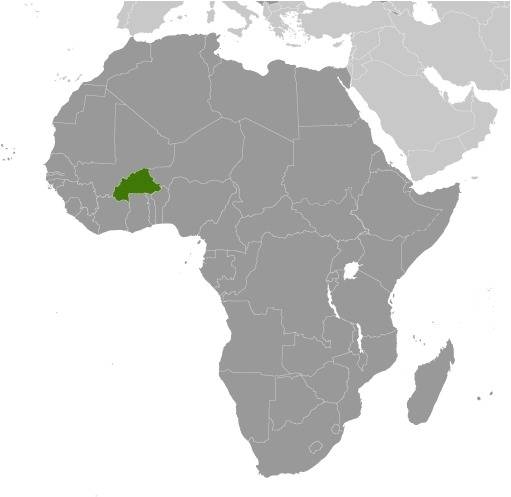
Quelle: CIA World Factbook
Landkarte des Landes:
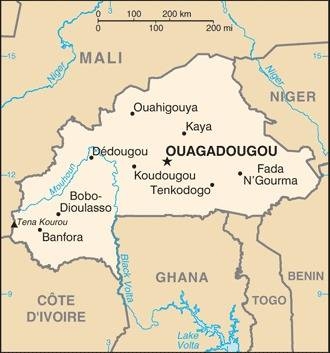
Quelle: CIA World Factbook
Fläche: 267.950 km²
Einwohner: 20.107.509 (2017), davon 40% Mossi, 14% Bobo, 9% Senufo, 8% Gurma, 7% Tuareg, 6% Lobi, 5% Fulbe
Religionen: 60% Moslems, 23% Christen, 15% Animisten
Bevölkerungsdichte: 75 Ew./km²
Hauptstadt: Ouagadougou, 2.388.700 Ew. (2017)
Amtssprache: Französisch
sonstige Sprachen: 68 verschiedene Sprachen
Währung: CFA-Franc BCEAO (FCFA, F, XOF) = 100 Centimes, FCFA = "Franc de la Communauté Financière d’Afrique"
Zeitzone: MEZ – 1 h
Quelle: Wikipedia (D)
1450–1896 · Mossi-Staat
1896 · Eroberung durch Frankreich
1919 · Gründung der Kolonie Obervolta
1958 · Autonome Republik Obervolta
05.08.1960 · Frankreich gewährt Unabhängigkeit
04.01.1966 · Lamizana-Putsch
04.08.1983 · Sankara-Putsch
04.08.1984 · Umbenennung in Burkina Faso
1987 · Compaoré-Putsch
1991 · neue Verfassung, Compaoré wird Präsident
Quelle:
Atlas zur Geschichte,
Wikipedia (D),
World Statesmen
Der Name "Obervolta" wurde dem Land von der Kolonialmacht Frankreich gegeben (Haute Volta). Er zeigt an, dass das Land an den Oberläufen des Flusses Volta liegt. Der Name Volta geht auf die Portugiesen zurück. Er heißt übersetzt "Kehre", "Kurve" oder auch "Krümmung", und hat seinen Ursprung in den zahlreichen Windungen des Flusses. Der Name "Burkina Faso" ist zweisprachig. "Burkina" heißt in der Mòoré-Sprache "ehrenwerte Person“, "Faso" heißt in der Dioula-Sprache "Vaterhaus", womit "Vaterland“ gemeint ist. Der Landesnamen lautet also übersetzt: "Vaterland der Ehrenwerten". Es gibt allerdings auch andere übersetzungen: "Land der ehrenwerten Menschen“, "Land der Aufrichtigen“, "Land der Unbestechlichen“, "Land der Menschen mit erhobenem Kopf“. Es gibt auch unterschiedliche Schreibweisen: so z.B. "Burkina Fasso", im Wappen lautet der Landesname "Burchina Faso".
Quelle:
Wikipedia (D),
Handbuch der geographischen Namen,
Volker Preuss