mobile Ansicht, to the English Version tap the flag

- Republik Burundi
- autoritäre präsidiale Republik mit Mehrparteiensystem
- Eigenbezeichnungen: Republika y'Uburundi / République du Burundi
- früherer Name: Urundi
• Flagge
• historische Flaggen
• Bedeutung/Ursprung der Flagge
• Wappen
• Bedeutung/Ursprung des Wappens
• regionale Flaggen
- Batwa
• Landkarte
• Zahlen und Fakten
• Geschichte
• Ursprung des Landesnamens
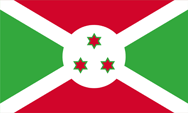
Nationalflagge,
Seitenverhältnis = 3:5,
Quelle, nach: Corel Draw 4,
Flags of the World


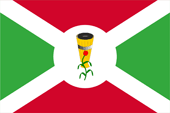
01.07.1962–28.11.1966,
Nationalflagge,
Seitenverhältnis = 2:3,
Quelle, nach: Die Welt der Flaggen

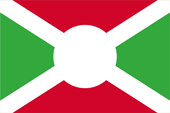
28.11.1966–28.07.1967,
Nationalflagge,
Seitenverhältnis = 2:3,
Quelle, nach: Flaggen und Wappen der Welt
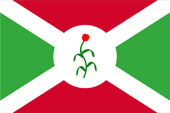
28.11.1966–28.07.1967,
Nationalflagge,
Seitenverhältnis = 2:3,
Quelle, nach: Flaggen und Wappen der Welt
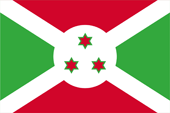
28.07.1967–27.09.1982,
Nationalflagge,
Seitenverhältnis = 2:3,
Quelle, nach: Flaggen und Wappen der Welt
Das Königreich Burundi wurde am 01.07.1962 unabhängig. Die in diesem Zusammenhang eingeführte Flagge wird durch ein weißes diagonales Kreuz in vier Viertel geteilt, links und rechts je ein grünes, oben und unten je ein rotes. In der Mitte trug die Flagge eine weiße Scheibe mit einer Trommel (Symbol der Tutsi-Monarchie) und einer Hirsepflanze darauf. Grün steht für die Hoffnung, Rot für das im Unabhängigkeitskampf vergossene Blut, und Weiß für den Frieden. Die Monarchie wurde am 28.11.1966 gestürzt, und die Republik ausgerufen. Nach Zwischenlösungen wurde die Flagge am 28.07.1967 in ihre heutige Form gebracht. Die Trommel und die Hirsepflanze auf der Flagge von 1962 wurden durch drei rote, grün umrandete, sechszackige Sterne ersetzt. Die drei Sterne stehen für das Motto des Staates "Unité, Travail, Progress" => "Einigkeit, Arbeit, Fortschritt", bzw. für die drei Volksgruppen im Lande, die Tutsi, Hutu und Twa. Im Jahre 1982 wurden die Seitenverhältnisse der Flagge von 2:3 auf 3:5 abgeändert. Als Farben für die Flaggen werden heute angegeben: Rot = pt 186, Grün = pt 361 und Weiß.
Quelle: Flaggen und Wappen der Welt
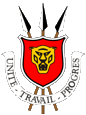
seit 1966,
Wappen von Burundi,
Quelle:
Corel Draw 4
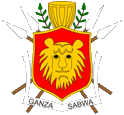
1962–1966,
Wappen von Burundi,
Quelle: Flags of the World
Das erste Wappen von 1962 zeigte einen roten Schild mit einem goldenen Löwenkopf, dahinter vier gekreuzte Speere, oberhalb des Schildes die Tutsi-Trommel, und darunter in einem Schriftband das Staatsmotto: "Ganza Sabwa" => "Herrschen Regieren". Nach Ausrufung der Republik wurde einer der Speere und die Trommel entfernt, und das Staatsmotto wurde abgeändert. Die drei Speere beziehen sich auf sie drei Sterne in der Flagge.
Quelle: Flaggen und Wappen der Welt,
Wikipedia (D)
Lage:
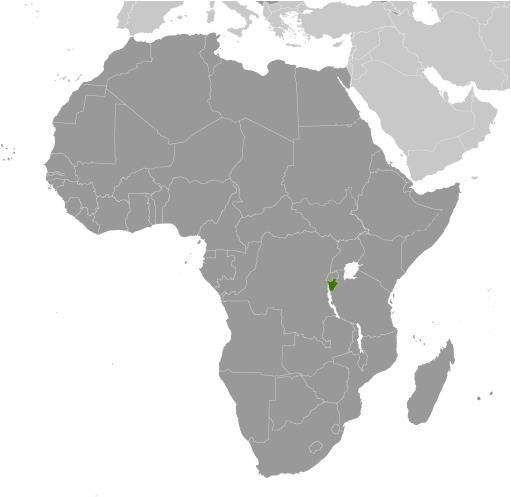
Quelle: CIA World Factbook
Landkarte des Landes:
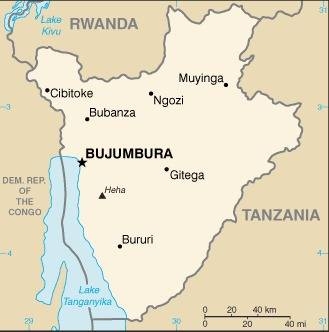
Quelle: CIA World Factbook
Fläche: 27.834 km²
Einwohner: 11.466.756 (2018), davon 85% Hutu, 14% Tutsi, 1% Twa
Religionen: 62% Katholiken, 5% Protestanten, 23% Animisten, 10% Moslems
Bevölkerungsdichte: 412 Ew./km²
Hauptstadt (ab 2019): Gitega (Kitega), 41.944 Ew. (2008)
Hauptstadt (bis 2019): Bujumbura (bis 1962 Usumbura), 497.166 Ew. (2008)
Amtssprachen: Kirundi, Französisch
sonstige Sprachen: Suaheli
Währung: 1 Burundi-Franc (BIF, FBu) = 100 Centimes
Zeitzone: MEZ + 1 h
Quelle: Wikipedia (D)
16. Jhd. bis 19. Jhd. · Tutsi-Königreiche
August 1884 · Errichtung des deutschen Protektorats
01.07.1890 · formeller Anschluss an Deutsch-Ostafrika
1896 · reguläre deutsche Inbesitznahme, Errichtung der Kololnialverwaltung
1914–1918 · Erster Weltkrieg (1916 · belgische und britische Truppen erobern Deutsch-Ostafrika, Widerstand der deutschen Schutztruppe bis zum 14.11.1918)
1919 · Ruanda und Urundi kommen unter belgische Kontrolle
1920 · Versailler Diktat, das Deutsche Reich verliert alle seine Kolonien, Deutsch-Ostafrika wird zwischen Belgien, Großbritannien und Portugal aufgeteilt – das heutige Burundi wird zusammen mit den heutigen Ruanda als "Ruanda-Urundi" ein Mandatsgebiet des Völkerbundes unter belgischem Mandat
20.07.1922 · Errichtung der belgischen Mandatsverwaltung
1946 · das Mandatsgebiet des Völkerbundes wird UNO-Treuhandgebiet unter belgischer Verwaltung
21.12.1961 · Belgien gewährt Autonomie
01.07.1962 · Unabhängigkeit
28.11.1966 · Sturz der Tutsi-Monarchie
1976 · Tutsi-Putsch
1987 · Tutsi-Putsch
Juni 1993 · Wahlen, Sieg der Hutu, Wahl eines Hutu-Präsidenten
Oktober 1993 · Ermordung des Hutu-Präsidenten
1993–1994 · Bürgerkrieg
1994 · Wahl eines Hutu-Präsidenten
1996 · Tutsi-Putsch
2000 · Friedensvertrag von Arusha
Quelle:
Wikipedia (D),
World Statesmen
Der Name "Burundi" (eigentlich Uburundi) bedeutet in der Kirundi-Sprache "Vaterland". In der Kolonialzeit wurde "Urundi" verwendet.
Quelle:
Handbuch der geographischen Namen,
Volker Preuss