|
seit/since 2011
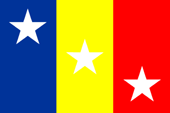
Nationalflagge – national flag
Quelle/Source: Verfassung
Kabindan Artikel 7
  
 |
| historische Flaggen – historical Flags: |
|
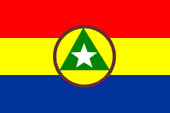
Nationalflagge –
national flag
Variante 1,
Quelle/Source: UNPO
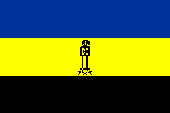
Nationalflagge –
national flag
Variante 2,
Quelle/Source: Stateless Nations
|
|
 Bedeutung/Ursprung
der Flagge: Bedeutung/Ursprung
der Flagge: |
 Meaning/Origin of the Flag: Meaning/Origin of the Flag: |
Die Flagge der Republik
Kabindan, die am 04.02.2011 ihre Unabhängigkeit erklärte, ist in Artikel 7 der
Verfassung des Landes festgelegt. Sie zeigt drei senkrechte Streifen in Blau, Gelb und
Rot, und in jedem der drei Streifen einen weißen, fünfzackigen Stern, im blauen Streifen
im oberen Teil, im gelben Streifen genau in der Mitte, im Roten Streifen im unteren Teil. Eine frühere Flagge
von Cabinda zeigte drei Streifen in Rot, Gelb und Blau, manchmal auch in umgekehrter
Reihenfolge, und in der Mitte ein Kreisemblem mit einem grünen Dreieck und einem Stern
darin. Das ist die Flagge der F.L.E.C., die seit 1974 operiert. Eine Variante der
Flagge von Cabinda zeigt drei Streifen in Blau, Gelb und Schwarz, und in der Mitte des
gelben Streifens eine Steinsäule, wie sie portugiesische Seefahrer als Zeichen der
Landnahme an den Küsten Afrikas aufstellten. über den Ursprung der Flagge und die
Bedeutung der Farben ist nichts bekannt.
The flag of the
Republic of Kabindan which declared its independence on 4th of February in 2011 is set out
in Article 7 of the Constitution of the country. It shows three vertical stripes in blue,
yellow and red, and in each of the three stripes a white, five-pointed star, in the blue
stripe on the upper part, the yellow stripe in the middle, in the red stripe at the
bottom. A former flag of
Cabinda showed three stripes in red, yellow and blue, and sometimes in reversed order, and
in the middle a circle emblem with a green triangle and a star in it. This is the flag of
the F.L.E.C., which operates since 1974. A variant of the flag
of Cabinda shows three stripes in blue, yellow and black, and in the middle of the yellow
stripe a stone-pillar, how portugese seafarers put up on the coasts of Africa as a sign of
appropriation. Nothing is known about the source of the flag and the meaning of its
colours. |
Quelle/Source
nach/by: Flags of
the World, DGF-Informationen Nr. 75 (Dezember 2015)
| Zahlen und Fakten – Numbers and Facts: |
|
|
|
|
|
|
- Einwohner:
152 000
(meist Ba-Kong)
|
- Inhabitants:
152 000
(mostly Ba-Kong)
|
- Bevölkerungsdichte:
21 Ew./km²
|
- Density of Population:
55 inh./sq.mi.
|
|
|
|
- Sitz der Exilregierung:
Tchiowa
|
- Seat of the Exile Government:
Tchiowa
|
- Amtssprache:
Portugiesisch
|
- official Language:
Portugese
|
- sonstige Sprachen:
Kikongo
|
|
|
|
|
|
|
|
- Geschichte:
siehe Text unten
|
|
- Wirtschaft:
Export tropischer Edelhölzer,
Erdölfürderung
|
- Economy:
export of tropic high-grade lumber,
mineral oil
|
|
|
| Landkarte – Map: |

Quelle/Source: Wikipedia (FR)
|
für eine große
Landkarte – for a big map: hier
klicken – click here
(Quelle/Source: wikimedia.org) |
| Ergänzung – Additional Text: |
|
|
Seit dem 19. Jhd. war
Cabinda ein portugiesisches Schutzgebiet. 1933 wurde Cabinda eine portugiesische
überseeprovinz. 1960 bildet sich die Nationale Bewegung von Cabinda für
Entkolonialisierung und Selbstbestimmung. 1962 wurde der Beschluss zur Selbstbestimmung
bei der 4. Kommission der UN eingereicht. Cabinda wurde als 39. zu entkolonisierendes Land
in die Organisation für Afrikanische Einheit aufgenommen. 1974 wurde die FLEC (FLEC/FAC =
Front of the Liberation of the Enclave of Cabinda (Front zur Befreiung der Enklave
Cabinda) ermächtigt, ihren Sitz in Tchiowa einzurichten. Der portugiesische
Außenminister der Spinoza-Regierung leitete die Frage nach Entkolonialisierung nach Neu
York weiter. Die Regierung Spinoza wurde kurz danach gestürtzt. 1975 wurde, ohne
Befragung des Volkes von Cabinda, das Alvor-Abkommen zwischen Portugal und drei
angolanischen Befreiungsbewegungen mit Hilfe von Regierungsvertretern, die General Spinoza
ersetzen sollten, unterzeichnet. Das Abkommen bezweckte die Annexion von Cabinda durch
Angola. Die gegenwärtige Situation in Cabinda ist durch Provokationen angolanischen
Militärs angespannt. Cabinda ist auf Grund seiner natürlichen Resourcen für Angola sehr
wichtig, da mehr als 90% des angolanischen Haushaltes aus Cabinda kommen.
Since the 19th century
Cabinda was a Portuguese protectorate. In 1933 Cabinda became a Portuguese overseas
province. In 1960 was established the National Movement of Cabinda for Decolonization and
Self Determination. In 1962, the decision for self-determination was submitted in the 4th
Commission of the UN. Cabinda joined as the 39th to decolonize country the Organisation of
African Unity. In 1974, the
FLEC (FLEC/FAC = Front of the Liberation of the Enclave of Cabinda) was authorized to
establish its headquarters in Tchiowa. The Portuguese Foreign Minister of the
Spinoza-government handed over the question of decolonization to New York. The government
Spinoza was overthrown shortly after. In 1975 was signed, without consulting the people of
Cabinda, the Alvor Agreement between Portugal and three Angolan liberation movements with
the help of some government officials, who should replace General Spinoza.
The agreement was intended by the annexation of Cabinda by Angola. The current situation in Cabinda is
strained by Angolan military provocations. Cabinda is very important for Angola, because
of its natural resources and because more than 90% of the Angolan budget come from
Cabinda. |
Quelle/Source:
Text: UNPO
Die FLEC (inzwischen:
Front de libération de l'état du Cabinda) proklamierte am 04.02.2011 in Brüssel
einseitig die Unabhängigkeit für Cabinda. Der Staat nennt sich Republik
Kabindan. Auch wurde eine Verfassung verabschiedet, die am 21.02.2011 juristisch
beglaubigt wurde. Am am 22.02.2012 wurde die erste Regierung gebildet. Die Republik
Kabindan wird von Angola nicht anerkannt.
The FLEC (now: Front de
libération de l'état de Cabinda) proclaimed on 4th of February in 2011 in Brussels
unilaterally the independence of Cabinda. The state is called now Republic
Kabindan. A constitution was also adopted, which became authenticated legally on
21st of February in 2011. On 22nd of February in 2012 the first government was formed. The
Republic Kabindan is not recognized by Angola.

|

