mobile Ansicht, to the English Version tap the flag


- Volksrepublik China
- kommunistische Republik mit Mehrparteiensystem
- Eigenbezeichnung: Zhonghuá Renmin Gongheguo
• Flaggen
• historische Flaggen
• regionale Flaggen:
– Tibet
– Ostturkestan
– Taiwan
– Mandschukuo
– Hongkong
– Macau
• Bedeutung/Ursprung der Flagge
• Wappen
• historische Wappen
• Bedeutung/Ursprung des Wappens
• Flugzeugkokarde
• Landkarte
• Zahlen und Fakten
• Geschichte
• Ursprung des Landesnamens
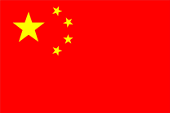
National- und Handelsflagge,
Seitenverhältnis = 2:3,
Quelle, nach: Corel Draw 4,
Wikipedia (EN)


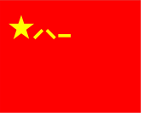
Flagge der Streitkräfte,
Seitenverhältnis = 5:4,
Quelle, nach: Wikipedia (EN)

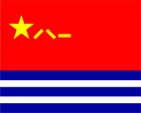
Marineflagge,
Seitenverhältnis = 5:4,
Quelle, nach: Wikipedia (EN)
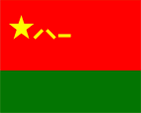
Flagge des Heeres,
Seitenverhältnis = 5:4,
Quelle, nach: Wikipedia (EN)
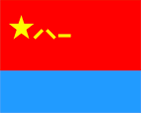
Flagge der Luftwaffe,
Seitenverhältnis = 5:4,
Quelle, nach: Wikipedia (EN)
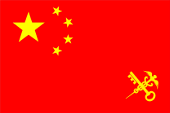
Zollflagge,
Seitenverhältnis = 2:3,
Quelle, nach: Wikipedia (EN)

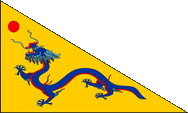
1872–1889,
Flagge des Kaiserreichs China,
Quelle, nach: Flags of the World,
!Original:清朝政府Vector: Sodacan, Public domain, via Wikimedia Commons
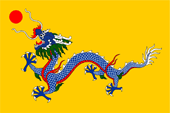
1889–1911,
Flagge des Kaiserreichs China,
Seitenverhältnis = 2:3,
Quelle, nach: Flags of the World,
!Original:清朝政府Vector: Sodacan, Public domain, via Wikimedia Commons

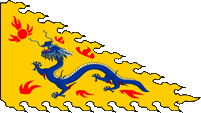
1862(?)–1911,
Flagge des Kaisers von China,
Quelle, nach: Flags of the World
!Original:清朝政府Vector: Sodacan, Public domain, via Wikimedia Commons
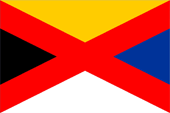
1915–1916,
Kaiserreich China,
Seitenverhältnis = 2:3,
Quelle, nach:
Flags of the World,
Wikipedia (DE)

1912–1928,
National- und Handelsflagge,
Seitenverhältnis = 2:3,
Quelle, nach: Flags of the World,
Wikipedia (EN)
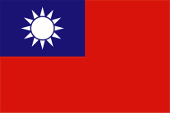
1912–1928,
Marineflagge,
Seitenverhältnis = 2:3,
Quelle, nach: Die Welt im bunten Flaggenbild
1928–1949,
National-, Staats- und Marineflagge,
Seitenverhältnis = 2:3,
Quelle, nach: Die Welt im bunten Flaggenbild
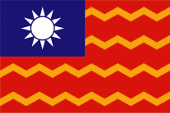
1929–1949,
Handelsflagge,
Seitenverhältnis = 2:3,
Quelle, nach: Die Welt im bunten Flaggenbild
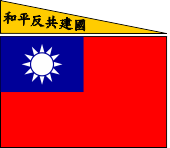
1940–1945,
Flagge Chinas unter der Nanking-Regierung
Quelle, nach: Der neue Brockhaus
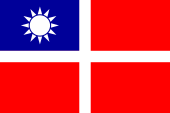
1942–1945,
Marineflagge Chinas unter der Nanking-Regierung,
Seitenverhältnis = 2:3,
Quelle, nach: Wikipedia (EN)
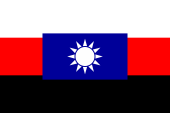
seit 1948/1949,
Revolutonäres Komitee der Guomindang,
Seitenverhältnis = 2:3,
Quelle, nach:
Jürgen Kaltschmitt
Die Flagge des chinesischen Kaiserreichs der Qing-Dynastie war einfarbig gelb und zeigte einem blauen Drachen in der Mitte. Die Farbe Gelb ist die Farbe des Volkes der Mandschuren und auch der mandschurischen Qing-Dynastie, die 1644 bis 1911 China beherrschte. Der Drache steht für den Osten. Eine Flagge im europäischen Stil wurde erst 1889 eingeführt. Vorher waren die chinesischen Flaggen wie Wimpel geformt.
(Quelle/Source: Die Welt der Flaggen, Flaggen und Wappen der Welt)
Im Jahre 1911 wurde die Monarchie gestürzt, und die Republik ausgerufen. In diesem Zusammenhang wurde eine neue Flagge eingeführt. Es war die Flagge der ehemaligen Provinz Jangtse. Sie zeigte fünf waagerechte Streifen in Rot, Gelb, Blau, Weiß und Schwarz. Die fünf Farben sollten die fünf Rassen Chinas repräsentieren: Rot = Han-Chinesen, Gelb = Mandschuren, Blau = Mongolen, Weiß = Hui und Turkestaner (Uiguren), Schwarz = Tibeter. Das Rot der Han-Chinesen, des dominanten Volkes, lag natürlich oben.
(Quelle/Source: Die Welt der Flaggen, Flags of the World)
Präsident und Oberbefehlshaber Yuan Shikai versuchte von Ende 1915 bis Anfang 1916 das Kaiserreich China wieder herzustellen, und zwar unter seiner eigenen Dynastie "Hongxian". Die Flagge des Hongxian-Kaiserreichs orientierte sich der fünfstreifigen Flagge der Republik. Das über allem liegende rote Kreuz symbolisierte die Herrschaft der Han-Chinesen über die Völker der Mandschuren, Mongolen, Uiguren und Tibeter.
(Quelle/Source: Flags of the World)
Schon im Jahr 1895 hatte sich eine Reformbewegung organisiert, die chinesische Regenerationsgesellschaft. Die Flagge dieser Organisation war einfarbig blau, mit einer weißen zwölfstrahligen Sonne in der Mitte. Im Jahre 1912 wurde die nationalrepublikanische Guomindang-Partei gegründet. Die Guomindang wählten sich eine einfarbige rote Flagge mit der blauen Flagge der Regenerationsgesellschaft in der Oberecke. Die gleiche Flagge wurde schon im gleichen Jahr als Marineflagge eingeführt. In einem langen Bürgerkrieg konnten sich die Guomindang im Jahre 1928 letzlich durchsetzen. Die Flagge der Guomindang wurde zur neuen Nationalflagge, die auf Taiwan noch immer verwendet wird (siehe Taiwan).
(Quelle/Source: Die Welt der Flaggen, Wikipedia (DE))
Im Jahre 1935 gelang es den Kommunisten sich in der Provinz Shanxi festzusetzen. Ihre "Volksbefreiungsarmee" verwendete eine einfarbig rote Flagge mit einem goldenen Stern in der Oberecke sowie mit den Zahlen "1" und "8". Sie erinnern an das Gründungsdatum der Truppe, den 1. August 1928. Diese Flagge ist noch heute Flagge der Streitkräfte Chinas.
(Quelle/Source: Die Welt der Flaggen, Atlas zur Geschichte)
Im Jahre 1931 hatten die Japaner die Mandschurei besetzt, und den Satellitenstaat Mandschukuo installiert. 1937 kam es zum zweiten chinesisch-japanischen Krieg, und Japan besetzte große Teile Chinas. Im Norden der Inneren Mongolei wurde der Satellitenstaat Mengjiang installiert. In Nanking (Nanjing) war bis 1945, dem Jahr des Abzugs der Japaner, eine projapanische Regierung für China eingesetzt. Diese verwendete weiterhin die Flagge der Guomindang, jedoch um einen gelben Wimpel ergänzt, auf dem stand: "Frieden, Antikommunismus, Nationaler Aufbau".
(Quelle/Source: Atlas zur Geschichte, Wikipedia (EN), Der neue Brockhaus)
Im "Herbst-Abkommen" vom Oktober 1945 vereinbarten Tschiang-Kai-Schek (Guomindang) und Mao-Tse-Tung (Kommunisten) eine gegenseitige Waffenruhe und auch Wahlen zu einer Volksvertretung. Infolge dessen verwendete die KP Chinas neben ihrer roten Partei-Flagge mit Hammer und Sichel – zumindest bei Wahlkampfveranstaltungen – die Flagge der Republik China mit der weißen Sonne als Nationalflagge. Als der Bürgerkrieg 1946 wieder offen ausbrach, wurde diese Praxis wieder eingestellt. Im folgenden Bürgerkrieg, der bis 1949 dauerte, setzten sich die Kommunisten gegen die Guomindang duch. Diese konten sich nach Taiwan retten. Die Insel verwendet bis heute die Flaggen der Guomindang. Am 01.10.1949 wurde durch die siegreichen Kommunisten die Volksrepublik China gegründet, und eine neue Flagge eingeführt. Sie ist einfarbig rot mit einem großen und vier kleinen goldenen fünfzackigen Sternen in der Oberecke. Das Rot steht für den Kommunismus, aber auch noch immer für die Han. Die fünf Sterne symbolisieren China, Mandschurei, Mongolei, Sinkiang (Ostturkestan) und Tibet, aber auch die kommunistische Partei und die vier Werktätigenklassen: Arbeiter, Bauern, Kleinbürger und "patriotische Kapitalisten".
(Quelle/Source: Flaggen Wappen Hymnen)
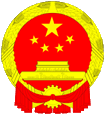
Wappen der Volksrepublik China,
Quelle: Corel Draw 4
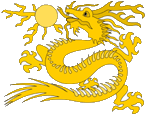
bis 1911,
Wappen des Kaiserreichs China

1928–1949,
(auf Taiwan bis heute)
Wappen der Republik China,
Quelle: Corel Draw 4
Das Sinn- und Wappenbild des Kaiserreichs China war der Drache. Er war das Symbol der mandschurischen Qing-Dynastie, die zwischen 1644 und 1911 China beherrschte. Die im Bürgerkrieg der Republik China siegreichen Guomindang führten im Jahre 1928 als neues Landeswappen ihr eigenes Emblem ein. Es geht auf das Logo der chinesischen Regenerationsgesellschaft von 1895 zurück und zeigt eine weiße, zwölfstrahlige Sonne auf einer blauen Scheibe. Sie erinnert an die zwölf Zwei-Stunden-Abschnitte des Tages und symbolisiert so den Geist des unaufhaltsamen Fortschritts. Das Wappen wird auf Taiwan noch immer verwendet (siehe Taiwan). Das Wappen der Volksrepublik China wurde am 20.09.1950 eingeführt. Es zeigt in Gold auf Rot das Tor zur Verbotenen Stadt am Platz des Himmlischen Friedens, den Mittelpunkt, das Zentrum der Macht in der Hauptstadt des Landes. Darüber die fünf goldenen Sterne aus der Flagge. Das Ganze ist umgeben von einem Kranz aus Weizen- und Reisähren. Sie stehen für die Landwirtschaft und werden im unteren Teil des Wappens durch rote Fahnen mit einem Zahnrad verbunden, das für die Industrie steht.
Quelle:
Wappen und Flaggen aller Nationen,
Flaggen Wappen Hymnen

1916-1920,
Flugzeugkokarde,
Quelle, nach: Wikipedia (EN)

1920-1928,
Flugzeugkokarde,
Quelle, nach: Wikipedia (EN)

1928-1949,
Flugzeugkokarde,
Quelle, nach: Wikipedia (EN)
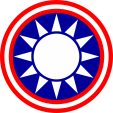
1942-1945,
Flugzeugkokarde unter der Nanking-Regierung,
Quelle, nach: Wikipedia (EN)

seit 1949,
Flugzeugkokarde,
Quelle, nach: Wikipedia (EN)
Lage:
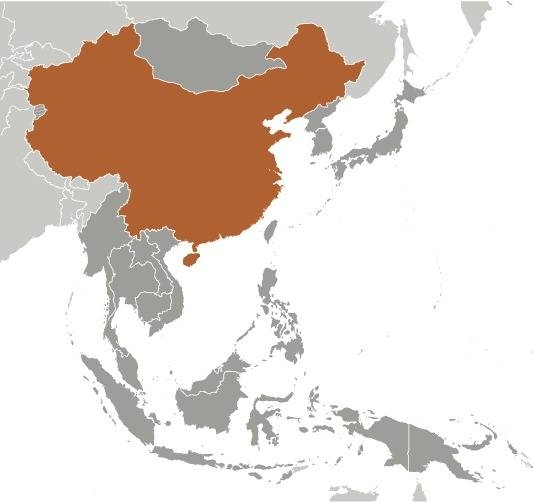
Quelle: CIA World Factbook
Landkarte des Landes:
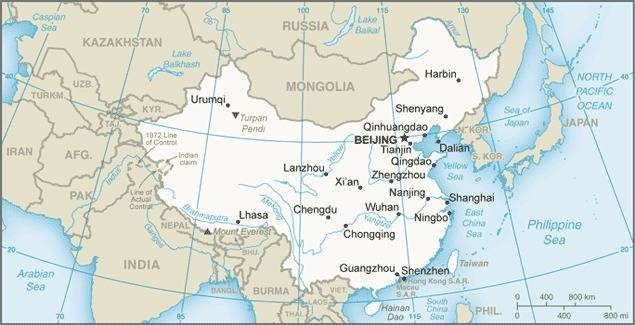
Quelle: CIA World Factbook
Fläche: 9.596.961 km²
Einwohner: 1.400.050.000 (2019), davon 91,5% Han, 1,2% Zhuang, 0,8% Uiguren (Ostturkestaner), 0,7% Hui, 0,7% Mandschuren, 0,6% Miao, 0,6% Yi, 0,6% Tujia, 0,4% Tibeter, 0,4% Mongolen, 0,2% Dong, 0,2% Buyei, 0,2% Yao
Religionen: 73,6% Nicht-Religiöse, 15,9% Buddhisten, 2,5% Christen, 0,9% Animisten, 0,8% Moslems
Bevölkerungsdichte: 146 Ew./km²
Hauptstadt: Peking (Beijing), 21.542.000 Ew. (2018)
Amtssprache: Chinesisch (Mandarin-Dialekt)
andere Sprachen: Chinesisch (Kanton-Dialekt), Mongolisch, u.a.
Währung: 1 Renminbi Yuan (RMB, CNY, RMB¥, CN¥) = 10 Jiao = 100 Fen
Zeitzone: MEZ + 7 h
Quelle: Wikipedia (D)
20.–15. Jhd. v.Chr. · Hsia-Dynastie
15.–11. Jhd. v.Chr. · Shang-(Yin-)Dynastie
11. Jhd.–249 v.Chr. · Dschou-Dynastie
221–206 v.Chr. · Tjin-(Qin-)Dynastie
206 v.Chr.–220 · Han-Dynastie
265–420 · Djin-Dynastie
386–598 · China zerfällt in Teilreiche
618–907 · Tang-Dynastie
960–1120 · Sung-(Song-)Dynastie
1234 · Mongoleneinfälle
1271–1368 · Mongolische Yüan-(Yuan-)Dynastie
1272–1292 · Marco Polo in China
1368–1644 · Ming-Dynastie
1557 · Portugal pachtet die Halbinsel Macau von China
1644 · Etablierung der Mandschurischen Tjing-(Qing-)Dynastie (bis 1911)
1720 · Tibet wird chinesisch
1757 · Dschungarei wird chinesisch
1840–1842 · 1. Opiumkrieg
1841 · Hongkong wird an Großbritannien verpachtet
1856–1860 · 2. Opiumkrieg
1884–1885 · chinesisch-französischer Krieg
1894–1895 · chinesisch-japanischer Krieg, Taiwan kommt an Japan, Korea wird unabhängig
1898 · Kiaotschou kommt an das Deutsche Reich, Guangzhouwan kommt an Frankreich, Weihaiwei kommt an Großbritannien, Port Arthur an Russland
1899–1901 · Boxeraufstand
10.10.1911 · Sturz der Monarchie
Oktober bis Dezember 1912 · Unabhängigkeit für Tibet, Ostturkestan (Dschungarei) und die Äußere Mongolei
01.01.1912 · Ausrufung der Republik China
1915–1916 · Kaiserreich China des Präsidenten Yuan Shikai
1916–1928 · Bürgerkrieg
10.10.1928 · Sieg der Guomindang, Proklamation der Nationalregierung
1928–1935 · Etablierung der Kommunisten in der Provinz Shanxi
1931 · Japan besetzt die Mandschurei
1932 · Gründung von Mandschukuo
1937 · Chinesisch-Japanischer Krieg, Japan besetzt große Teile Chinas bis 1945, Gründung von Mengjiang
1937–1945 · Krieg der Kommunisten und Guomindang gegen Japan
1945–1949 · Krieg der Kommunisten gegen die Guomindang
1949 · die Guomindang gehen nach Taiwan
01.10.1949 · Proklamation der Volksrepublik
1966 · Kulturrevolution
1979 · Krieg gegen Vietnam
1989 · Niederschlagung der Demokratiebewegung
seit 1992/93 · vorsichtige Reformen
Quelle:
Atlas zur Geschichte,
World Statesmen,
Wikipedia (D,
Deutsche Kolonien,
Länder der Erde
Der Name "China" geht auf den Legendären Kaiser und Begründer der Tjin-Dynastie (sprich Tschin) zurück, der das Land im 3. Jahrhundert vor Christus einigte. China selbst nennt sich "Zhonghuá", was "Reich der Mitte" heißt.
Quelle: Handbuch der geographischen Namen