mobile Ansicht, to the English Version tap the flag


- Khanat Chiwa
- ehem. turkestanischer Staat
- historisches Reich Choresm, bestehend zwischen dem 4. Jhd.v.Chr. und ca. 1400
- andere Namen: Choresm, Chorezm, Choresmien, Chwarizm, Chwarezm
• Flaggen
• Bedeutung/Ursprung der Flagge
• Landkarte
• Zahlen und Fakten
• Geschichte
• Ursprung des Landesnamens

11.–19. Jhd.,
Flagge von Choresm/Chiwa,
Quelle/Source Dank an: Faruk Tezer



1873–1918,
Flagge des Khanats Chiwa,
Quelle, nach: Wikipedia (EN)
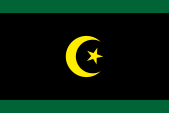
1918– Jan. 1920,
Flagge des Khanats Chiwa,
Quelle, nach: World Statesmen
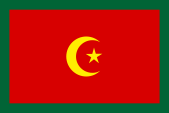
bis April 1920,
Flagge des Khanats Chiwa,
Seitenverhältnis = 2:3,
Quelle, nach: World Statesmen

bis Juli 1922,
Flagge der Choresmischen Volks-Sowjetrepublik,
Seitenverhältnis = 1:2,
Quelle, nach: World Statesmen
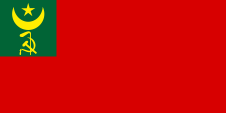
Juli 1923 bis Oktober 1923,
Flagge der Choresmischen Volks-Sowjetrepublik,
Seitenverhältnis = 1:2,
Quelle, nach: World Statesmen
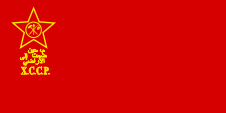
Oktober 1923 bis Oktober 1924,
Flagge der Choresmischen Sozialistischen Sowjetrepublik,
Seitenverhältnis = 1:2,
Quelle, nach: World Statesmen

Das alte Reich von Choresm verwendete eine einfarbige schwarze Flagge. Die Farbe dürfte auf den Kalifen Abbas I. zurückgehen. Noch heute steht die Farbe Schwarz auf Flaggen in der arabisch-islamischen Welt für die Abbasiden, also Abbas I. und seine Nachkommen. Nachdem Chiwa russisches Protektorat geworden war, wurde eine einfarbige weiße Flagge eingeführt, die in der Oberecke einen blauen Halbmond zeigte. Das Weiß sollte wahrscheinlich die friedlichen Absichten gegenüber Russland symbolisieren, Blau ist die Farbe der Turkvölker und Tataren. In der kurzen Phase der Unabhängigkeit wurden zwei andere Flaggen verwendet, deren gemeinsames Symbol Halbmond und Stern waren, die Symbole des Islam aber auch der Türken. Die Flagge zwischen 1918 und 1920 war einfarbig schwarz, eine Rückkehr zur alten Tradition, und zeigte oben und unten grüne Kanten, andere Quellen zeigen auch einen komplett umlaufenden grünen Rand. Das Modell von 1920 zeigte bereits anstelle von Schwarz das kommunistische Rot. Die Flagge der Sozialistischen Republik zeigte ein rotes Flaggentuch, wie es bei Sowjetrepubliken üblich war. Eine quadratische grüne Oberecke zeigte zunächst drei Monate lang Halbmond und Stern, später wurden Hammer, Sichel und Sense ergänzt und das Motiv so ein Jahr lang verwendet. Bis zum Eintritt in die Sowjetunion gab es dann noch ab Oktober 1923 eine komplett rote Fahne, die in der Oberecke in Gold die kommunistische Symbolik, den Landesnamen in Arabisch und die Initialen des Landes in Kyrillisch zeigte.
Quelle:
Wikipedia (EN),
Wikipedia (D),
World Statesmen,
Volker Preuss
Reich Choresm im 6. Jahrhundert:
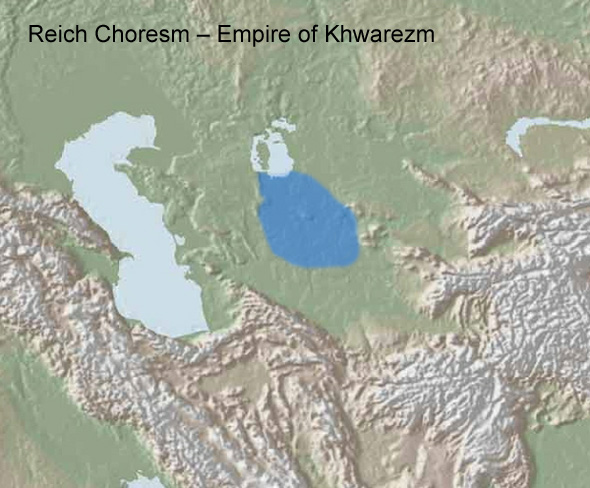
Quelle: University of Texas Libraries, modyfied by: Volker Preuss
Turkistan um 1870:
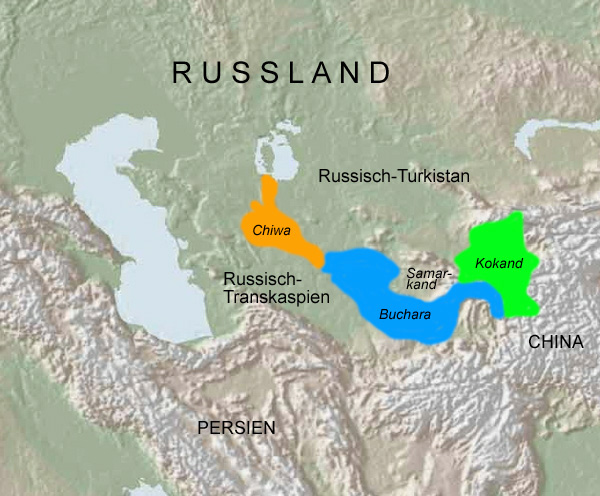
Quelle: Freeware, University of Texas Libraries, modyfied by: Volker Preuss
Fläche: 57.800 km²
Einwohner: 700.000 (1885), davon 1920 ca. 65% Usbeken, 27% Turkmenen, 4% Karakalpaken, 3% Kasachen
Religionen: 99% sunnitische Moslems (1914)
Bevölkerungsdichte: 12 Ew./km² (1885)
Hauptstadt: Chiwa, 6.000 Ew. (1885)
Amtssprache: Usbekisch, Turkmenisch
andere Sprachen: Tadschikisch, Kirgisisch, Karakalpakisch, Persisch
Währung: 1873-1918 Russischer Rubel, 1918-1920 Chiwa-Tenge, 1920-1923 Sowjetischer Chiwa Rubel
Quelle:
Meyers Konversationslexikon via
RetroBib Retrobibliothek,
World Statesmen
Antike · Besiedlung durch iranische Völker
5. Jhd. v.Chr. · Provinz des Persischen Reiches, später selbstständiges Königreich Choresm
5. Jhd. n.Chr. · Einwanderung von Turkvölkern, Choresm wird tributpflichtig
751 · arabische Eroberung, Islamisierung
1043 · Eroberung durch die Seldschuken
ca. 1090 · Kuthb Eddin Mohammed wird Schah von Choresm als Statthalter der Seldschuken, größte Machtentfaltung von Choresm
1194 · Abzug der Seldschuken
1220 · Eroberung durch die Mongolen unter Dschingis Khan und seinen Nachfolgern, später Eingliederung in das Reich der Goldenen Horde
1372, 1373, 1376 · Invasionen des Timur
1379 · Eroberung durch Timur, Zerstörung der Haupstadt, Niedergang des Reiches
1388 · Invasion des Timur
1484–1511 · zu Persien
15. Jhd. · Einwanderung der Usbeken (benannt nach Ösbek Khan, einem Herrscher der Goldenen Horde) unter Abulkhair Khan
1511 · Eroberung durch die Usbeken unter Ilbars Khan, Entstehung des Khanats Choresm
1620 · Verlegung der Hauptstadt von Urgentsch nach Chiwa
1700–1715 · Vasall Russlands
1740–1792 · Eroberung durch den Perser Nadir Schah, Herrschaft kirgisischer Khane
1792 · der Usbeke Mehemmed Emin Inag vertreibt die Kirgisen, Wiederherstellung der Usbeken-Herrschaft unter einer neuen Dynastie, als Landesname, verbreitet sich im Ausland und teilweise auch lokal der Name "Khanat Chiva", der offizielle Name ist und bleibt aber "Khanat Choresm"
1839 · russischer Eroberungsversuch
März–Mai 1873 · Eroberung durch Russland
12.08.1873 · Vertrag zwischen Chiwa und Russland, Chiwa wird russisches Protektorat und muss alle Gebiete nördlich des Amudaria an Russland abtreten (Kenka-Gebiet)
1917 · Bolschewistischer Putsch in Russland, es folgt ein bis 1920 andauernder, von Sowjetrusssland ausgehender, für die Bolschewisten siegreicher Bürgerkrieg und die Errichtung der Sowjetherrschaft im gesamten Gebiet des ehemaligen Kaiserreichs Russland, aus dem 1922 die Sowjetunion hervorgeht
13.02.1917 · das Khanat Chiwa erklärt seine Unabhängigkeit
09.04.1919 · Sowjetrussland erkennt die Unabängigkeit das Khanat Chiwa an
01.02.1920 · sowjetrussische Truppen besetzen das Land
26.04.1920 · Proklamation der Choresmischen Volks-Sowjetrepublik
13.09.1920 · Unionsabkommen mit Sowjetrussland, die Souveränität von Choresm wird bestätigt
1920–1925 · Basmatschi-Aufstand unter Junaid Khan gegen sie Sowjetherrschaft
20.10.1923 · Proklamation der Choresmischen Sozialistischen Sowjetrepublik
27.10.1924 · Beitritt zur Sowjetunion
17.02.1925 · Aufteilung zwischen Sowjetrussland (RSFSR), Sowjet-Turkmenien und Sowjet-Usbekistan
Quelle:
Meyers Konversationslexikon via
RetroBib Retrobibliothek,
Wikipedia (D),
World Statesmen
Der Name "Chiwa" geht auf die gleichnamige Stadt zurück. Der alte Name des Landes ist "Choresm" was "Land der Niederung" heißt und sich auf das Mündungsgebiet des Flusses Amudaria bezieht. Hauptstadt von Choresm war Urgentsch. Um 1620 wurde die Hauptstadt nach Chiwa verlegt.
Quelle:
Meyers Konversationslexikon via
RetroBib Retrobibliothek