|
|
| Übersicht Contents: | |
| Flagge Flag: | ||
|
||
| historische Flaggen historical Flags: | ||
|
||
|
||
|
||
|
||
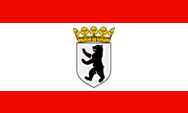
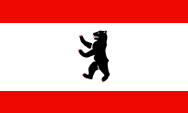
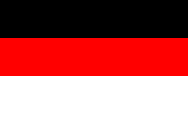
| Ursprünglich zeigte die Flagge Berlins drei waagerechte Streifen in Schwarz, Rot und Weiß. Die Farben gehen auf die Farben Brandenburgs (Rot und Weiß) und die Farben des Berliner Wappens zurück (Schwarz und Weiß). Im Jahre 1911 wurde die heutige Flagge eingeführt. Sie zeigt drei waagerechte Streifen in den Farben Rot, Weiß und Rot im Verhältnis 1:3:1 mit einem aufgerichteten schwarzen, rot bewehrten Bären in der Mitte des weißen Streifens. Als Berlin eine Preußische Provinz wurde, hat man diese Flagge zu amtlichen Zwecken übernommen und bis 1934 beibehalten. Nach 1945 wurde diese Flagge wieder verwendet und ist heute die Landesflagge von Berlin. Sie darf von jedermann gezeigt werden, sofern dies nicht in einer Weise oder unter Umständen geschieht, die dem Ansehen oder der Würde dieses Symbols abträglich sind. | Initialy showed the
flag of Berlin three horizontal stripes in black, red and white. The colours have their
roots in the colours of Brandenburg (red and white) and in the colours of the coat of arms
of Berlin (black and white). In the year 1911 was introduced the today's flag. It shows
three horizontal stripes in the colours red, white and red in ratio 1:3:1 with a
straighten red armed black bear in the middle of the white stripe. As Berlin became a Prussian province they took over that flag for official purpose and maintained it to 1934. After 1945 this flag was used again and is today the flag of the country of Berlin. It is everybody allowed to use it, provided that this is not made in a kind or under conditions which are harmful for the esteem or the dignity of that symbol. |
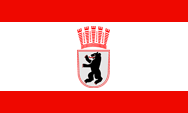
| Am 13.05.1954 hat West-Berlin ein neues Wappen (geschaffen von Ottfried Neubecker) eingeführt. Es zeigt den Bären auf einem silbernen Schild mit einer goldenen Laubkrone. | On 13th of May in 1954 West Berlin introduced a new coat of arms (created by Ottfried Neubecker). It shows the bear on a silvery shield with a golden leafage crown. |
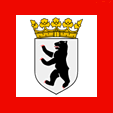
| Dieses Wappen wurde entsprechend auch auf der zeitgleich eingeführten allgemeinen Dienstflagge verwendet. Die allgemeine Dienstflagge konnte von jenen Dienststellen und Ämtern des Landes Berlin, die überwiegend hoheitliche Aufgaben wahrnehmen, anstelle der Landesflagge verwendet werden. Der Senat hatte eine eigene Dienstflagge. Diese Dienstflaggen und auch das Wappen waren seit der Wiedervereinigung für ganz Berlin gültig. | This coat of arms was
used accordingly since the in this point in time introduced general official flag. The general official flag could be used instead of the flag of the country by those departments and offices of the Country of Berlin which work prevalently in sovereign assignments. The senate had an own official flag. That official flags and also the coat of arms were valid since the re-unification for whole Berlin. |
| 2007 wurden alle Dienstflaggen abgeschafft. | In 2007 all official flags became abolished. |
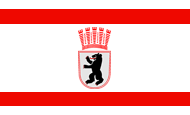
| Ost-Berlin führte im Jahre 1956 ebenfalls die rot-weiß-rote Berliner Flagge ein, jedoch zeigte sie darin das Wappen von 1934. Sie wurde offenbar nicht lange benutzt. Zur Feier von "750 Jahre Berlin" wurde eine Sonderform dieser Flagge gezeigt. Sie zeigte an den Außenkanten zusätzlich schmale weiße Streifen. | East Berlin introduced in 1956 likewise the red-white-red flag of Berlin, but it showed in it the coat of arms of 1934. It was obviously not used for a long time. On the occasion of the festivity of "750 years of Berlin" was used s special form of this flag. It showed on the outer borders additionally slender white stripes. |
| Quelle/Source: Die Welt der Flaggen, Wikipedia (D), Volker Preuß | |
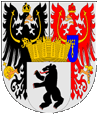
| Wappen Coat of Arms: | ||
|
||
|
||
|
||
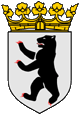
| Das Wappen von Berlin ist ein so genanntes redendes Wappen. Es zeigt ein aufgerichtetes schwarzes "Bärlein" mit roter Bewehrung in schwarz auf silbernem Grund. Über dem Wappen eine goldene Laubkrone mit einem Tor darin. | The coat of arms of Berlin is a so named speaking coat of arms. It shows a straighten red armed "small bear" in black on silvery ground. Above the coat of arms a golden leafage crown with a gate in it. |
| In dieser Form (geschaffen von Ottfried Neubecker) wurde es am 13.05.1954 in West-Berlin eingeführt und 1990 für die ganze Stadt übernommen. | In this form (created by Ottfried Neubecker) it was introduced on 13th of May in 1954 in West Berlin and in 1990 it was tooken over for the whole city. |
| Der Bär als Symbol für die Stadt geht bis auf das Jahr 1307 zurück, als sich Berlin und Cölln zum ersten Mal zusammenschlossen. | The bear as a symbol of the city dates back to the year 1307, when Berlin and Cölln joined together for the first time. |
| Berlin hatte 1934 ein Wappen eingeführt, welches den Bären auf einen silbernen rot umrandeten Schild mit einer roten Mauerkrone zeigt. Dieses Wappen wurde von Ost-Berlin bis zur Vereinigung beider Teile Berlins im Jahre 1990 beibehalten. | Berlin had indroduced in 1934 a coat of arms which showed the bear on a silvery red bordered shield with a red mural crown. This coat of arms maintained from East Berlin until the unification of both parts of Berlin in 1990. |
| In seiner heutigen Form (geschaffen von Ottfried Neubecker) wurde es am 13.05.1954 in West-Berlin eingeführt und 1990 für die ganze Stadt übernommen. | In its todays form (created by Ottfried Neubecker) it was introduced on 13th of May in 1954 in West Berlin and in 1990 it was tooken over for the whole city. |
| Quelle/Source: Die Welt der Flaggen, Wikipedia (D), Volker Preuß | |
| Landkarte Map: interaktive Karte clickable map |
| Die BRD und ihre Länder FRG and its countries: |
|
| Zahlen und Fakten Numbers and Facts: | |
|
|
|
|
|
|
|
|
| ca. 1160 · Markgraf
Albrecht I. (der Bär), lässt Berlin wahrscheinlich eine slawische Siedlung
gezielt besiedeln 1307 · Berlin wird mit der Stadt Cölln vereinigt 1442 · Berlin und Cölln werden wieder getrennt 1470 · Hauptstadt des Kurfürstentums Brandenburg 1701 · Hauptstadt von Preußen 1710 · Berlin, Cölln, Friedrichswerder, Dorotheenstadt und Friedrichstadt werden zur Haupt- und Residenzstadt Berlin vereinigt 1871 · Hauptstadt des Deutschen Reichs 01.10.1920 · Schaffung der Stadtgemeinde Groß-Berlin als Preußische Provinz 1934 · die territoriale Länder-Struktur des Deutschen Reiches wird durch die Gaue der NSDAP abgelöst, die Länder werden bedeutungslos 1945 · von den Alliierten besetzt und aufgeteilt 1948 · Spaltung in Ost- und West-Berlin 1949 · Ost-Berlin wird Hauptstadt der DDR 1961 · Bau der "Berliner Mauer" um West-Berlin 1989 · Fall der "Berliner Mauer" 1990 · Vereinigung von Ost- und Westberlin 1990 · Hauptstadt der BRD 1991 · Regierungssitz der BRD 1994 · Abzug der alliierten Truppen |
| ca. 1160 · Margrave
Albrecht I. (the Bear), colonizes Berlin targeted before probably a Slavic
settlement 1307 · Berlin becomes united with the City of Cölln 1442 · Berlin and Cölln become separated 1470 · capital of the Electorate of Brandenburg 1701 · capital of Prussia 1710 · Berlin, Cölln, Friedrichswerder, Dorotheenstadt and Friedrichstadt become united to the capital and residence city of Berlin 1871 · capital of the German Empire 1st of October 1920 · creation of the municipal community of Great Berlin as Prussian province 1934 · the territorial structure of the states of the German Empire becomes replaced by the districts of the NSDAP, the countries become meaningless 1945 · occupied and separated by the allies 1948 · separation into East and West Berlin 1949 · East Berlin became capital of the GDR 1961 · construction of the "Berlin Wall" around West Berlin 1989 · fall of the "Berlin Wall" 1990 · unification of Berlin 1990 · capital of the FRG 1991 · seat of government of the FRG 1994 · withdrawal of the allies |
| Quelle/Source: Wikipedia (D) |
| Der Name "Berlin" ist seit dem 12. Jahrhundert bekannt, und bei der Schaffung des Wappens der Stadt im Jahre 1307, wurde mit dem Bären im Wappen auf den Namen "Berlin" als "Bärlein" angespielt. Jedoch ist der Name älter und slawischen Ursprungs, und die erste Silbe im Wort "Berlin" ist ein Hinweis auf "Sumpf". | The name "Berlin" is known since the 12th century, and in creating the emblem of the city in 1307, they made an allusion with the Bear in the crest to the name "Berlin" as a "Bärlein" (little bear). However, the name may be older and is of Slavic origin, and the first syllable in the word "Berlin" is a reference to the word "swamp". |
| Quelle/Source: Handbuch der geographischen Namen, Atlas der wahren Namen | |

| Status von Berlin Status of Berlin: | |
| * Abschluss der Ratifizierung der 2+4-Verträge und damit Ende einiger der alliierten Vorbehalte bezüglich des Status Berlins im Grundgesetz und der Berliner Verfassung | * conclusion of ratification of the 2+4 Treatys and in this way ending of some of the allied reservations referring to the status of Berlin in the "Grundgesetz" and the constitution of Berlin |
| Das Bundesverfassungsgericht Karlsruhe (Präsidentin Prof. Dr. Jutta Limbach) urteilte am 31.7.1973 [BVerfGE Bd. 36, 1-37 (LT1-9) BGBl I 1973, 1058] and on the 21st of October in 1987 [Bd.77, S.137,150,154,160,167] einstimmig und wunschgemäß, daß das Deutsche Reich 1945 nicht untergegangen sei, sondern fortbestehe. Hier S.15-16: ... "Das Grundgesetz nicht nur eine These der Völkerrechtslehre und der Staatsrechtslehre geht davon aus, daß das Deutsche Reich den Zusammenbruch 1945 überdauert hat und weder mit der Kapitulation noch durch Ausübung fremder Staatsgewalt in Deutschland durch die alliierten Okkupationsmächte noch später untergegangen ist; das ergibt sich aus der Präambel, aus Art. 16, Art. 23, Art. 116 und Art. 146 GG. Das entspricht auch der Rechtsprechung des Bundesverfassungsgerichts, an der der Senat festhält. ... | The Federal
Constitution Court in Karlsruhe (President Prof. Dr. Jutta Limbach) decided on 31st of
July in 1973 [BVerfGE Bd. 36, 1-37 (LT1-9) BGBl I 1973, 1058] and on the 21st of October
in 1987 [Bd.77, S.137,150,154,160,167] unanimous and how intended, that the German Empire
in 1945 not perished but continued. Page 15 to 16: ... "The Grundgesetz (Basic Law) not only a thesis of the International Law and of the State Law sees that the German Empire outlasted the breakdown of 1945 and neither perished by the capitulation nor by the exertion of foreign state power in Germany by the allied occupation mights nor perished later; this is to recognize from the preamble, from article 16, article 23, article 116 and article 146 of the Basic Law. This corresponds to the jurisdiction of the Federal Constitution Court in which the senat persists. ... |
| Das Deutsche Reich (vgl zB BVerfG, 1956-08-17, 1 BvB 2/51, BVerfGE 2, 266 (277); 3,288 (319f); 5,85 (126); 6,309, 336, 363) besitzt nach wie vor Rechtsfähigkeit, ist allerdings als Gesamtstaat mangels Organisation, insbesondere mangels institutionalisierter Organe selbst nicht handlungsfähig ... Verantwortung für Deutschland als Ganzes"(= Deutsches Reich) tragen auch die vier Mächte. Die BRD ist nicht "Rechtsnachfolger" des Deutschen Reiches, sondern als Staat identisch mit dem Staat "Deutsches Reich", in bezug auf seine räumliche Ausdehnung allerdings "teilidentisch", so daß insoweit die Identität keine Ausschließlichkeit beansprucht. Die Bundesrepublik umfaßt also, was ihr Staatsvolk und ihr Staatsgebiet anbelangt, nicht das ganze Deutschland unbeschadet dessen, daß sie ein einheitliches Staatsvolk des Völkerrechtssubjekts "Deutschland" (Deutsches Reich) ... und ein einheitliches Staatsgebiet Deutschland" (Deutsches Reich) ... anerkennt. Sie (= die Bundesrepublik) beschränkt staatsrechtlich ihre Hoheitsgewalt auf den Geltungsbereich des Grundgesetzes. | The German Empire (see e.g. BVerfG, 1956-08-17, 1 BvB 2/51, BVerfGE 2, 266 (277); 3,288 (319f); 5,85 (126); 6,309, 336, 363) owns still competence in law, but is as whole state not able to act by itself because of lacking organization, especially because of lacking institutionalized organs ... the responsibility for Germany as whole thing" (= German Empire) have even the four mights. The Federal Republic of Germany is in this way not "successor in law" of the German Empire, but identical as state with the state of the "German Empire", under reference to its territorial expanse only "partially identical", so that insofar the identity demands no exclusivity. The Federal Republic of Germany includes in this way, concerning its state people and its state territory, not the whole Germany regardless of that it recognizes a consistent state people of the subject of the International Law "Germany" (German Empire) ... and a consistent state territory Germany" (German Empire) ... It (= Federal Republic of Germany) limits its sovereignty in legal terms of state to the field of application of the Basic Law. |
| "Die BRD stimmt
der Erklärung der vier Mächte zu und unterstreicht, dass die in dieser Erklärung
erwähnten Ereignisse und Umstände nicht eintreten werden, d. h., dass ein
Friedensvertrag oder eine Friedensregelung nicht beabsichtigt ist". Bundeskanzleramtprotokoll zur Verhandlung vom 17.07.1990 in Paris, Anlage Nr. 354 B. (Weiter dazu Dissertation von Dr. Michael Rensmann, Besatzungsrecht im wiedervereinten Deutschland) |
"The Federal
Republic of Germany agrees the statement of the four mights and emphasizes that the in
this statement mentioned incidents and circumstances will not occure, what means, that a
peace treaty or a peace regulation is not intended". Protocol of the Bureau of the
Federal Chancellor in negotiations of the 17th of July on 1990 in Paris, appendix No. 354
B. (furthermore dissertation of Dr. Michael Rensmann, occupation law in the re-united Germany) |