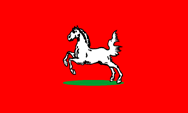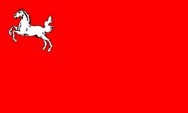
bis 1714,
Seeflagge des Kurfürstentums (Handelsflagge),
Quelle, nach: Landesmuseum Emden


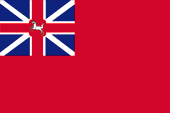
1727–1801,
Flagge des Kurfürstentums,
Quelle, nach: World Statesmen
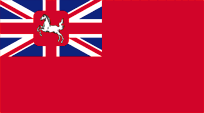
1801–1810 Flagge des Kurfürstentums,
1814–1837 Flagge des Königreichs,
Quelle, nach: World Statesmen
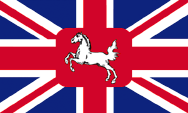
1801–1837
Lotsen(ruf)flagge,
Quelle, nach: Ostfriesisches Landesmuseum Emden
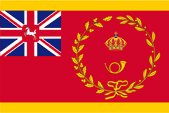
1801–1837
Postflagge,
Quelle, nach: Ostfriesisches Landesmuseum Emden


1837–1866
Flagge des Königreiches,
Quelle, nach: Flags of the World
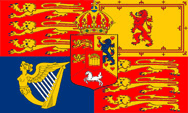
1814–1866
Flagge des Königs,
Quelle, nach: Welfen
1873–1934
Flagge der preußischen Provinz,
Quelle, nach: Flags of the World
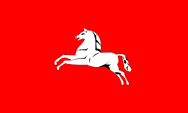
23.08.1946–01.11.1946
Flagge des Staates Hannover,
Quelle, nach: Königreich Hannover
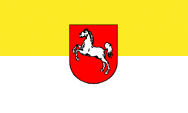
seit 1952
Flagge der ehemals Hannoverschen Gebiete innerhalb des deutschen Bundeslands Niedersachsen,
Quelle, nach: Königreich Hannover
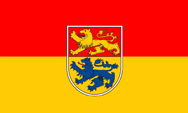
bis 2001
Flagge des ehemaligen Landkreises Hannover,
Quelle, nach: flaggenkunde.de


Als Landesfarben von Hannover galten ursprünglich die Farben Rot und Weiß, abgeleitet vom weißen "Sachsenross" auf rotem Grund. Das Sachsenross wurde 1361 von den Welfen übernommen, und tauchte in den Flaggen oder Wappen ihrer Territorien auf, dem Herzogtum Braunschweig und dem Kurfürstentum Braunschweig-Lüneburg (später Kurfürstentum und Königreich Hannover genannt). Die Flaggen von Hannover waren zunächst einfarbig rot, und zeigten das "Sachsenross" groß in der Mitte der Flagge auf einer stilisierten grünen Scholle. Diese Flagge war eigentlich das Wahrzeichen der Welfischen Dynastie, die das Land regierte. Jedoch wurde sie als Landes- bzw. Handelsflagge von den Monarchen geduldet, und auch inoffiziell bis weit in das 19. Jahrhundert hinein verwendet. Auf der Seeflagge war das Sachsenross im Obereck zu finden, damit das Schiff auch bei Windstille einwandfrei zu identifizieren war.
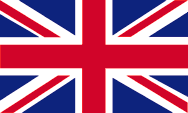
Zwischen 1714 und 1837 war Hannover in Personalunion mit Großbritannien und Irland verbunden, d.h., der Monarch von Hannover war auch der Monarch von Großbritannien und Irland. Hannover wurde von London aus regiert. In dieser Zeit verwendete Hannover eine einfarbige rote Flagge mit dem britischen Union Jack in der Oberecke. In der Mitte des Union Jack befand sich ein rotes Feld mit dem weißen "Sachsenross". Diese Regelung brachte für den Hannoverschen Handel große Vorteile, denn alle Häfen des Britischen Empire standen den Schiffen Hannovers uneingeschränkt offen.
Nach dem Ende der Personalunion mit Großbritannien und Irland führte König Ernst August von Hannover, der Bruder des letzten welfischen Königs von Großbritannien und Irland, als Landesfarben die Farben Gelb und Weiß ein. Es sind die Farben der Welfen-Linie von Calenberg-Göttingen-Grubenhagen. Ab 1866, als Hannover preußische Provinz wurde, durften diese Farben nicht mehr verwendet werden. Erst 1873 – zwei Jahre nach der Gründung des Deutschen Reiches – akzeptierte Preußen Gelb und Weiß als Farben seiner 'Provinz Hannover'.
Ab 1875 konnten die Provinzen Preußens weitestgehend Selbstverwaltung betreiben. Es gab Provinziallandtage und eine provinziale Regierung (Provinzialausschuss). Jede Provinz hatte ihre Landesfarben, die auch als Flagge verwendet wurden, und auch ein Wappen. Ob die Provinzregierungen ihre Landesfarben-Flaggen für amtliche Zwecke (Dienstflagge) dem einem Wappen belegten ist nicht zweifelsfrei und nicht für alle Provinzen überliefert.
Ein für die Flagge bedeutsames Ereignis war die Machtergreifung durch die Nationalsozialisten im Deutschen Reich im Jahre 1933. Alle offiziellen Nicht-Hakenkreuz-Flaggen die auf den Föderalismus, regionale Bezüge oder das Kaiserreich zurückgingen wurden zwischen 1933 und 1935 abgeschafft. Für die Nationalsozialisten galten die föderale Struktur des Deutschen Reiches, seine historisch gewachsenen Länder, als überholt, als Relikte einer zu überwindenenden Vergangenheit. In diesem Sinne wurden mehrere Gesetze erlassen, am 31.03.1933 das 'Vorläufige Gesetz zur Gleichschaltung der Länder mit dem Reich', am 07.04.1933 das 'Zweite Gesetz zur Gleichschaltung der Länder mit dem Reich' und schließlich, am 30.01.1934 das 'Gesetz über den Neuaufbau des Reiches'. Die föderale Länder-Struktur des Deutschen Reiches wurde damit durch die Gaue der NSDAP abgelöst, die Länder wurden bedeutungslos. Ämter und Behörden hatten ab jetzt die Hakenkreuzflagge als Dienstflagge zu verwenden, und zwar bis zum 15. September 1935, als mit dem Reichsflaggengesetz eine Dienstflagge für alle Ämter und Behörden des Reiches geschaffen wurde. Die Ministerpräsidenten der Länder, ab spätestens 1933 alle von der NSDAP – und dann meist Reichsstatthalter genannt – blieben jedoch bis 1945 im Amt. In diesem Sinne wurde dann auch mit den Provinzen des Landes Preußen verfahren. Ihre hoheitlichen Aufgaben wurden von den Gauen der NSDAP übernommen, die sich manchmal mit den Grenzen der Provinzen deckten und manchmal neu geschafen wurden. Die jeweiligen Provinzflaggen verschwanden. Die entsprechenden Landesfarben galten mit Einschränkungen zwar weiter, auf jeden Fall aber nicht in Form von Flaggen. Sie wurden z.B. vereinzelt an Uniformen der SA oder bei bestimmten Dienstgraden der Hitlerjugend in der Brustschnur verwendet.
Nach dem Zweiten Weltkrieg, das Deutsche Reich lag in Trümmern und war durch die Siegermächte besetzt, wurde das Land Hannover am 23.08.1946 mit Genehmigung der britischen Besatzungsmacht für kurze Zeit wiederbelebt. Man führte die alte Flagge von vor 1714 wieder ein. Aber schon nach zwei Monaten wurde das Land wieder aufgelöst und am 01.11.1946 Bestandteil des Landes Niedersachsen.
Quelle/Source:
Volker Preuß,
Königreich Hannover,
Jürgen Kaltschmitt,
Uniform-Fibel
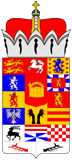
1692–1810, mittleres Wappen,
Kurfürstentum Braunschweig-Lüneburg,
Quelle, nach: Wikipedia (D)
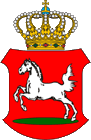
1814–1866, kleines Wappen,
Königreich Hannover,
Quelle, nach: Königreich Hannover
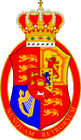
1814–1866, mittleres Wappen,
Königreich Hannover,
Quelle, nach: Wikipedia (D)
Ein wichtiges Symbol der (Nieder-)Sachsen und auch der Welfen ist das "Sachsenross", ein weißes Pferd auf rotem Grund. Es galt von alters her als das Zeichen des Herzogs Widukind, der im 8. Jahrhundert Sachsen gegen die Franken verteidigte. Im Kampf gegen die Franken wurde das "Sachsenross" schnell zum legendären Symbol aller Sachsen. Dieses Zeichen wurde von den Welfen im Jahr 1361 in ihre Heraldik aufgenommen.
So wurde es ab 1814 – auf dem kleinen Wappen – zum Wappentier des Königreichs Hannover (ab 1866 preußische Provinz Hannover), ab 1815 der preußischen Provinz Westfalen und ab 1922 des Landes Braunschweig. In der BRD wird diese Tradition fortgesetzt, in dem jene Bundesländer der BRD, zu denen ehemals welfische Gebiete gehören, noch heute das weiße Pferd im Wappen haben: Niedersachsen und Nordrhein-Westfalen.
Auf alten Wappendarstellungen (mindestens bis 1945) trägt das Sachsenross den Schweif immer nach oben gerichtet. Mit der Neugründung des Staates Hannover wurde nach dem Zweiten Weltkrieg mit dieser Tradition gebrochen, denn das Sachsenross trug auf dessen Flagge einen eher herabhängenden Schweif. Das wurde für das Land Niedersachsen – dem Nachfolger des Staates Hannover – beibehalten. Daher wird das Sachsenross in Westfalen, wo es den Schweif noch immer noch oben gerichtet trägt, als "Westfalenpferd" bezeichnet, im Gegensatz zum "Niedersachsenpferd".
Der Schild des Wappens des Kurfüstentums war sehr reich gegliedert und zeigte viele Felder, die Heroldsstücke der Familienlinien oder territoriale Erwerbungen widerspiegelten. Der rote Herzschild zeigt die deutsche Kaiserkrone und symbolisiert die Kurwürde.
Feld 1 zeigt die welfischen Löwen, Feld 2 das Sachsenross, Feld 3 Lüneburg, Feld 4 Everstein, Feld 5 und 8 bedeckt der rote Herzschild, Feld 6 Homburg, Feld 10 (Bärentatzen) Hoya, Feld 11 Lutterberg und Schwarzfeld, Feld 12 (Hirsch) Klettenberg, Feld 13 Grimmenberg, Feld 14 (rot-weiß geschacht) Hohnstein, Feld 15 Regenstein und Feld 16 Blankenburg.
Der Schild des Wappens des Königreichs zeigt die Heraldik Großbritanniens: die Löwen von England, den Löwen von Schottland und die Harfe von Irland. In der Mitte ein Herzschild. Er zeigt die Abkunft der Dynastie aus der kurbraunschweigischen Linie des Herzogtums Braunschweig-Lüneburg.
Quelle: Ronald Preuß, Volker Preuß, Deutsche Staatenkunde - Band 2,
www.niedersachsen.de
Lesen Sie hier:
Hintergründe, Geschichte und Fakten zum Thema "Der Löwe in der Heraldik". Ausführungen, Varianten, Entwicklung, sowie Panther und Leoparden.


bis 1803, 1813-1815,
Kokarde von Hannover,
Quelle: Jürgen Kaltschmitt → "The Hanoverian Army of the Napoleonic Wars", Band 206, Reihe "Men-at-Arms", Osprey-Verlag

ab 1815,
Kokarde von Hannover,
Quelle: Jürgen Kaltschmitt → H.u.R.Knötel/H.Sieg, "Farbiges Handbuch der Uniformkunde", Seite 100

ab 1832,
Kokarde von Hannover,
Quelle: Jürgen Kaltschmitt → koenigreich-hannover.de

1837–1866,
Kokarde von Hannover,
Quelle: Jürgen Kaltschmitt → wikipedia.org
Zur Kokarde von Hannover gibt es sehr unterschiedliche Angaben. Sicher ist, dass, als das Land noch Kurfürstentum Braunschweig-Lüneburg hieß, bis 1803 schwarze Kokarden verwendet wurden, wie auch in Großbritannien, mit dem das Land seit 1714 in Personalunion verbunden war. Exil-Soldaten, die wegen Napoléon das Land verlassen hatten, trugen weiterhin schwarze Kokarden. 1810 schaffte Napoléon das Kurfürstentum Braunschweig-Lüneburg einfach ab. Nach der Niederlage Napoléons bei Leipzig (1813) wurde das Land wieder hergestellt, und 1814 in Königreich Hannover umbenannt. Nach den Befreiungskriegen wurden Kokarden mit den Farben Schwarz, Weiß und Gelb eingeführt, nur ist die Anordnung teilweise umstritten und die Quellen lassen unterschiedliche Ergebnisse zu. Die Farben Gelb und Weiß waren die Farben der Welfen-Linie Calenberg-Göttingen-Grubenhagen, seit 1665 bestand und das Land regierte. Immerhin ist schwarz als britische Kokardenfarbe zur Ergänzung denkbar, nach 1837 - Ende der Personalunion mit Großbritannien - könnte es als schmale Trennlinie zwischen beiden Farben Gelb und Weiß übrig geblieben sein.
Quelle: Jürgen Kaltschmitt, Volker Preuß
Lesen Sie hier:
Hintergründe, Geschichte und Fakten zum Thema "Kokarden".

Kokarde
Die Aufspaltung der Welfen in verschiedene Linien führte zwar ab 1269 zur Teilung des Landes in verschiedene Fürstentümer, jedoch blieb das Herzogtum als Ganzes bis 1810 erhalten. Jeder der Fürsten, z.b. der Fürst von Grubenhagen, war zugleich Herzog von Braunschweig-Lüneburg. In den Jahren 1814/1815 wurde auf dem Wiener Kongress die Neuordnung Europas nach der Ära Napoléon beschlossen. Das Fürstentum Braunschweig-Wolfenbüttel wird unter Herzog Friedrich Wilhelm als Herzogtum Braunschweig wieder hergestellt und besteht bis 1918. Die Linie der Welfen von Braunschweig-Wolfenbüttel stirbt im Jahre 1884 aus.
Andere Linien des Herzogtums waren ab 1291 ebenfalls territorial souverän: die Fürstentümer Calenberg, Göttingen, Grubenhagen und Lüneburg (ab 1261). Das Fürstentum Grubenhagen wurde 1617 an Lüneburg vererbt, Calenberg und Göttingen vereinigten sich 1495 zum Fürstentum Calenberg-Göttingen, und dieses Fürstentum wurde 1692 zum Kurfürstentum Braunschweig-Lüneburg erhoben. Das Fürstentum Lüneburg ging 1705 an das Kurfürstentum. Das Kurfürstentum, und damit das Herzogtum Braunschweig-Lüneburg, endete 1810 vorübergehend als es dem Königreich Westphalen angeschlossen wurde. Auf dem Wiener Kongress wurde das Kurfürstentum wieder hergestellt und zum Königreich Hannover erhoben, das aber 1866 endete als es als Provinz dem Königreich Preußen eingegliedert wurde. Die Welfen der Linie Braunschweig-Lüneburg besteigen im Jahre 1913 den Thron des Herzogtums Braunschweig, und regieren bis 1918.
Quelle, nach: Wikipedia (D),
Volker Preuß
Die preußischen Provinzen 1871 bis 1920:
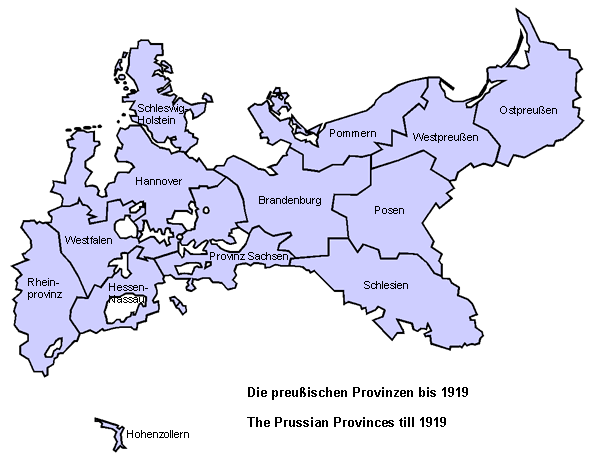
Quelle/Source: Volker Preuß
Fläche: 38.788 km²
Einwohner: 2.000.000 (geschätzt) (1866)
Hauptstadt: Hannover
Währung bis 1858: 1 Taler = 24 Groschen = 288 Pfennige
Währung 1858–1866: 1 Taler = 30 Groschen = 300 Pfennige
Quelle/Source:
Der Michel,
Volker Preuß
1142 · Heinrich der Löwe aus dem Haus der Welfen erhält Braunschweig und das Herzogtum Sachsen zum Lehen
1154 · Heinrich der Löwe wird Herzog von Bayern
1180 · im Konflikt mit dem Staufischen Kaiser wird über Heinrich die Reichsacht verhängt, in den folgenden Kämpfen unterliegt Heinrich und verliert alle Besitzungen (auch Bayern), außer Braunschweig und Lüneburg und einige sehr kleine Gebiete
1235 · Otto das Kind überträgt all seinen Besitz zurück an den Kaiser, diese werden als Herzogtum Braunschweig zusammengefasst und Heinrich, als Herzog von Braunschweig, wieder übertragen
1269 · das Herzogtum Braunschweig wird in das Fürstentum Braunschweig und das Fürstentum Lüneburg aufgeteilt, bleibt jedoch formell als Herzogtum Braunschweig-Lüneburg bestehen
1291 · in Folge weiterer Teilungen entstehen unter anderem das Fürstentum Calenberg-Göttingen und das Fürstentum Braunschweig-Wolfenbüttel, die braunschweigischen Fürstentümer (außer Braunschweig-Wolfenbüttel) werden in den Folgejahren vereinigt, und bilden ab 1692 das Kurfürstentum Braunschweig-Lüneburg (auch: Kurfürstentum Hannover)
1705 · das Fürstentum Lüneburg kommt an das Kurfürstentum Braunschweig-Lüneburg
1714–1837 · Personalunion mit Großbritannien, der Kurfürst von Hannover ist gleichzeitig König von Großbritannien
1792, 1796, 1800 und 1805 · Invasionen französischer Revolutionstruppen unter Napoléon in das Deutsche Reich, das Deutsche Reich unterliegt und wird von Napoléon territorial umgestaltet: geistliche Besitzungen werden enteignet, alte Fürstenterritorien aufgehoben und alten oder neuen Fürstentümern übertragen
01.08.1806 · das Heilige Römische Reich Deutscher Nation endet
18.08.1807 · Napoléon gründet nach dem Frieden von Tilsit das Königreich Westphalen, und überträgt es seinem Bruder Jérôme. Dazu wurden folgende deutsche Staaten abgeschafft, voll oder teilweise territorial enteignet: Kurfürstentum Hessen (Hessen-Kassel), Fürstentum Braunschweig-Wolfenbüttel, Teile von Braunschweig-Lüneburg (Kurbraunschweig), Teile von Preußen, Teile von Sachsen
1810 · das Königreich Westphalen annektiert das Kurfürstentum Braunschweig-Lüneburg, das alte Herzogtum Braunschweig endet
Oktober 1813 · Niederlage Napoléons bei Leipzig (Völkerschlacht 16.–18.10.1813)
06.11.1813 · das Kurfürstentum Braunschweig-Lüneburg wird wieder hergestellt
1814–1815 · Wiener Kongress, Neuordnung Europas nach der Ära Napoléon
12.10.1814 · das Kurfürstentum Braunschweig-Lüneburg wird zum Königreich Hannover unter König Georg III. erhoben, Hannover muss das Herzogtum Lauenburg abtreten, wird aber um die Territorien Emsland und Ostfriesland erweitert und tritt dem Deutschen Bund bei
1837 · Tod von König Wilhelm IV., seine Nichte Victoria wird Königin von Großbritannien, sein Bruder Ernst August (der Vater von Victoria), wird König von Hannover die Personalunion mit Großbritannien endet
1866 · Niederlage Österreichs und seiner Verbündeten (darunter Hannover) im Bruderkrieg gegen Preußen, Sturz der Welfen-Dynastie, Hannover wird preußische Provinz
28.11.1913 · Bundesratsbeschluss: die Thronfolge in Braunschweig geht an Ernst August von Hannover, bis zum Sturz der Monarchie am 08.11.1918
01.10.1932 · der Kreis Grafschaft Schaumburg wird von der Provinz Hessen-Nassau abgetrennt und in die Provinz Hannover eingegliedert
23.08.1946 · nach dem Zweiten Weltkrieg Neugründung als Freistaat
01.11.1946 · im Land Niedersachsen aufgegangen
Quelle/Source:
Atlas zur Geschichte,
Wikipedia (D),
Wikipedia (D),
Wikipedia (D),
Königreich Hannover
Der Name "Hannover" besagt, dass die Ursiedlung "Honovere" am 'Hohen Ufer' des Flusses Leine entstanden ist.
Quelle/Source: Handbuch der geographischen Namen




Mit freundlicher Untersützung von: A. Kortmann (D) und
Königreich Hannover