mobile Ansicht, to the English Version tap the flag

- Nordrhein-Westfalen (NRW)
- 1946 gegründet
- seit 1949 Bundesland der BRD
• Flaggen
• Bedeutung/Ursprung der Flagge
• Wappen
• Bedeutung/Ursprung des Wappens
• Landkarte
• Zahlen und Fakten
• Geschichte
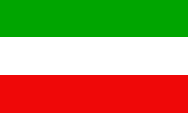
Landesflagge,
Seitenverhältnis = 3:5


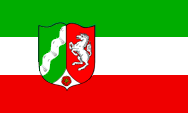
Landesdienstflagge,
Seitenverhältnis = 3:5


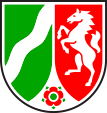
Flagge und Wappen von Nordrhein-Westfalen wurden im Jahre 1948 eingeführt und 1953 per Gesetz bestätigt. Die Flagge stellt eine Kombination aus den Farben der preußischen Provinzen Rheinland (grün-weiß) und Westfalen (weiß-rot) dar. Das Wappen zeigt die heraldischen Symbole für die Landesteile Rheinland (weiße Wellenlinie auf grünem Grund), Westfalen (weißes Pferd auf rotem Grund) und Lippe-Detmold (rote Rose auf weißem Grund). In den 1920-er Jahren verwendeten bereits die rheinischen Separatisten die gleiche Flagge (ohne Wappen!).
Quelle:
Die Welt der Flaggen,
Volker Preuß
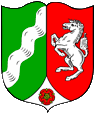
Wappen von Nordrhein-Westfalen,
Quelle, nach: Corel Draw 4
seit 2007,
vereinfachtes Wappen,
Quelle, nach: www.land.nrw
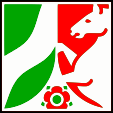
seit 2009,
Nordrhein-Westfalen-Zeichen,
Quelle, nach: www.land.nrw
Das Wappen von Nordrhein-Westfalen wurde im Jahre 1948 eingeführt und 1953 per Gesetz bestätigt. Das Wappen zeigt die heraldischen Symbole für die Landesteile Rheinland (weiße Wellenlinie auf grünem Grund), Westfalen (weißes Pferd auf rotem Grund) und Lippe-Detmold (rote Rose auf weißem Grund). Das weiße Pferd im Wappen ist das "Westfalenpferd". Es geht als "Sachsenross" auf das Stammesherzogtum Sachsen zurück, und wurde von den Welfen übernommen, deren Symbol eigentlich ein goldener Löwe auf rotem Grund war. So wurde es zum Wappentier des Königreichs Hannover (ab 1866 preußische Provinz Hannover), der preußischen Provinz Westfalen und ab 1922 des Landes Braunschweig. In der BRD wird diese Tradition fortgesetzt, in dem jene Bundesländer der BRD, zu denen ehemals welfische Gebiete gehören, noch heute das weiße Pferd im Wappen haben: Niedersachsen und Nordrhein-Westfalen.
Quelle:
Die Welt der Flaggen,
Volker Preuß
"Das Wappen des Landes Nordrhein-Westfalen besteht aus Rhein, Ross und Rose und ist in den Farben Grün, Weiß und Rot gehalten. Neben dem Landeswappen gibt es auch ein so genanntes Nordrhein-Westfalen-Zeichen. Im Gegensatz zu den amtlichen Wappen kann dieses von Jedermann verwendet werden. " ¹
Quelle: ¹ www.land.nrw
Die BRD und ihre Länder, interaktive Karte:
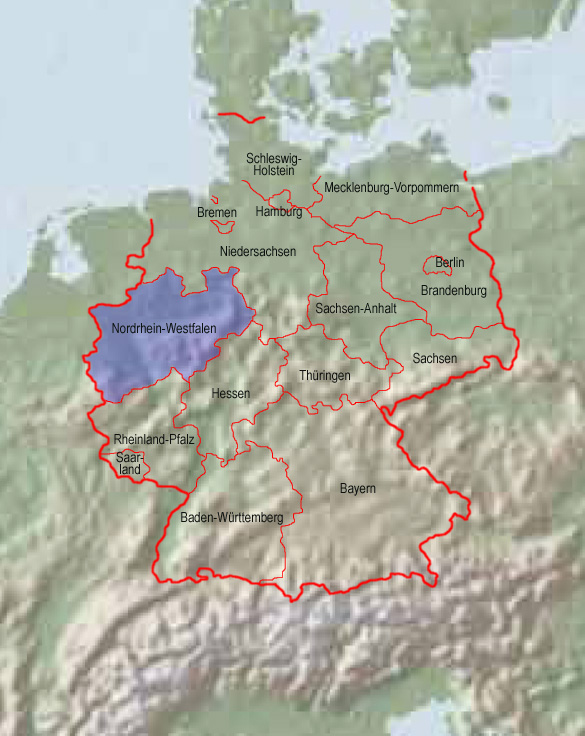
Quelle: Freeware, University of Texas Libraries, modyfied by: Volker Preuß
Fläche: 34.088 km²
Einwohner: 17.849.000 (2012)
Bevölkerungsdichte: 524 Ew./km²
Hauptstadt: Düsseldorf, 592.000 Ew.
Quelle: Wikipedia (D)
Das Land Nordrhein-Westfalen wurde am 01.08.1946 auf Beschluss der Alliierten aus der preußischen Provinz Westfalen, dem Norden der preußischen Rheinprovinz und dem Land Lippe-Detmold gebildet.
Quelle:
Wikipedia (D)




Mit freundlicher Untersützung von: A. Kortmann (D)