mobile Ansicht, to the English Version tap the flag


- Reuß jüngere Linie (Reuß-Gera)
- ab 1848 souveränes Fürstentum
- 1871–1919 Land des Deutschen Reiches
- 1919 Vereinigung mit Reuß-Greiz
- 1920 in Thüringen aufgegangen
• Flaggen
• Bedeutung/Ursprung der Flagge
• Wappen
• Bedeutung/Ursprung des Wappens
• Die Kokarde
• Landkarte
• Zahlen und Fakten
• Geschichte
• Ursprung des Landesnamens

ca. 1820 bis 1919,
Landesfarben,
Seitenverhältnis = 3:5,
Quelle, nach: Jens Hild


bis 1918,
Flagge des Fürsten,
Quelle, nach: Deutsche Wappen Rolle


Die Landesfarben aller Linien von Reuß war die Farbkombination aus Schwarz, Rot und Gold, die auf Kokarden, und, wenn überhaupt, in normalerweise waagerechter Anordnung auf Flaggen geführt wurden. Eine senkrechte Anordnung – vor allem für die Fürstentümer von Reuß jüngerer Linie – gab es nicht, auch wenn einige Quellen das vereinzelt so anführen.Die Landesfarben aller Linien von Reuß war die Farbkombination aus Schwarz, Rot und Gold, die auf Kokarden, und, wenn überhaupt, in normalerweise waagerechter Anordnung auf Flaggen geführt wurden. Eine senkrechte Anordnung – vor allem für die Fürstentümer von Reuß jüngerer Linie – gab es nicht, auch wenn einige Quellen das vereinzelt so anführen.
Die Farben Schwarz, Rot und Gold gleichen den Farben der deutschen Trikolore des Revolutionsjahres 1848. Die Ursache dafür liegt darin, dass die Farben Schwarz-Rot-Gold in den Reußischen Landen älter sind als 1848.
Die Fürsten Reuß des 18./19. Jahrhunderts waren im Mittelalter die Vögte von Weida, denen 13. Jahrhundert die Reußischen Lande als reichsunmittelbare Gebiete vom Kaiser zur Verwaltung übergeben wurden. Das Bild des Wappens geht auf den Pfalzgrafen Rudolf bei Rhein und Herzog von Bayern zurück, der es 1294 in einem Brief offziell bestätigte, wenn man so will als Kopie des Wappens der Pfalz: goldener Löwe mit roter Bewehrung und Krone (ab 1240) auf schwarzem Grund. So ist es nicht verwunderlich, dass später als Farben an Kokarden die Gold und Schwarz verwendet wurden. Schwarz Rot und Gold wurden erstmals 1814 an Ordensbändern verwendet, ab 1820 auch an Urkunden und Siegelschnüren.
Der Fürst hatte keine besondere Flagge. Er verwendete die schwarz-rot-goldene Landesflagge.
Die Landesfarben der deutschen Länder (oft aus den Farben des Wappens abgeleitet und in Form von Kokarden, aber auch Flaggen verwendet), bildeten sich – vor allem bei den deutschen Binnenländern – erst recht spät heraus, oft in Folge der französischen Revolution und den folgenden Befreiungskriegen. In dem Zeitraum von ca. 1815 bis ca. 1830 war dieser Prozess dann in allen deutschen Ländern abgeschlossen.
Die Landesfarben der thüringischen Kleinstaaten bestanden nach der Abdankung der Fürsten weiter, auch nach der Bildung des Landes Thüringen (01.05.1920), nur wurden sie zu Gebietsflaggen. Am 25.04.1922 wurde die "Verordnung über die Beflaggung der staatlichen Dienstgebäude" erlassen, die festlegte, dass die bisherigen Gebietsflaggen nicht mehr zu verwenden sind. Erst die Abschaffung der Gebiete am 01.04.1923 bedeutete das Ende für die Landesfarben der ehemaligen Thüringischen Staaten.
Quelle: Volker Preuß,
Jens Hild, Hartmut Grimm,
Deutsche Wappen Rolle
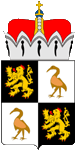
Wappenschild der Reußischen Fürstentümer,
Quelle, nach: Deutsche Wappen Rolle
Die Herren des Hauses Reuß, im 12. Jahrhundert aus Thüringen kommend, begannen im heutigen Vogtland ihre Herrschaft auszubauen, als Vögte von Weida, die im Auftrag des Kaisers Verwaltungsaufgaben übernahmen. Im 14. Jahrhundert wurden sie in einen fürstengleichen Rang erhoben und wurden im 17. Jahrhundert reichsunmittelbare Grafen. Die Familie spaltete sich in viele Linien auf, die ab dem Ende des 18. Jahrhunderts nach und nach fast alle zu Fürsten erhoben wurden. Alle Linien des Hauses verwendeten immer das gleiche Wappen, die letzte verbliebene Linie – Reuß-Köstritz – bis heute. Das Bild des Wappens geht auf den Pfalzgrafen Rudolf bei Rhein und Herzog von Bayern zurück, der es 1294 in einem Brief offziell bestätigte, wenn man so will als Kopie des Wappens der Pfalz: goldener Löwe mit roter Bewehrung und Krone (ab 1240) auf schwarzem Grund.
Nach der Erwerbung der Herrschaft Kranichfeld wurde der schwarze Schild im Geviert mit der Heraldik von Kranichfeld kombiniert. Kranichfeld ist 1454 durch Kauf von den Burggrafen von Kirchberg an Reuß gekommen. Um Schulden abzutragen wurde die Herrschaft im Jahre 1615 für 80 000 Meißnische Gulden an Sachsen Weimar verpfändet. Sie ist nie wieder eingelöst, sondern im Jahre 1686 erblich an Sachsen Gotha verkauft worden. Dabei behielten sich aber die Reußen das Recht vor, den Titel "Herren von Kranichfeld" und den Kranich im Wappen zu tragen (Quelle: Dr. Berthold Schmidt, "Geschichte des Reußenlandes" 1927). Das viergeteilte Wappen tragen die reußischen Nachkommen noch heute.
Quelle: Volker Preuß, Hartmut Grimm,
Deutsche Wappen Rolle
Lesen Sie hier:
Hintergründe, Geschichte und Fakten zum Thema "Der Löwe in der Heraldik". Ausführungen, Varianten, Entwicklung, sowie Panther und Leoparden.


bis 1919,
Kokarde von Reuß jüngere Linie
Lesen Sie hier:
Hintergründe, Geschichte und Fakten zum Thema "Kokarden".

Kokarde
Die Thüringischen Staaten:
Quelle:
Volker Preuß
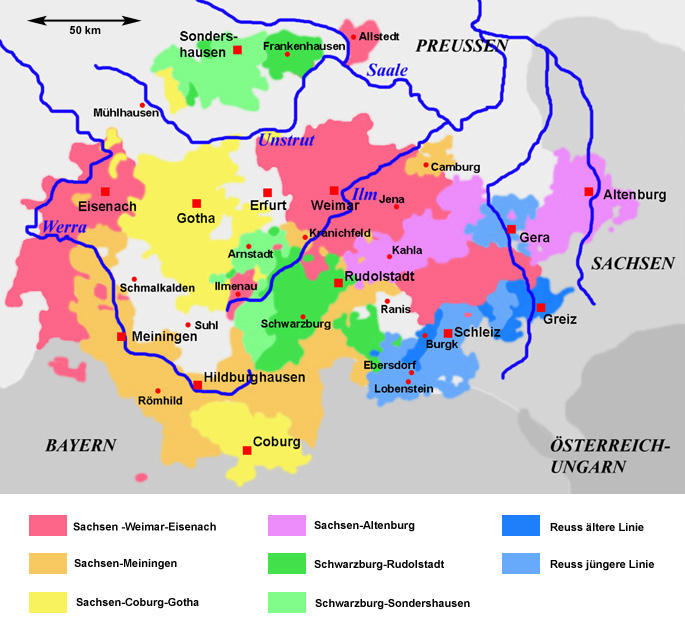
Die Landkarte zeigt das Fürstentum Reuß jüngere Linie (Reuß-Gera) zwischen 1867 und 1918 in Hellblau.
Fläche: 827 km²
Einwohner: 139.200 (1910)
Bevölkerungsdichte: 168 Ew./km²
Hauptstadt: Gera
Währung bis 1875: 1 Taler = 30 Groschen = 360 Pfennige
Währung 1875–1919: 1 Mark = 100 Pfennig
Quelle: Wikipedia (D),
Der Michel
ca. 100 v.Chr. · im heutigen Vogtland siedelt der germanische Stamm der Hermunduren
9 v.Chr.–9 n.Chr. · das heutige Vogtland gehört zum Römischen Reich
ca. 400 n.Chr. · der germanische Stamm der Thüringer siedelt sich an, Herausbildung des Thüringerreiches
531 · das Thüringerreich wird von den Franken erobert, die Gebiete nördlich des Flusses Unstrut kommen an das Reich der Sachsen, westlich des Flusses Saale dringt der slawische Stamm der Sorben ein
936 · der deutsche König Otto I. beginnt die Ostexpansion gegen die Slawen
937 · Feldzug gegen die Sorben, Gründung der Markgrafschaft Zeitz unter Markgraf Gero
999 · der deutsche König Otto III. verleiht die Region um Gera dem Kloster Quedlinburg, die Verwaltung wurde als Vogtei Gera den Herren von Weida übertragen
1165–1190 · die Herren von Weida erwerben die Vogteien von Gera, Greiz, Hof und Plauen (für die gesamte Region entsteht der Name 'Vogtland')
ca. 1244 · Teilung der Vogtei in die drei Linien Weida, Plauen und Gera
Die Linie Weida umfasste zunächst Weida, Greiz, Ronneburg, Werde, das Regnitzland, Hof und Hirschberg. Im Jahre 1373 wurden Hof und das Regnitzland an die Burggrafen von Nürnberg verkauft, im Jahre 1427 Weida an das Kurfürstentum Sachsen. Im Jahre 1454 wurde Wildenfels erworben, und der Name der Linie wird zu 'Vögte von Weida und Wildenfels', den sie bis zu ihrem Aussterben im Jahre 1535 behielten.
Die Linie Gera umfasste zunächst Gera, Lobenstein, Schleiz, Saalburg und Reichenfels. Jedoch musste in den Jahren 1371 bis 1374 fremde (z.B. böhmische) Lehnsherrschaft über Lobenstein, Schleiz, Saalburg und Reichenfels hingenommen werden. Im Jahre 1450 wurde Gera belagert, erobert und zerstört. Zwischen 1451 und 1538 gab es vorübergehend mehrere Erbteilungen. Nach der Schlacht bei Mühlberg im Jahre 1547 mussten Lobenstein, Schleiz, Saalburg und Reichenfels von Böhmen zum Lehen genommen werden, und Gera musste an Heinrich von Plauen, den Burggrafen zu Meißen, abgetreten werden. Im Jahre 1550 erlosch die Linie der 'Vögte von Gera', Heinrich von Plauen trat die Erbschaft an.
Die Linie Plauen umfasste zunächst Plauen und Vogtsberg. Der Begründer der Linie, Heinrich, der 'Vogt von Plauen', hatte zwei Söhne, die Linie spaltete sich, mit dem älteren Sohn, in die ältere Line 'Plauen', und mit dem jüngeren Sohn, in die jüngere Linie 'Reuß von Plauen'. Bis 1572 war die ältere Line vom Kaiser mit der Burggrafschaft Meißen belehnt. Im Jahre 1550 erlosch die Linie der 'Vögte von Gera', und die ältere Linie Plauen trat das Erbe an. 1572 starb auch die ältere Line Plauen aus, und die jüngere Linie 'Reuß von Plauen' trat das Erbe an. Die jüngere Linie 'Reuß von Plauen' begründete Heinrich der Reuße. Er war der erste der Vögte der den Namen 'Reuß' trug. Im Jahre 1325 wurden Reichenbach und Mylau vom Kaiser an die Linie Plauen als Lehen gegeben. 1451 wurden Ober- und Niederkranichfeld erworben.
1564 spaltete sich die Linie 'Reuß' in drei Linien auf: 1.) die ältere Linie 'Reuß von Plauen auf Untergreiz' (Reuß ältere Linie). Sie starb 1927 aus. 2.) die mittlere Linie 'Reuß von Plauen auf Obergreiz'. Sie erlosch bereits 1616. 3.) die jüngere Linie 'Reuß von Plauen zu Gera'. Sie teilte sich 1647 in die Linien Reuß-Gera (ab 1673 Grafen, 1802 ausgestorben, das Erbe ging 1848 an Reuß-Schleiz), Reuß-Saalburg (1666 ausgestorben, das Erbe ging an Reuß-Gera), Reuß-Schleiz (ab 1673 Grafen, ab 1806 Fürsten) und Reuß-Lobenstein (ab 1673 Grafen, ab 1790 Fürsten, 1824 ausgestorben, das Erbe ging an Reuß-Ebersdorf). Im Jahre 1678 teilte sich die Linie Reuß-Lobenstein in die Linien Reuß-Lobenstein, Reuß-Ebersdorf (ab 1790 Fürsten, 1848 abgedankt) und Reuß-Hirschberg (1711 ausgestorben, das Erbe ging an Reuß-Lobenstein). Um die vielen Erbteilungen zu verhindern, wurde im Jahre 1690 die Primogenitur eingeführt. Das heißt, dass das gesamte Erbe an den erstgeborenen Sohn geht. Nach 1690 entstanden zwei weitere, nicht erbberechtigte Linien, die mit einem Paragium abgefunden wurden: Sie erhielten Grundbesitz, wurden jedoch nicht souverän. Das war die Linie Reuß-Köstritz (ab 1692), die 1855 in den Fürstenstand erhoben wurde, und die Linie Reuß-Selbitz (1718–1824).
1792, 1796, 1800 und 1805 · Invasionen französischer Revolutionstruppen unter Napoléon in das Deutsche Reich, das Deutsche Reich unterliegt und wird von Napoléon territorial umgestaltet
1802 · die Linie Reuß-Gera stirbt aus, das Fürstentum Reuß-Gera wird von den verbleibenden Linien Reuß-Lobenstein, Reuß-Ebersdorf und Reuß-Schleiz als Kondominat verwaltet
1803 · Reichsdeputationshauptschluss, Umgestaltung der territorialen Gliederung des Deutschen Reiches, geistliche Besitzungen werden enteignet, alte Fürstenterritorien und freie Städte werden enteignet oder aufgehoben und alten oder neuen Fürstentümern übertragen, die Zahl der Gebietskörperschaften des Reiches wird dadurch von 300 auf 60 reduziert
12.07.1806 · Napoléon erzwingt die Gründung des Rheinbundes, ein Zusammenschluss von sechzehn süd- und südwestdeutschen Staaten unter französischem Protektorat
01.08.1806 · die Staaten des Rheinbunds treten aus dem Heiligen Römischen Reich Deutscher Nation aus
06.08.1806 · Kaiser Franz II. legt die Krone des Heiligen Römischen Reiches Deutscher Nation nieder, das Reich endet
18.04.1807 · die Fürstentümer Reuß jüngere Linie (Reuß-Schleiz, Reuß-Lobenstein und Reuß-Ebersdorf) treten dem Rheinbund bei
Oktober 1813 · Niederlage Napoléons bei Leipzig, der Rheinbund beginnt zu zerfallen, Napoléon und seine Truppen ziehen sich hinter den Rhein zurück
1814–1815 · Wiener Kongress, Neuordnung Europas nach der Ära Napoléon, die Besitzverhältnisse und die Raumordnung im ehemaligen Deutschen Reich werden wieder hergestellt, jedoch nicht die Souveränität der geistlichen Länder, deren Besitzungen werden alten oder neuen Fürstentümern übertragen oder angeschlossen, die 39 verbleibenden deutschen Staaten – so auch die Fürstentümer Reuß jüngerer Linie – werden in einem lockeren Zusammenschluss, dem Deutschen Bund organisiert
1824 · die Linie Reuß-Lobenstein stirbt aus, das Erbe geht an Reuß-Ebersdorf, die Fürstentümer Reuß-Ebersdorf und Reuß-Lobenstein werden zum Fürstentum Reuß-Lobenstein und Ebersdorf vereinigt
01.10.1848 · Fürst Heinrich LXXII. von Lobenstein-Ebersdorf dankt zugunsten der Linie Reuß-Schleiz ab, die Linie Reuß-Schleiz ist somit als letzte souveräne jüngere Linie übrig geblieben und nennt sich von jetzt ab 'Reuß jüngere Linie', die Territorien von Reuß-Lobenstein-Ebersdorf, Reuß-Schleiz und des Kondominats Reuß-Gera werden im Fürstentum Reuß jüngere Linie vereinigt
1849 · Annahme einer Verfassung
1866 · Deutscher Krieg (Bruderkrieg) Preußens und seiner Verbündeten gegen Österreich und seine Verbündeten, Preußen siegt, das Fürstentum Reuß jüngere Linie steht auf der Seite Preußens
28.06.1866 · Reuß jüngere Linie tritt dem Norddeutschen Bund bei
1871 · Beitritt des Fürstentums Reuß jüngere Linie zum Deutschen Reich
1902 · Tod von Heinrich XXII. von Reuss-Greiz (Reuß ältere Linie), sein Sohn wird entmündigt, und Reuß jüngere Linie übernimmt die Vormundschaft über Reuß ältere Linie, beide Reußischen Lande werden in Personalunion regiert
1918 · Sturz der Monarchie, Umbenennung in Volksstaat Reuß-Gera, Schaffung einer gemeinsamen Verwaltung für beide Reußische Staaten
1919 · Vereinigung der beiden Reußischen Lande zum Volksstaat Reuß
01.05.1920 · im Land Thüringen aufgegangen
1945 · das Haus Reuß jüngere Linie stirbt aus, als letzte Linie des Hauses Reuß existiert bis heute die Line Reuß-Köstritz, die sich ab 1927 (Aussterben von Reuß ältere Linie) nur noch 'Reuß zu Köstritz' nennt
Quelle: Wikipedia (D),
RetroBib Retrobibliothek,
Atlas zur Geschichte,
HGISG Geoinform
1.) Der Name Reuß geht auf Heinrich II., einen der Vögte von Plauen zurück. Für seinen Mut und seine Einsatzbereitschaft im Kampf gegen die Polen, hat man ihm 1247 den Beinamen "der Reuße" gegeben. Man bezeichnete damals die Polen manchmal als Reußen, obwohl das eigentlich die Bezeichnung für die Russen ist.
2.) Nach anderen Quellen war Heinrich II. mit einer Russin verheiratet und hat ihm daher den Beinamen "der Reuße" gegeben.
3.) Der ab 1918 für das Land "Reuss jüngere Linie" verwendete Name "Reuß-Gera", ist etwas unglücklich gewählt. Sicherlich sollte die größte Stadt des Landes damit gewürdigt werden. Jedoch entsteht der Eindruck, als würde es sich um das Land der Linie der Familie Reuß zu Gera (Reuß-Gera) handeln, die jedoch schon 1802 ausgestorben ist. In Wirklichkeit war Reuß-Schleiz die letzte der jüngeren Linien, die hier bis 1918 herrschte, und 1945 ausstarb.
Quelle: 1.) RetroBib Retrobibliothek,
2.) Wikipedia (D),
3.) Volker Preuß