mobile Ansicht, to the English Version tap the flag


• Flagge ?
• Wappen
• Bedeutung/Ursprung des Wappens
• Die Kokarde
• Zahlen und Fakten
• Geschichte
• Ursprung des Landesnamens
Die Farben des Hauses Wettin sind Blau und Gelb. Sie leiten sich höchstwahrscheinlich vom Wappen der Herrschaft Landsberg ab. Diese Farben wurden von den Angehörigen der Schweizer Garde am kursächsischen Hof getragen. Ebenso waren die Bänder einzelner Orden blau-gelb. Schwarz und Gelb waren jahrhundertelang die Hoffarben (Livreefarben) an den sächsischen Höfen (Albertiner und auch Ernestiner). Sie stammen entweder vom ursprünglichen Stammwappen (schwarzer Löwe in goldenem Feld, das später zum Wappen der Markgrafschaft Meißen wurde) oder vom Wappen des Herzogtums Sachsen (das Rautenkranzwappen) ab. Schwarz und Gelb wurden etwa seit dem 17. Jahrhundert für Urkundenschnüre und für viele militärische Feldzeichen. Landesfarben im eigentlichen Sinne waren sie jedoch noch nicht.
Das ehemalige Albertinische Kurfürstentum und neue Königreich Sachsen trat am 11.12.1806 dem Rheinbund bei, und am 15.12.1806 folgten die Ernestinischen Herzogtümer in Thüringen. Die Truppen der Herzogtümer wurden zusammengefasst und gemäß Konvention vom 13.02.1807 mit einheitlichen Kokarden in Schwarz-Gold ausgestattet. Die Kokarden des Königreichs Sachsen blieben weiß.
Als der sächsische König Friedrich-August I., aus dem Geschlecht der albertinischen Wettiner, im Mai 1815 nach dem Endes der Befreiungskriege gegen Napoleon aus der Gefangenschaft nach Sachsen heimkehrten wollte, wies er Generalleutnant von Lecoq am 22.05.1815 an, die am Rhein stehenden sächsischen Truppen zu reorganisieren und heimzuführen. Die dort noch immer weißen Kokarden an den Mützen der Soldaten waren gemäß der Anweisung des Königs mit einem breiten grünen Rand zu umgeben, um Verwechslungen mit anderen Truppen auszuschließen. Die Nachricht von der Schaffung der Farbkombination von Weiß und Grün verbreitete sich sehr schnell, und gelangte noch vor dem König nach Sachsen. Und so wurde er von seinem Volk mit weiß-grünen Girlanden, Fahnen und Bändern empfangen. In Würdigung dieser Tatsache erklärte der Monarch am 16.06.1815 die weiß-grüne Kokarde zur Nationalkokarde. Das war die Geburtsstunde von Weiß und Grün als Landesfarben von Sachsen. Die sächsischen Herzogtümer (Thüringen), regiert von den ernestinischen Wettinern, übernahmen zumeist diese Regelung für ihre Landesfarben und Flaggen.
Die Landesfarben der deutschen Länder (oft aus den Farben des Wappens abgeleitet und in Form von Kokarden, aber auch Flaggen verwendet), bildeten sich – vor allem bei den deutschen Binnenländern – erst recht spät heraus, oft in Folge der französischen Revolution und den folgenden Befreiungskriegen. In dem Zeitraum von ca. 1815 bis ca. 1830 war dieser Prozess dann in allen deutschen Ländern abgeschlossen. Ob diese Entwicklung in Sachsen-Coburg-Saalfeld auch noch stattgefunden hat, und ob sie bis zum Ende des Landes im Jahre 1826 zu einem Ziel kam, ist bis dato wenig erforscht und unbekannt.
Quelle: Volker Preuß,
www.sachsenlied.de,
Jens Hild

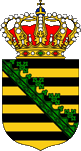
Kleines Wappen von Sachsen-Coburg-Saalfeld,
Quelle, nach: historische Abbildung
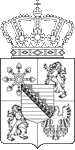
bis 18. Jhd.,
Schild des mittleren Wappens von Sachsen-Coburg-Saalfeld,
Quelle, nach: historische Abbildung
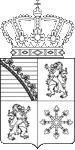
ab 18. Jhd.,
Schild des mittleren Wappens von Sachsen-Coburg-Saalfeld,
Quelle, nach: historische Abbildung
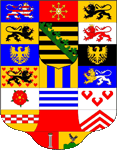
ab 18. Jhd.,
Schild des großen Wappens von Sachsen-Coburg-Saalfeld,
Quelle, nach: historische Abbildung
Das zentrale Element der Heraldik der sächsischen Monarchien ist der sächsische Wappenschild. Es wurde um 1180 geschaffen, als die Askanier, Markgrafen von Brandenburg und Grafen von Ballenstedt zu den Herzögen von Sachsen wurden: Über das schwarz-goldene Ballenstedter Wappen wurde ein grüner Rautenkranz gelegt. Der Titel des Herzogs von Sachsen wanderte mit der Belehnung an verschiedene adlige Familien (zuletzt 1423 die Wettiner) im Prinzip die Elbe aufwärts bis ins heutige Mitteldeutschland. Im Jahre 1485 erfolgte die "Leipziger Teilung" der wettinischen Lande zwischen den Brüdern Herzog Albrecht (Stammvater der Albertiner) und Kurfürst Ernst (Stammvater der Ernestiner). Die Ernestiner teilten sich in viele Linien, welche die sächsiche Heraldik beibehielten. Eine davon war Sachsen-Coburg-Saalfeld. Die Linie erlebte 1826 einen dynastischen Umbruch, der sich auch im Wappen manifestierte. Die Zeit vor 1826 war von der Heraldik her wenig festgelegt und und ist nicht so gut überliefert. Es gibt kaum farblich richtige Darstellungen, eher noch einfarbige Skizzen oder Wappendarstellungen auf Münzen, an denen man sich orientieren kann.
Zum Wappen: Das große Wappen (Schild, 6 Helme mit Helmkleinodien, Helmdecken) zeigte auf dem Wappenschild neben 18 Feldern das sächsische Rautenkranzwappen als Herzschild. Das mittlere Wappen (Schild mit den wichtigsten Feldern und Krone) ist in größerem Umfang nur auf Münzen überliefert. Die Elemente des Wappens dort sind nur stilisiert dargestellt. Die Methode Farben in einfarbig reproduzierten Wappen durch feine Schraffuren darzustellen kam zwar Anfang bis Mitte des 17. Jahrhunderts auf, jedoch waren die Prägungen der Münzen noch nicht so fein machbar, das man feine Schaffuren hätte darstellen können. Man muss den Löwen als Löwen nehmen, den Adler als Adler, ohne Färbung, ohne definierte Hintergrundfarbe, damit nicht wissend welcher Titel, Besitz oder Erbanspruch sich dahinter verbirgt. Vielleicht war das ja auch gewollt, weil man so mehrfache Belegungen der Wappenfigur interpretieren kann. Das Herzogtum Cleve (eigentlich goldenes Clevenrad auf Rot) ist zweifelsfrei erkennbar, ebenso der sächsische Schild, der manchmal in einem Feld des Wappens platziert war, manchmal als Herzschild mittig auf dem gevierteilten Wappen lag. Von der Praxis des Herzschilds auf dem mittleren Wappen scheint man im 18. Jahrhundert abgekommen zu sein. Das kleine Wappen (Schild mit Krone) zeigt nur das mehrfach schwarz-golden geteilte sächsische Rautenkranzwappen. Zu den Kronen in den Wappen scheint es keine Regelung gegeben zu haben, denn es erscheinen hier öfters Fürstenhüte oder -kronen und erst zu Beginn des 19. Jahrhunderts die Herzogskrone.
Quelle:
Volker Preuß,
Deutsche Wappen Rolle,
historische Abbildung,
www.thulex.de

bis 1807,
Kokarde von Sachsen-Coburg-Saalfeld,
Quelle, nach: Jens Hild

1807–1815(?),
Kokarde von Sachsen-Coburg-Saalfeld,
Quelle, nach: Jens Hild
Das ehemalige Albertinische Kurfürstentum und neue Königreich Sachsen trat am 11.12.1806 dem Rheinbund bei, und am 15.12.1806 folgten die Ernestinischen Herzogtümer in Thüringen. Die Truppen der Herzogtümer wurden zusammengefasst und gemäß Konvention vom 13.02.1807 mit einheitlichen Kokarden in Schwarz-Gold ausgestattet. Die Kokarden des Königreichs Sachsen blieben weiß. Als das Königreich Sachsen am 16.06.1815 die Farben Weiß und Grün zu Nationalfarben machte, folgten die sächsischen Herzogtümer in Thüringen, regiert von den ernestinischen Wettinern, zumeist diese Regelung für ihre Landesfarben, Flaggen und Kokarden. Die Anordnung von Weiß und Grün wurde dabei verschiendentlich variiert. Ob, wann und wie das für Sachsen-Coburg-Saalfeld umgesetzt wurde, ist leider nicht bekannt.
Quelle: Volker Preuß,
Jens Hild,
Deutsche Wappen Rolle
Lesen Sie hier:
Hintergründe, Geschichte und Fakten zum Thema "Kokarden".

Kokarde
Fläche: 1.498 km²
Einwohner: 80.000 (1816)
Hauptstadt: Coburg
Währung bis 1826: ?
Quelle: www.thulex.de
1264 · die Landgrafschaft Thüringen (damals wesentlich größer) wird nach einem Erbfolgekrieg geteilt, der Markgraf von Meißen aus dem Hause Wettin erhält den östlichen Teil, die Landgrafschaft Thüringen (fast das gesamte heutige Thüringen), der westliche Teil wird die Landgrafschaft Hessen
1342–1346 · das Haus Wettin kann sich gegen eine Koaliton lokaler thüringischer Grafen durchsetzen, die Grafen müssen ihr Land vom Markgrafen von Meißen und Landgrafen von Thüringen zum Lehen nehmen, nach deren Aussterben fielen diese Gebiete an Thüringen (außer Schwarzburg und Reuss)
1423 · der Meißner Markgraf Friedrich der Streitbare erhält Sachsen-Wittenberg (Kurfürstentum Sachsen) zum Lehen, danach allmähliche Übertragung der Bezeichnung "Sachsen" auf die Markgrafschaft Meißen
1485 · "Leipziger Teilung" der wettinischen Lande zwischen den Brüdern Herzog Albrecht (Stammvater der Albertiner) und Kurfürst Ernst (Stammvater der Ernestiner; Herzog Albrecht: Mark Meißen, westliches Osterland, Nordthüringen; Kurfürst Ernst: Kurfürstentum Sachsen, Südthüringen, Vogtland
1547 · "Wittenberger Kapitulation" die Kurwürde geht von den Ernestinern auf die Albertiner über
1640 · Ernestinische Teilung, Herzog Wilhelm IV. teilt das sein Herzogtum Sachsen-Weimar, in das Herzogtum Sachsen-Eisenach, unter seinem Bruder Albrecht, und das Herzogtum Sachsen-Gotha, unter unter seinem Bruder Ernst I. (dem Frommen)
1675 · Tod von Herzog Ernst I. dem Frommen von Sachsen-Gotha (Ernestiner), er hinterlässt sieben Söhne
1680 · Sachsen-Gotha wird unter den sieben Söhnen aufgeteilt, dabei etstehen folgende 7 Herzogtümer: Sachsen-Gotha-Altenburg unter Herzog Friedrich I., Sachsen-Coburg unter Herzog Albrecht, Sachsen-Meiningen unter Herzog Bernhard I., Sachsen-Römhild unter Herzog Heinrich, Sachsen-Eisenberg unter Herzog Christian, Sachsen-Hildburghausen unter Herzog Ernst, Sachsen-Saalfeld unter Herzog Johann Ernst
1699 · Tod von Herzog Albrecht von Sachsen-Coburg, er hinterlässt keine Erben, es folgen Erbstreitigkeiten zwischen Sachsen-Meiningen, Sachsen-Hildburghausen und Sachsen-Saalfeld
1735 · Sachsen-Coburg kommt zum größten Teil an Sachsen-Saalfeld, es entsteht die Linie Sachsen-Coburg-Saalfeld
1806 · Beitritt von Sachsen-Coburg-Saalfeld zum Rheinbund
1815 · Beitritt zum Deutschen Bund
1825 · Aussterben der Linie Sachsen-Gotha-Altenburg. Durch einen vom sächsischen König Friedrich August I. gefällten Schiedsspruch werden im Jahre 1826 die sächsischen Herzogtümer in Thüringen territorial neu geordnet: Die Linie Sachsen-Hildburghausen verzichtet auf ihr Land und übernimmt Sachsen-Altenburg. Sachsen-Coburg-Saalfeld verzichtet auf Saalfeld. Die Teilherzogtümer Hildburghausen und Saalfeld kommen zu Sachsen-Meiningen. Das Teilherzogtum Gotha kommt zu Sachsen-Coburg, so entsteht Sachsen-Coburg-Gotha.
Quelle:
Wikipedia (D),
RetroBib Retrobibliothek,
Atlas zur Geschichte
Der Ursprung des Namens "Sachsen" liegt im 5. Jahrhundert im alten Stammesherzogtum der Sachsen im heutigen Nordwestdeutschland. Das Land wurde 1180 durch den deutschen Kaiser zerschlagen, jedoch blieb der Titel des "Herzogs von Sachsen" erhalten, war mit Randgebieten des alten Herzogtums verbunden und wanderte mit der Belehnung an verschiedene adlige Familien im Prinzip die Elbe aufwärts bis ins heutige Sachsen (damals Markgrafschaft Meißen unter dem Haus Wettin) in Mitteldeutschland. Zur Unterscheidung vom eigentlichen Sachsen, dem Stammesherzogtum, wurde das Sachsen der Wettiner "Obersachsen" genannt. Das blieb so, bis sich für die alten sächsischen Gebiete der Begriff "Hannover" durchgesetzt hatte, die heute grob zu "Niedersachsen" zusammengefasst sind.
Der Name "Sachsen" übertrug sich 1485 mit der Teilung des wettinischen Sachsen in die Linien der Albertiner und Ernestiner auch auf die thüringischen Gebiete. Da die Herzöge dort die Promogenitur lange ablehnten, wurde die Herzogtümer vielfach zwischen allen Söhnen geteilt und es entstand ein dichtes Geflecht von von kleinen Teilherzogtümern (benannt nach der Hauptstadt des Herzogtums), die, oft miteinender verbunden, den verschiedenen Familienlinen dynastisch zugeteilt waren, oft vererbt, teilweise vererbt oder gar ausgetauscht wurden. Das schlug sich immer im Namen des jeweiligen Herzogtums nieder. So verzichtete z.B. Sachsen-Coburg-Saalfeld auf das Teilherzogtum Saalfeld und bekam das Teilherzogtum Gotha übertragen. So entstand das Herzogtum Sachsen-Coburg-Gotha, offziell aus den zwei Teilherzogtümern Coburg und Gotha bestehend.
Der Name Thüringen für die ganze Region hat sich trotzdem erhalten, er kommt vom alten Königreich der Thüringer, das jedoch schon im 6. Jahrhundert durch die Franken vernichtet und annektiert wurde. Im 7. Jahrhundert wurde das Herzogtum Thüringen gegründet, das wiederum nur ein Jahrhundert lang Bestand hatte. Ein Stammesherzogtum war das jedoch nicht, da es die Thüringer nicht mehr gab. Im Jahre 1131 wurde vom späteren Kaiser Lothar III. die Landgrafschaft Thüringen errichtet und dem Haus der Ludowinger übertragen, die jedoch schon 1247 ausstarben. Das Land wurde 1264 nach einem Erbfolgekrieg zwischen den Wettinern (als Landgrafschaft Thüringen) und dem Haus Brabant (als Landgrafschaft Hessen) aufgeteilt.
Quelle: Volker Preuß