mobile Ansicht, to the English Version tap the flag
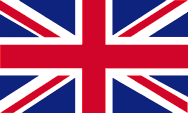

- Teil des Vereinigten Königreiches von Großbritannien und Nordirland
- mit eigener Gesetzgebung
- Eigenbezeichnung auf Walisisch: Cymru
• Flaggen
• historische Flaggen
• Bedeutung/Ursprung der Flagge
• Wappen
• Bedeutung/Ursprung des Wappens
• Landkarte
• Zahlen und Fakten
• Geschichte
• Ursprung des Landesnamens
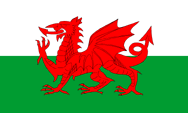
seit 1959,
Flagge von Wales
Seitenverhältnis = 3:5,
Quelle, nach:
Corel Draw 4


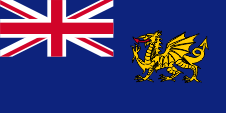
seit 2017,
Flagge für Regierungsschiffe
Seitenverhältnis = 1:2,
Quelle, nach:
Wikipedia (EN)

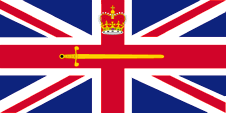
Flagge des Lord High Commissioner von Wales
Seitenverhältnis = 1:2,
Quelle, nach:
Flags of all Nations
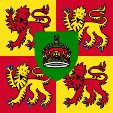
Flagge des Prinzen von Wales
Seitenverhältnis = 1:1,
Quelle, nach:
Flags of all Nations
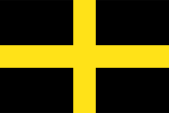
Flagge von St. David
(inoffizielle Nationalflagge)
Seitenverhältnis = 2:3,
Quelle, nach:
Wikipedia (EN)

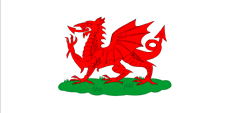
1907–1953,
Flagge von Wales
Seitenverhältnis = 1:2,
Quelle, nach:
World Statesmen
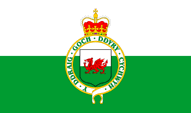
1953–1959,
Flagge von Wales
Seitenverhältnis = 3:5,
Quelle, nach:
World Statesmen
Wales verwendet keine eigene Heraldik (mehr). Alle heute verwendeten Farben und Symbole sind englischen Ursprungs. Die eigentlichen Wappenfarben von Wales sind Gelb und Rot, wie die Englands. Um 1500 wurde der walisische rote Drache, der als Zeichen schon sehr alt ist, mit den grün-weißen Tudorfarben zur heutigen Flagge kombiniert. Wales ist keltisches Gebiet, und die Kelten verwenden eigentlich Flaggen und Wappen in ihren Nationalfarben Schwarz und Weiß. Dies hat sich jedoch nur in der Bretagne und in Cornwall bzw. mit Einschränkungen in Schottland erhalten, bzw. ist dort zum tragen gekommen. Alle anderen keltischen Gebiete haben ihre Heraldik von ihren jeweiligen Herrschern entlehnt oder aus anderen Kulturkreisen importiert. Die britischen Nordinseln (Nordische Inseln) verwenden skandinavische Modelle, Irland ist von der französischen Trikolore beeinflusst, Wales und Man haben englische Heraldik übernommen. Durch den Lauf der Geschichte war Wales zum Zeitpunkt der Bildung des Vereinigten Königreiches, der Union, Vollbestandteil (quasi unterworfenes Gebiet) Englands, und hatte so nie eine Chance seine – wenn auch fremde Heraldik – irgendwo einfließen zu lassen, weder in die englische Flagge, noch in die des Vereinigten Königreichs. Das Wales heute als "gleichberechtigter" Bestandteil des Vereinigten Königreichs erscheint, ist nur dem im 19./20. Jhd. aufkommenden walisischen Nationalismus zu verdanken, so dass es seit 1912 beschränkte Autonomie genießt, und seit 1999 sein eigenes Regionalparlament besitzt. Erst in den letzten Jahren hat sich eine Flagge als Symbol des walisischen Nationalbewusstseins etabliert. Es handelt sich um die Flagge des Heiligen David. Das Bild der Flage wurde vom Wappen der Diözese St. David entnommen, goldenes Kreuz auf Schwarz. Sie wird von Nationalisten werwendet, oder auch von Christlichen Partei. Die Gründe der Ablehnung der offiziellen walisischen Flagge sind entweder die Ablehnung englischer Heraldik oder gar die Ablehung des Drachens als Symbol Satans.
Quelle: Die Welt der Flaggen,
1) Wikipedia (EN),
2) Wikipedia (EN),
Volker Preuß
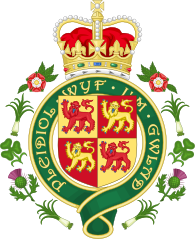
Wappen von Wales,
Quelle: Sodacan, CC BY-SA 3.0,
via Wikimedia Commons
Das Wappen von Wales zeigt einen gelb-rot gevierteilten Schild mit je einem blaubewehrten Leoparden in umgekehrter Färbung in jedem Feld. Es geht auf das Banner von Owain Glyndŵr (Fürst von Wales im 14. Jahrhundert) zurück. Der Wahlspruch "Pleidiol Wyf I’m Gwlad" heißt übersetzt: "Treu bin ich meinem Land" und entstammt der walisischen Nationalhymne.
Quelle: Wikipedia (DE)
Lage:
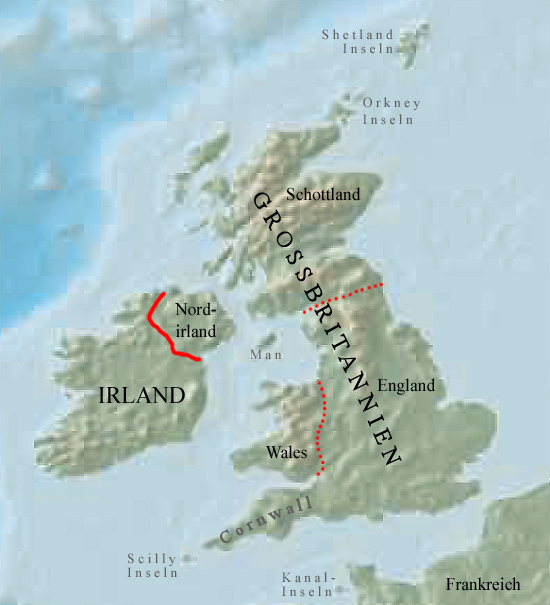
Quelle/Source: Freeware, University of Texas Libraries, modyfied by: Volker Preuß
Landkarte des Landes:
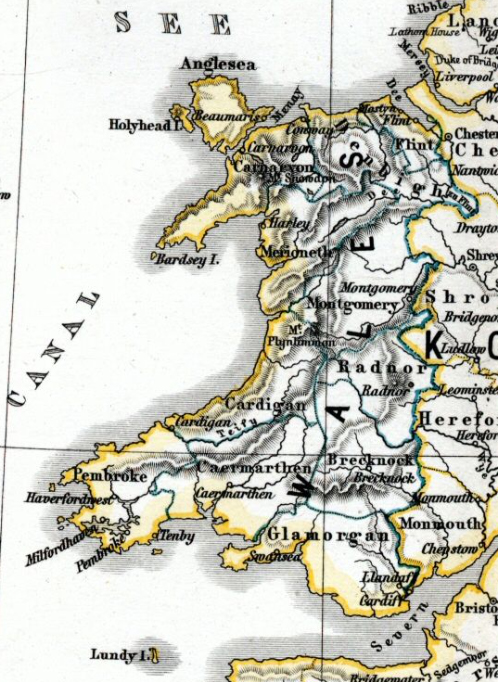
Quelle/Source: Hand-Atlas für die Geschichte des Mittelalters und die neueren Zeit, von Spruner und Menke
Fläche: 20.735 km²
Einwohner: 3.138.631 (2018)
Bevölkerungsdichte: 151 Ew./km²
Hauptstadt: Cardiff (walisisch: Caerdydd), 366.903 Ew. (2019)
Amtssprache: Englisch, Walisisch
Zeitzone: MEZ – 1 h
Quelle:
Wikipedia (DE)
ca. 600 v.Chr. · keltische Besiedlung
57 v.Chr.–74 n.Chr. · zum Römischen Reich, Provinz Britannia
ab ca. 400 · Abzug der römischen Legionen, in den Folgejahren Einwanderung der germanischen Stämme der Angeln, Sachsen und Jüten nach Britannien, die später unter dem Begriff Angelsachsen zusammengefasst wurden, Wales wird Rückzugsgebiet für die keltischen Briten
1066 · die einfallenden Normannen besiegen die Angelsachsen in der Schlacht von Hastings und Errichten ihre Herrschaft in England und auch in Wales
1301 · Eduard I. unterwirft Wales endgültig
1416 · letzte nationale Erhebung der Waliser gegen das englische Joch
1536 · Wales wird mit England vereinigt
1912 · Gewährung begrenzter Eigenständigkeit
1999 · ein walisisches Regionalparlament nimmt seine Arbeit auf
Quelle:
Atlas zur Geschichte,
Discovery '97,
Wikipedia (DE)
Der Name des Landes geht auf das germanische Wort "welsch" zurück, womit zunächst die Kelten im Allgemeinen gemeint waren, später auch Romanen. Die übertragene Bedeutung des Wortes "welsch" als "fremd" hat sich bis in die heutige Zeit erhalten. Auf Walisisch heißt das Land "Cymru", was auf das keltische Wort "Kom-brogi" zurückgeht und "Landsleute" heißt.
Quelle: Wikipedia (DE)