mobile Ansicht, to the English Version tap the flag

- Republik Guinea-Bissau
- autoritäre präsidiale Republik mit Mehrparteiensystem
- Eigenbezeichnung: Repúblika da Guiné-Bissau
• Flagge
• historische Flaggen
• Bedeutung/Ursprung der Flagge
• Wappen
• Bedeutung/Ursprung des Wappens
• Flugzeugkokarde
• Landkarte
• Zahlen und Fakten
• Geschichte
• Ursprung des Landesnamens
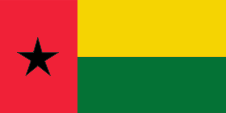
Nationalflagge,
Seitenverhältnis = 1:2,
Quelle, nach:
Corel Draw 4


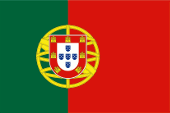
1911–1973,
Nationalflagge Portugals,
Seitenverhältnis = 2:3,
Quelle, nach:
Corel Draw 4
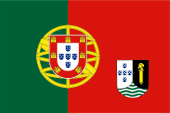
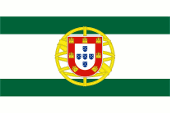
60-er Jahre 19. Jhd.,
geplante Flagge für Portugiesisch-Guinea,
Seitenverhältnis = 2:3,
Quelle, nach:
Wikipedia (D)

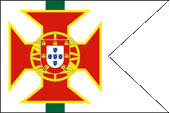
bis 1935,
Flagge eines Oberkommissars,
Seitenverhältnis = 2:3,
Quelle, nach:
Flaggenbuch 1939
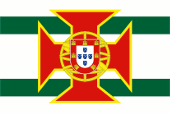
1935–1961,
Flagge eines Distriktskommandanten,
Seitenverhältnis = 2:3,
Quelle, nach:
Flaggenbuch 1939
1935–1973,
Flagge des Generalgouverneurs,
Seitenverhältnis = 2:3,
Quelle, nach:
Die Welt im bunten Flaggenbild
Die heutige Flagge von Guinea-Bissau wurde am 24.09.1973 im Zusammenhang mit der Erklärung der Unabhängigkeit eingeführt. Sie zeigt zwei waagerechte Streifen in Gelb und Grün, und am Mast einen senkrechter Streifen in Rot, darauf einen schwarzen fünfstrahligen Stern. Dieser Stern ist das Symbol für Afrika und und seine schwarze Bevölkerung, er ist unmittelbar von der Flagge Ghanas abgeleitet. Diese Flagge entspricht (bis auf die fehlenden Initialen) der im Jahre 1961 eingeführten Flagge der PAIGC-Partei. Die Farbe Rot steht für das im Freiheitskampf vergossene Blut, Gelb für die Sonne und die Bodenschätze des Landes, Grün für die Vegetation und die Landwirtschaft. Die Farben sind wie folgt definiert: Rot = Pantone 032, Gelb = Pantone 109, Grün = Pantone 355. Die Farbkombination von Grün, Gelb und Rot in der heutigen Flagge sind die Panafrikanischen Farben: Etwa 1900 setzte die Panafrika - Bewegung ein, die Gemeinsamkeiten aller Menschen mit schwarzer Hautfarbe hervorheben wollte. Für die politische Einheit Afrikas steht der Farbendreiklang Grün-Gelb-Rot, den viele afrikanische Staaten nach Erlangung ihrer Unabhängigkeit in ihre Flaggen übernahmen. Das erste Land war Ghana im Jahr 1957. Als Ursprung gelten die Landesfarben von Athiopien (Abessinien, dem ältesten unabhängigen Staat Afrikas. In der Zeit als portugiesische Kolonie wurde ausschließlich die portugiesische Nationalflagge verwendet, da man die Kolonien als fester Bestandteil des Mutterlandes betrachtete, und nicht als Außenbesitzungen. Das bedeutete, das portugiesische Kolonien nie eigene Flaggen hatten, auch wenn es in den sechziger Jahren des 20. Jahrhunderts Bestrebungen gab Flaggen für die Kolonien einzuführen, indem man das Wappen der Kolonie in das fliegende Ende der portugiesischen Nationalflagge platzierte. Diese Pläne wurden jedoch nie realisiert.
Quelle:
Wikipedia (D),
Die Welt der Flaggen,
Flaggen Wappen Hymnen,
Flaggen und Wappen der Welt,
Flags of the World
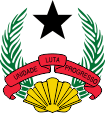
seit 1973,
Wappen von Guinea-Bissau,
Quelle, nach:
Corel Draw 4
1935–1974,
Wappen von Portugiesisch-Guinea,
Quelle, nach:
Wikipedia (D)
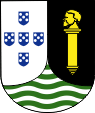
Das Staatswappen von Guinea-Bissau wurde, wie die Flagge, im Jahre 1973 eingeführt. Es zeigt die pan-afrikanischen Farben und auch den auf der Flagge gezeigten schwarzen Stern. Im unteren Teil des Wappens ist eine goldene Muschel zu sehen. Sie steht für die Kapverdischen Inseln. Auf einem roten Band zwischen zwei grünen Palmzweigen (sie stehen für das Festland) der Staatswahlspruch: "Unidade, Luta, Progresso" → "Einigkeit, Kampf, Fortschritt". Im Jahre 1935 wurden für die portugiesischen Kolonien eigene Wappen eingeführt. Die Gestaltung unterlag einem gewissen Schema und so zeigte jedes Wappen neben einer lokalen Symbolik die fünf Quinas aus dem Wappen von Portugal und fünf grüne Wellen auf Silber. Als lokale Symbolik erschien im Wappen von Portugiesisch-Guinea ein schwarzes Feld mit dem goldenen Zepter von König Alfons V.
Quelle:
Wikipedia (D),
Flaggen Wappen Hymnen,
Flaggen und Wappen der Welt

Flugzeugkokarde,
Quelle, nach: Wikipedia (EN)
Lage:
Quelle/Source: CIA World Factbook
Landkarte des Landes:
Quelle/Source: CIA World Factbook
Fläche: 36.125 km²
Einwohner: 1.970.000 (2020), davon 28% Fulbe, 22% Balanta, 14% Mandingo (Malinke), 9% Pepel, 8% Mandyak (Manjaco)
Religionen: 85% Moslems, 8% Christen, 7% Animisten, 2% Nicht-Religiöse
Bevölkerungsdichte: 54 Ew./km²
Hauptstadt: (São Joé des) Bissau, 407 000 Ew. (2007)
Amtssprache: Portugiesisch
sonstige Sprachen: Balante, Fulani, Malinke, kreolisches Portugiesisch (Crioulo)
Währung: CFA-Franc BCEAO (FCFA, XOF) = 100 Centimes, FCFA = Franc Communauté Financière d'Afrique, bis 1997: 1 Guinea-Peso (PG) = 100 Centavos
Zeitzone: MEZ – 1 h
Quelle: Wikipedia (D)
1446 · der Portugiese Nuño Tristão entdeckt und erforscht die Küste des heutigen Guinea-Bissau
1460 · Gründung der portugiesischen Handelsstation Cacheu
1630 · Portugal erhebt Gebietsforderungen und dominiert den Handel an der Küste
1687 · Gründung der ersten portugiesischen Siedlung in der Nähe des heutigen Bissau
1765 · Gründung der Stadt São Joé des Bissau
1792 · britischer Siedlungsversuch bei Bolama scheitert
1879 · Gründung der Kolonie Portugiesisch-Guinea
1884 · Großbritannien und Frankreich errichten Handelsstützpunkte an der Küste
1885 · Berliner Konferenz: Portugiesisch-Guinea wird Portugal zugesprochen
1941 · Verlegung der Hauptstadt von Bolama nach Bissau
1951 · Portugiesisch-Guinea wird Überseeprovinz
1955 · Gewährung teilweiser innerer Autonomie
1956 · Gründung der linksextremistischen Befreiungsbewegung Partido Africano da Independencia de Guinea-Bissao e Cabo Verde (PAIGC)
1963 · Beginn des bewaffneten Kampfes der PAIGC gegen Portugal
24.09.1973 · die PAIGC erklärt einseitig Guinea-Bissaus Unabhängigkeit, Luis Cabral (PAIGC) wird Präsident
25.04.1974 · Revolte der portugiesischen Armee gegen die Regierung Caetano in Portugal
10.09.1974 · Portugal erkennt die Unabhängigkeit von Guinea-Bissau an
1980 · rassisch motivierter Staatsstreich von Major J. B. Vieira, Cabral wird gestürtzt
1981 · organisatorische Trennung der
PAIGC, auf den Kapverden entsteht die
PAICV
1984 · neue Verfassung, Vieira als Präsident bestätigt, die seit der Staatsgründung beabsichtigte Vereinigung mit den Kapverden wird für die Zukunft ausgeschlossen
1990 · Ansätze von Demokratisierung
1991 · Einführung des Mehrparteiensystems
1994 · Parlaments- und Präsidentschaftswahlen, absolute Mehrheit für PAIGC, Vieira als Präsident bestätigt
1998 · Armeerevolte, Bürgerkrieg
2010 · Putschversuch des Militärs
2012 · Militärputsch
2014 · Wahlen, in den Folgejahren unstabile Machtverhältnise
Quelle:
Wikipedia (D),
Atlas zur Geschichte,
Weltgeschichte,
Discovery '97
Der Name "Guinea" geht auf das Berber-Wort "aguinaou" zurück, was "Schwarze" heißt und sich urspünglich auf alle Bewohner der Westafrikanischen Küste von Senegal bis Gabun bezog. Der zweite Teil des Landesnamens, "Bissau", dient der Unterscheidung zu anderen Staaten die den namen "Guinea" tragen und bezieht sich auf die Haupstadt des Landes. In der Zeit als portugiesische Kolonie hieß das Land Portugiesisch-Guinea.
Quelle/Source:
Handbuch der geographischen Namen,
Volker Preuß