mobile Ansicht, to the English Version tap the flag

- Republik Haiti
- US-amerikanische Einflusssphäre
- Eigenbezeichnung: République d'Haïti
• Flaggen
• historische Flaggen
• Bedeutung/Ursprung der Flagge
• Wappen
• Bedeutung/Ursprung des Wappens
• Landkarte
• Zahlen und Fakten
• Geschichte
• Ursprung des Landesnamens
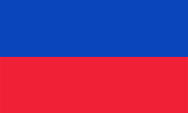
National- und Handelsflagge,
Seitenverhältnis = 3:5,
Quelle, nach:
Wikipedia (EN), Corel Draw 4


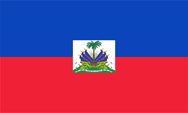
Staats- und Marineflagge,
Seitenverhältnis = 3:5,
Quelle, nach:
Wikipedia (EN), Corel Draw 4


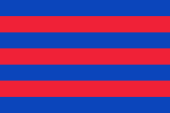
Gösch,
Seitenverhältnis = 2:3,
Quelle, nach:
Flags of the World

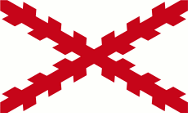
16./17. Jhd.,
Haiti gehört zum spanischen Machtbereich,
Quelle, nach:
Wikipedia (EN)

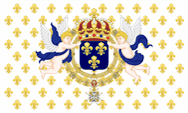
1697–1790,
Staats- und Königsflagge von Frankreich,
Quelle, nach:
Flaggen Enzyklopädie
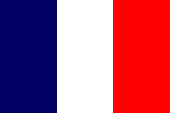
1790–1803,
Flagge Frankreichs,
Seitenverhältnis = 2:3,
Quelle, nach:
Corel Draw 4
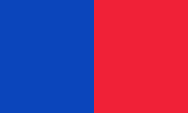
1803–1805,
Nationalflagge,
unter Toussaint l'Ouverture,
Quelle, nach:
Die Welt der Flaggen

1805–1806,
Nationalflagge,
unter Dessalines,
Quelle, nach:
Die Welt der Flaggen
1808–1820,
Nord-Haiti,
Nationalflagge,
Quelle, nach: World Statesmen
1808–1964, (1808–1820, Süd-Haiti)
Nationalflagge,
zuerst unter Boyer,
Quelle, nach:
Die Welt der Flaggen

1964–1986,
Handelsflagge,
Quelle, nach:
Flaggen und Wappen
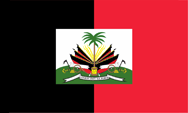
1964–1986,
Nationalflagge,
Quelle, nach:
Flaggen und Wappen
Die heutige Flagge von Haiti wurde 21.06.1964 erstmals gehisst, und am 25.02.1986 erneut eingeführt. Sie besteht aus zwei waagrechten Streifen in den Farben Blau und Rot. Über die Bedeutung der Farben gibt es unterschiedliche Auffassungen:
• Blau und Rot sollen jeweils die errungene Freiheit und die neue Zeit symbolisieren.
Quelle/Source: Flaggen Wappen Hymnen
• Blau steht für das afrikanische Erbe, und Rot für den Unabhängigkeitskampf.
Quelle/Source: Flaggen-Atlas Erde
• Blau steht für die Schwarzen und für die Mulatten, Rot steht für das im Freiheitskampf vergossene Blut.
Quelle/Source: Flaggen und Wappen der Welt
• Die erste blau-rote Flagge Haitis war quergestreift (1803), und ist durch entfernen des weißen Streifens aus der französischen Trikolore hervorgegangen.
Quelle/Source: Die Welt der Flaggen
• Blau repräsentiert die Schwarzen, Rot die Mulatten.
Quelle/Source: Das farbige Flaggenlexikon
Die Geschichte Haitis war geprägt von Auseinandersetzungen zwischen Schwarzen, Weißen, und Mulatten. Die Weißen waren schon beim Aufstand von 1791 fast alle getötet worden. Die übrigen folgten 1805. Die Kämpfe setzten sich zwischen Schwarzen und Mulatten fort. Die Schwarzen verwendeten rot-schwarze Flaggen, deren Farben "Freiheit oder Tod" bedeuteten. Die Mulatten hatten blau-rote Flaggen in Gebrauch, die selben Farben, die schon Toussaint l'Ouverture im Jahre 1803 verwendete, wobei auch seine Flagge noch die Inschrift "Liberté ou la Mort" ("Freiheit oder Tod") getragen haben soll. Aber das ist wenig wahrscheinlich, und wahr wohl nicht verbreitet, denn Flaggen mit Inschriften ließen sich nur sehr schwer produzieren. Zur Zeit der Duvalier-Diktatur, zwischen 1964 und 1986, war die blau-rote durch eine schwarz-rote Flagge ersetzt worden – ähnlich wie sie seit 1805 und später in Nord-Haiti verwendet wurde – um das afrikanische Erbe des Landes zu betonen. Die Farben der Flagge (einschließlich der Wappenabbildung) sind wie folgt definiert: Blau = Pantone 293, Rot = Pantone 032, Grün = Pantone 355, Braun = Pantone 125, Gelb = Pantone 102, Grau = Pantone 430. Heute befindet sich das Staatswappen (innerhalb eines weißen Rechtecks) nur noch in der Mitte der Staats- und Marineflagge.
Quelle:
Die Welt der Flaggen,
Wappen und Flaggen aller Nationen,
The Observers Book of Flags,
Wikipedia (D),
Flags of the World
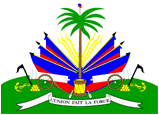
seit 1986,
Wappen von Haiti,
Quelle, nach:
Flags of the World,
Corel Draw 4
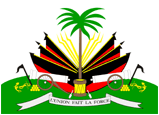
1964–1986,
Wappen von Haiti,
Quelle, nach:
Flaggen und Wappen,
Corel Draw 4
Das Wappen Haitis wurde 1807 entworfen, und bis heute nur in kleinen Details geändert. Die heutige Version vom 25.02.1986 zeigt auf grünem Rasen eine Palme sowie eine Waffentrophäe mit Ankern und links und rechts je drei Nationalflaggen. Im Vordergrund ist ein weißes Schriftband mit dem Motto "L'Union fait la Force" ("Einigkeit macht stark") zu sehen. Das Wappen zeigte zwischen 1964 und 1986 schwarz-rote Flaggen und die Freiheitsmütze fehlte auf der Palme.
Quelle:
Flaggen Wappen Hymnen
Lage:
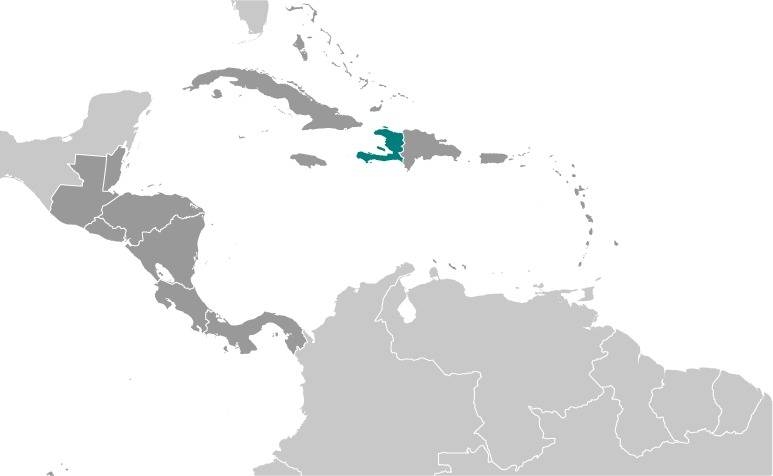
Quelle/Source: CIA World Factbook
Landkarte des Landes:
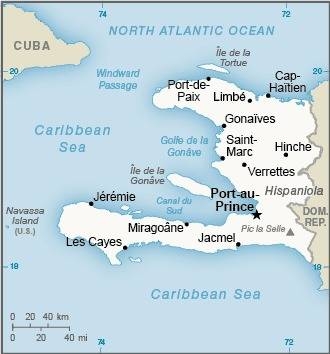
Quelle/Source: CIA World Factbook
Fläche: 27.750 km²
Einwohner: 11.400.000 (2020), davon 95% Afroamerikaner, 5% Mulatten
Religionen: 55% Katholiken, 30% Protestanten, 10% Nicht-Religiöse
Bevölkerungsdichte: 411 Ew./km²
Hauptstadt: Port-au-Prince, 1.275.000 Ew. (2018)
Amtssprachen: Haitianisch (Creole), Französisch
Währung: 1 Gourde (HTG, Gde.) = 100 Centimes
Zeitzone: MEZ – 6 h
Quelle: World Statesmen, Wikipedia (D)
05.12.1492 · der spanische Seefahrer Christof Kolumbus entdeckt die Insel auf der heute Haiti und die Dominikanische Republik liegen, und nennt sie "La Isla Española", und nimmt sie für Spanien in Besitz
1494 · Beginn der spanischen Kolonisierung
1496 · Gründung von Santo Domingo (heute Hauptstadt der Dominikanischen Republik), der Name der Stadt wurde später für die ganze Insel übernommen
1500 · Kronkolonie "Santo Domingo" unter einem vom Spanischen König eingesetzten Gouverneur
1505 · Import der ersten schwarzen Sklaven als Ersatz für die aussterbende indianische Urbevölkerung
17. Jhd. · Piraten (Bukanier und Flibustier) lassen sich an der Küste der Insel nieder, besonders auf der vorgelagerten Insel Tortuga (Île de la Tortue), die Piraten im Westteil der Insel stehen dabei unter französischem Schutz
1697 · Friede von Rijswijk, Spanien muss den Westteil der Insel (Saint Domingue) an Frankreich abtreten, damit Teilung der Insel
1791 · antikolonialer Aufstand der schwarzen Sklaven und der Mulatten in Saint Domingue unter Toussaint l'Ouverture, Ermordung der meißten Europäer
1794 · Aufhebung der Sklaverei
1801 · Toussaint l'Ouverture wird Präsident von Haiti (ehemals Saint Domingue), Eroberung des spanischen Ostteils der Insel (Santo Domingo) durch die Aufständischen
1802 · militärische Intervention durch Frankreich, Toussaint l'Ouverture gerät in Französische Gefangenschaft, Dessalines wird Nachfolger von Toussaint l'Ouverture
1803 · antifranzösische Aufstände, die Aufständischen schlagen die französischen Interventen
01.01.1804 · Dessalines erklärt Haiti endgültig für von Frankreich unabhängig und lässt sich als Kaiser Jacob I. von Haiti ausrufen, erneute Intervention durch Frankreich (im Osten der Insel)
1805 · Haiti erobert erneut Santo Domingo (den Osten der Insel), die heutige Dominikanische Republik
1806 · Kaiser Jakob I. wird ermordet, Schwarze und Mulatten wenden sich gegeneinander, Bürgerkrieg, Anarchie
1808 · Santo Domingo, die heutige Dominikanische Republik, kommt wieder unter spanische Herrschaft
1808 · im Südwesten der Insel entsteht eine Mulattenrepublik unter General J. P. Boyer
1811 · im Norden lässt sich der Schwarze Henri Christophe zum König krönen
1820 · der Südstaat erobert das Königreich der Schwarzen im Norden
1821 · der spanische Teil der Insel (Santo Domingo) erklärt seine Unabhängigkeit von Spanien (Unabhängiger Staat Spanisch-Haiti)
1822 · Santo Domingo schließt sich dem Staat Haiti an
1843 · Sturz von J. P. Boyer durch aufständische Schwarze
1844 · Aufstand der Mulatten im ursprünglich spanischen Teil der Insel, dieser trennt sich als selbständige Republik Santo Domingo wieder von Haiti ab (→ Dominikanische Republik)
1844–1915 · Bürgerkrieg und ständige Unruhen in Haiti
1915 · militärische Intervention der USA, Haiti wird Protektorat der USA
1934 · Abzug der US-Truppen
1957–1971 · Militärdiktatur unter François Duvalier
1971–1986 · Militärdiktatur unter Jean-Claude Duvalier
1988–1990 · Militärregierung unter unter General P. Avril
1990 · Jean-Bertrand Aristide wird zum Präsidenten gewählt
1991 · Militärputsch, Aristide geht ins Exil
1994 · militärische Intervention der USA
1995 · Arisitide wird wieder als Präsident eingesetzt, bei den Wahlen wird jedoch René Preval zum Präsidenten gewählt
2000 · Wahlen, Aristide wird zum Präsidenten gewählt, Abzug der US-Truppen
2004 · Aristide wird durch einen Aufstand vertrieben
2004 · das Land wird durch eine internationale Eingreiftruppe besetzt (USA, Frankreich, Chile später auch Brasilien), Bildung einer Regierung unter Latortue
ab 2006 · Wahlen, wechselnde Regierungen und Präsidentschaften
07.07.2021 · Ermordung von Präsident Moïse
Quelle:
Atlas zur Geschichte,
World Statesmen,
Wikipedia (D)
Der Name "Haiti" geht auf das araukanische Wort "ahiti" zurück, was übersetzt übersetzt "bergig" heißt. So nannten die Araukanischen Indianer (Arawak) einst die gesamte Insel. Als Kolumbus am 5. Dezember 1492 die Insel entdeckte, auf der heute die Staaten Haiti und Dominikanische Republik liegen, nannte er sie "La Isla Española" (die Spanische Insel), im Laufe der Zeit wurde "Hispaniola" daraus. Der Name hat sich bis heute erhalten, auch wenn Einheimische heute ab und zu das Wort "Kiskeya" verwenden. Ein weiterer Name für die Insel war "Santo Domingo", nach der 1496 gegründeten Stadt. Im französischen Inselteil wurde daraus "Saint Domingue".
Quelle/Source:
Handbuch der geographischen Namen,
Wikipedia (D)