mobile Ansicht, to the English Version tap the flag

- Republik Honduras
- demokratische präsidiale Republik
- US-amerikanische Einflusssphäre
- Eigenbezeichnung: República de Honduras
• Flaggen
• historische Flaggen
• Bedeutung/Ursprung der Flagge
• Wappen
• Bedeutung/Ursprung des Wappens
• Flugzeugkokarde
• Landkarte
• Zahlen und Fakten
• Geschichte
• Ursprung des Landesnamens
• Swan-Inseln
Farbe und Anordnung offiziell:
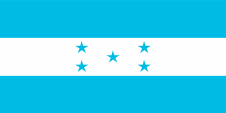
National-, Staats- und Handelsflagge,
Seitenverhältnis = 1:2,
Quelle, nach: Wikipedia (ES)


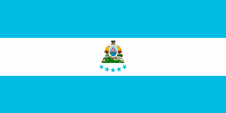
Marineflagge,
Seitenverhältnis = 1:2,
Quelle, nach: Wikipedia (DE)
Farbe und Anordnung in der Praxis:
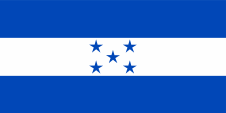
National-, Staats- und Handelsflagge,
Seitenverhältnis = 1:2,
Quelle, nach: Wikipedia (ES)


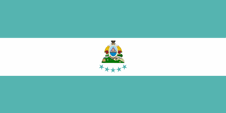
Marineflagge,
Seitenverhältnis = 1:2,
Quelle, nach: Wikipedia (ES)

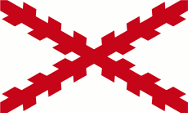
16. Jhd. – 1785,
zum spanischen Machtbereich,
Quelle, nach:
Wikipedia (EN)

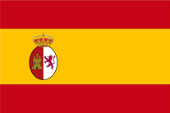
1785–1821,
zum spanischen Machtbereich,
Quelle, nach: Wikipedia (EN)
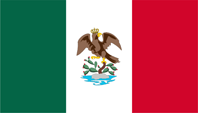
1822–1823,
Honduras gehört zu Mexiko,
Seitenverhältnis = 2:3
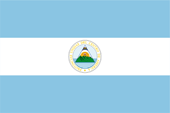
1823–1824,
Nationalflagge der Vereinigten Provinzen von Mittelamerika,
Seitenverhältnis = 2:3,
Quelle, nach:
Wikipedia (D)
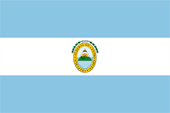
1824–1839,
Nationalflagge der Zentralamerikanischen Konföderation,
Seitenverhältnis = 2:3,
Quelle, nach:
Wikipedia (D)
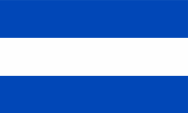
1839–1866,
National-, Staats- und Handelsflagge,
Seitenverhältnis = 3:5,
Quelle, nach:
Wikipedia (ES)
1866–1949,
National-, Staats- und Handelsflagge,
Seitenverhältnis = 1:2,
Quelle, nach: Wikipedia (ES)
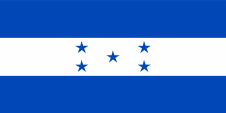
1949–2022,
National-, Staats- und Handelsflagge,
Seitenverhältnis = 1:2,
Quelle, nach: Wikipedia (ES)
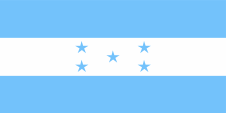
2018,
Vorschlag in Maya-Blau,
Seitenverhältnis = 1:2,
Quelle, nach: Wikipedia (ES)
Honduras wurde 1823 Mitglied der Zentralamerikanischen Konföderation und übernahm deren blau-weiß-blau längsgestreifte Flagge. Auch nach dem Ende der Konföderation im Jahre 1838/1839 wurde in Honduras diese Flagge beibehalten, wenn auch ohne Wappendarstellung. Erst im Jahre 1866 wurden fünf Sterne in der Mitte der Flagge angebracht, deren Spitzen auch schon mal nach unten zeigen konnten. Das Staatswappen auf der Marine- und Kriegsflagge wurde unterhalb durch fünf in einem Halbkreis angeordnete blaue Sterne ergänzt. Diese sollen, genau wie die Sterne in der im selben Jahr eingeführten Nationalflagge, an die fünf Staaten der Zentralamerikanischen Konföderation erinnern. Die Flagge in ihrer heutigen Form wurde am 18.01.1949 eingeführt, nachdem dass Format der Flagge in 2:1 geändert worden war.
Die Farbe der Flagge war nie exakt definiert, vorgegeben war ab 1866 "blau" (Gesetzesdekret Nr. 7 vom 16. Februar 1866) ab 1949 "türkis" (Gesetzesdekret Nr. 29 vom 26. Januar 1949). Das hat bis heute zur Folge, dass in der Praxis der blaue Farbton sehr unterschiedlich ausfallen kann, bis in zu Mittelblau und Dunkelblau. Das Dunkelblau wurde so auch offziell verwendet, besonders zwischen den 30er und 50er Jahren. Offenbar war der Blauton immer wieder Gegenstand von Diskussionen, gerade um dem Wortlaut des Gesetzes Nr. 29 gerecht zu werden. Im September 2018 wurde vorgeschlagen Maya-Blau zu verwenden (HEX: #73C2FB, RBG: 115|194|251, CMYK: 55|13|0|0, pt 2915 c). Die Nationale Autonome Universität von Honduras schlug im September 2020 ein Blau vor, HEX: #00BCE4 (RBG: 0|188|228, CMYK: 71|0|9|0, pt 306 c), was 2021 von der Regierung bestätigt wurde. Am 4. Januar 2022 führten die honduranischen Streitkräfte eine eigene Version des Blautons als "Gelbblau" (RBG: 85|180|176, CMYK: 66|4|35|1, pt 7472 c) ein, wohl wissend, dass damit dem Wortlaut des Gesetzes von 1949 als "Türkisblau" Genüge getan wird.
Ebenso ist die Anordung der fünf Sterne nicht geregelt. Historisch überliefert ist seit 1866 die Anordung als Rechteck (nahezu Quadrat). Das Gesetzesdekret Nr. 29 vom 26. Januar 1949 sagt dazu aus: "Sie bilden mit vier von ihnen ein Rechteck parallel zu den Streifen, wobei der Rest in der Mitte desselben Vierecks platziert wird". Daraus wird jetzt aber abgeleitet, dass das Rechteck der Sterne die gleichen Seitenverhältnisse wie die Flagge haben soll, nämlich 1:2, was auf offziellen Darstellungen so übernommen wird. In der Praxis hat sich das nicht durchgesetzt, es wird immer noch die Form von 1866 verwendet und auch das dunkle Blau.
Quelle:
Volker Preuß nach/by:
Wikipedia (D),
Wikipedia (ES),
Flags of the World,
World Statesmen
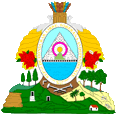
Wappen von Honduras,
Quelle:
Corel Draw 4
Das Staatswappen, das nur sehr klein auf der Marineflagge zu sehen ist, zeigt eine dreieckige Pyramide in einem ovalen Schild. Sie soll Gleichheit und Freiheit symbolisieren. Zwei Türme links und rechts eines Vulkans stehen für Unabhängigkeit und Verteidigungsbereitschaft. Die Pfeile oberhalb des Schildes erinnern an die indianischen Bewohner des Landes. Die Füllhörner, die Minen und das Werkzeug stehen für die Naturreichtümer und die Bodenschätze des Landes.
Quelle:
Flaggen Wappen Hymnen

Flugzeugkokarde,
Quelle, nach: Wikipedia (EN)
Lage:
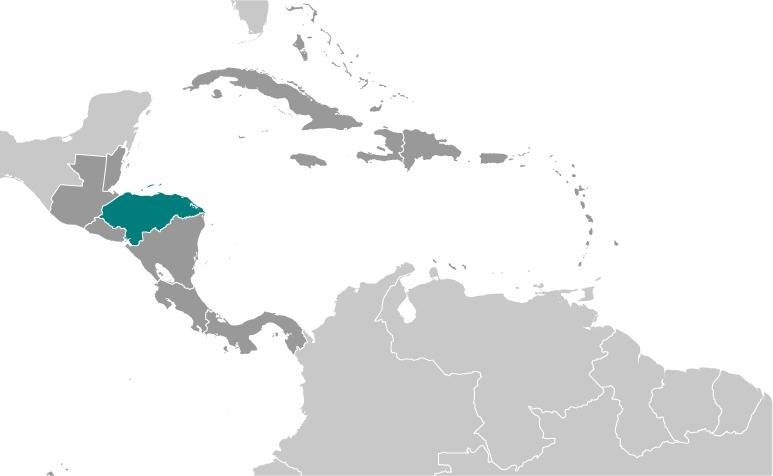
Quelle/Source: CIA World Factbook
Landkarte des Landes:
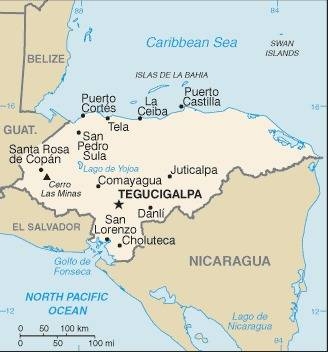
Quelle/Source: CIA World Factbook
Fläche: 112.090 km²
Einwohner: 9.700.000 (2019), davon 90% Mestizen, 7% Indianer, 2% afrikanischer Abstammung, 1% Europäer
Religionen: 47% Katholiken, 41% Protestanten
Bevölkerungsdichte: 87 Ew./km²
Hauptstadt: Tegucigalpa, 1.055.729 Ew. (2013)
Amtssprache: Spanisch
sonstige Sprachen: kreolisches Englisch
Währung: 1 Lempira (HNL, L) = 100 Centavos
Zeitzone: MEZ – 7 h
Quelle:
Wikipedia (D),
CIA World Factbook
1502 · Kolumbus entdeckt die Küste von Honduras
1524 · Beginn der spanischen Eroberung und Kolonisierung durch Olid und Cortés
1535 · Errichtung des Vizekönigreiches Neuspanien, dem Mittelamerika (und damit auch das heutige Honduras) als "Generalkapitanat Guatemala" angeschlossen wird
15.09.1821 · Honduras erklärt seine Unabhängigkeit von Spanien
1822 · Honduras schließt sich dem Kaiserreich Mexiko an
1823 · nach dem Sturz des mexikanischen Kaisers wird die Verbindung zu Mexiko gelöst, und die Staaten des ehemaligen Generalkapitanats Guatemala verbinden sich zu den "Vereinigten Provinzen von Mittelamerika" (Zentralamerikanische Konföderation)
1838 · Honduras verlässt die Zentralamerikanische Konföderation
1838–1895 · Phase ständiger Putsche und Bürgerkriege
1860 · Der US-amerikanische Abenteurer und Pirat William Walker versucht in Honduras die Herrschaft an sich zu reißen, er wird von vereinten mittelamerikanischen Truppen gestellt und gefangen genommen und am 12.09.1860 in Trujillo hingerichtet
1895–1898 · Honduras bildet zusammen mit Nikaragua und El Salvador die Großrepublik Mittelamerika
1905 · USA-Militärintervention
1907 · Niederlage im Krieg gegen Nikaragua
1907 · USA-Militärintervention
1909–1911 · Bürgerkrieg
1911 · USA-Militärintervention
1913 · USA-Militärintervention
1924 · USA-Militärintervention, die USA besetzen die Swan-Inseln, die auch Islas del Cisne oder Islas Santanilla genannt werden, und errichten dort einen Militärstützpunkt
1963 · Militärputsch
1969 · 13 Tage dauernder „Fußballkrieg” zwischen Honduras und El Salvador
1971 · die USA treten die Swan-Inseln wieder an Honduras ab
1978 · Militärputsch
1980 · demokratische Reformen
1981 · erste Präsidentschaftswahlen, in der Folgezeit wechselnde Regierungen
1981 · Inbetriebnahme des US-Militärstützpunkts Palmerola Air Base
2009 · Militärputsch, Wahlen, in der Folgezeit wechselnde Regierungen
2010 · Einrichtung des US-Marine-Militärstützpunkts Caratasca Lagune
Quelle:
Atlas zur Geschichte,
Discovery '97,
Wikipedia (D)
Der Name des Landes geht auf den spanischen Ausdruck "las honduras" zurück, was übersetzt "die Tiefen" bedeutet und sich auf das Tiefland im Nordosten des Landes bezieht.
Quelle:
Handbuch der geographischen Namen