mobile Ansicht, to the English Version tap the flag

- parlamentarische Monarchie mit dem britischen Monarchen als Staatsoberhaupt
• Flaggen
• historische Flaggen
• Bedeutung/Ursprung der Flagge
• Wappen
• Bedeutung/Ursprung des Wappens
• Flugzeugkokarde
• Landkarte
• Zahlen und Fakten
• Geschichte
• Ursprung des Landesnamens
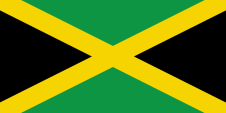
National- und Handelsflagge,
Seitenverhältnis = 1:2,
Quelle, nach: Flaggen und Wappen


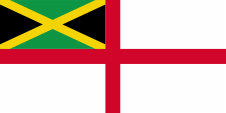
Marineflagge,
Seitenverhältnis = 1:2,
Quelle, nach: Flaggen und Wappen

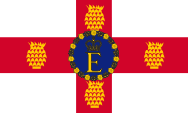
1962–2022,
Flagge der Königin,
Seitenverhältnis = 4:7,
Quelle, nach: Wappen und Flaggen aller Nationen

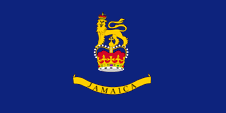
Flagge des Generalgouverneurs,
Seitenverhältnis = 1:2,
Quelle, nach: Wappen und Flaggen aller Nationen

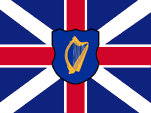
1655–1660,
Flagge des Commonwealth von England, Schottland und Irland,
Quelle, nach:
Die Welt der Flaggen
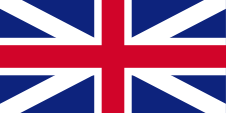
1660–1801,
Flagge Großbritanniens,
Seitenverhältnis = 1:2,
Quelle, nach:
Die Welt der Flaggen
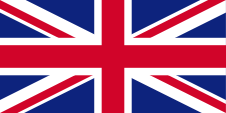
1801–1875,
Flagge Großbritanniens,
Seitenverhältnis = 1:2,
Quelle, nach:
Die Welt der Flaggen
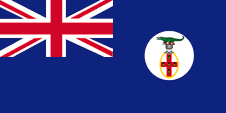
1875–1906,
Flagge der Regierung (Staatsflagge),
Seitenverhältnis = 1:2,
Quelle, nach:
Wikipedia (DE)
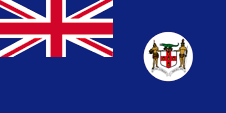
1906–1957,
Flagge der Regierung (Staatsflagge),
Seitenverhältnis = 1:2,
Quelle, nach:
Wikipedia (DE)
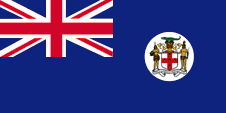
1957–1962,
Flagge der Regierung (Staatsflagge),
Seitenverhältnis = 1:2,
Quelle, nach:
Wikipedia (DE)
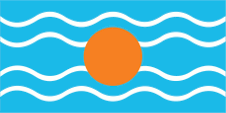
1958–1961,
Flagge der Westindischen Föderation,
Seitenverhältnis = 1:2,
Quelle, nach:
Flags of the World
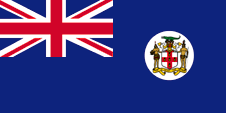
1962,
Flagge der Regierung (Staatsflagge),
Seitenverhältnis = 1:2,
Quelle, nach:
Wikipedia (DE)
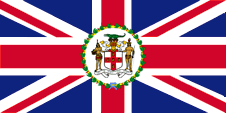
1957–1962,
Flagge des Gouverneurs,
Seitenverhältnis = 1:2,
Quelle, nach:
Wikipedia (DE)
Die heutige Flagge wurde erstmals am 06.08.1962 anlässlich der Unabhängigkeit des Landes offiziell gehisst. Die Flagge wird durch ein gelbes (goldenes) Schrägkreuz in zwei grüne und zwei schwarze dreieickige Felder geteilt. Das Grün steht für die Hoffnung und die Landwirtschaft, das Gelb (Gold) für das Sonnenlicht und die Naturschätze, und das Schwarz für die Schwierigkeiten der Vergangenheit, aber auch der Gegenwart. Die Farben der Flagge wurden bei einem zuvor veranstalteten Wettbewerb festgelegt. Ursprünglich war Jamaika eine britische Kolonie. Die Flagge war in dieser Zeit ein sogenannter "Blue Ensign", ein dunkelblaues Flaggentuch mit einer Flaggendarstellung – dem britischen Union Jack – in der Oberecke. Der Union Jack wies auf die Verbindungen zu Großbritannien hin. Großbritannien hatte in Jahr 1864 ein Flaggensystem eingeführt, in dem:
• Kriegsschiffe einen sogenannten "White Ensign" (Marineflagge), eine weiße Flagge oft mit durchgehendem roten Georgskreuz und mit dem Union Jack in der Oberecke,
• Handelsschiffe einen "Red Ensign" (auch "Civil Ensign" → Bürgerflagge genannt, die eigentl. Handelsflagge), eine rote Flagge mit dem Union Jack in der Oberecke, und
• Dienstschiffe einen "Blue Ensign" (Regierungsflagge → die eigentl. Staatsflagge), eine blaue Flagge mit dem Union Jack in der Oberecke führten.
Seit 1865 durften Schiffe von Kolonialregierungen einen Blue Ensign mit einem Badge (Abzeichen) im fliegenden Ende führen. Die jeweiligen Regierungen sollten entsprechene Bagdes zur Verfügung stellen. Handelsschiffe und seefahrende Privatpersonen aus Kolonien dürfen nur dann einen Red Ensign mit Badge führen, wenn von der britischen Admiralität eine entsprechende Erlaubnis für die Kolonie erteilt wurde. Das Badge von 1875 zeigte das heutige Wappenschild als Oval, mit dem Helm und dem Krokodil darüber. Ab 1906 erschien das Wappen im Blue Ensign – der Dienstflagge der Kolonie – in der weißen Scheibe. Die Farben der Flagge von Jamaika sind, außer Schwarz, wie folgt festgelegt: Gelb = Pantone 109, Grün = Pantone 355. Soweit die Flaggen britischen Vorgaben folgen, gelten hier zusätzlich: Blau = Pantone 280, Rot = Pantone 186.
Quelle:
Die Welt der Flaggen,
Flaggen Wappen Hymnen,
Flaggen und Wappen der Welt,
Flags of the World
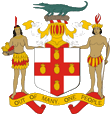
Wappen von Jamaika,
Quelle, nach:
Corel Draw 4
Das Wappen wurde bereits im Jahre 1661 der damaligen britischen Kolonie verliehen. Es zeigt in Silber (Weiß) ein rotes Kreuz (Georgskreuz), belegt mit fünf goldenen (gelben) Ananasfrüchten. Über dem Schild ein Helm, und auf dem Helm ein Krokodil auf einem Baumstamm. Als Schildhalter dient ein Arawak-Indianerpaar, welches auf einem Spruchband steht. Ab 1906 wurde das Wappen auch im Blue Ensign – der Dienstflagge der Kolonie – in einer weißen Scheibe gezeigt. Vorher (seit 1875) erschien dort nur ein Badge. Dieses zeigte das Wappenschild als Oval, mit dem Helm und dem Krokodil darüber. Im Jahre 1957 wurde das Wappen leicht abgeändert, indem der Helm üppiger gestaltet und das Spruchband anders gefaltet wurde. Im Jahre 1962, dem Jahr der Unabhängigkeit, wurde das bisherige Motto im Spruchband "Indus uterque serviet uni" ("Beide Indien werden einem dienen") abgeändert in "Out of many, one People" ("Aus vielen ein Volk"). Außerdem änderte sich die Farbe des Bandes von Silber zu Gold.
Quelle:
Wikipedia (D),
Flaggen Wappen Hymnen,
Flaggen und Wappen der Welt
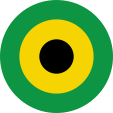
Flugzeugkokarde,
Quelle, nach: Wikipedia (EN)
Lage:
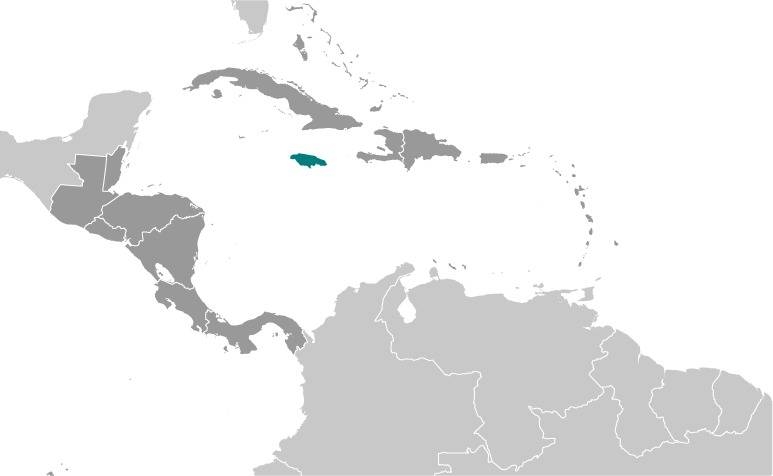
Quelle/Source: CIA World Factbook
Landkarte des Landes:
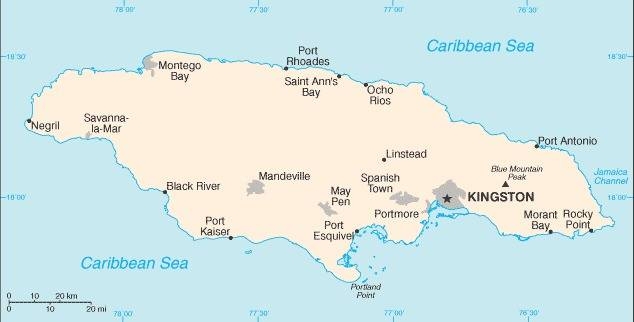
Quelle/Source: CIA World Factbook
Fläche: 10.991 km²
Einwohner: 3.000.000 (2020), davon 92,1% Afroamerikaner, 6,1% Mulatten, 0,8% Asiaten, 0,2% Europäer (einschl. 500 Deutsche) und Chinesen
Religionen: 53% Protestanten, 4% Katholiken, 3% Anglikaner, 1% Rastafari
Bevölkerungsdichte: 273 Ew./km²
Hauptstadt: Kingston, 648.683 Ew. (2010)
Amtssprache: Englisch
sonstige Sprachen: Kreolisches Englisch
Währung: 1 Jamaika-Dollar (JMD, J$) = 100 Cents
Zeitzone: MEZ – 6 h
Quelle:
1. Wikipedia (DE),
2. Wikipedia (EN),
"Hilfe für Deutsche im Osten Europas. Warum?", Bundesministerium des Inneren, 1992
1494 · von Kolumbus entdeckt
1510 · Kolonisierung durch Spanien
1536 · offizielle Spanische Kolonie im Besitz der Nachkommen des Kolumbus, der Herzöge von Veragua, Ausrottung der indianischen Ureinwohner
1655 · britische Eroberung, Ausbau zum Zentrum der britischen Besitzungen in Westindien
1795 · großer Sklavenaufstand
1834 · Abschaffung der Sklaverei
1866 · Kronkolonie
1940 · die USA pachten für die Dauer des Krieges auf Jamaika Militärstützpunkte
1943 · allgemeines Wahlrecht
1944 · neue Verfassung
1953 · Großbritannien gewährt beschränkte Selbstverwaltung
01.01.1958 · Bildung der Westindischen Föderation (Zusammenschluss fast aller britischen Besitzungen in der Karibik)
1961 · Gewährung vergrößerter Selbstverwaltung
19.09.1961 · erfolgreiche Volksabstimmung für das Verlassen der Westindischen Föderation (1962 aufgelöst)
06.08.1962 · Unabhängigkeit im Rahmen des Commonwealth of Nations
1972–1980 · Phase des Demokratischen Sozialismus, wirtschaftlicher Niedergang
1983 · Jamaika beteiligt sich an der US-amerikanischen Invasion auf Grenada
Quelle:
Atlas zur Geschichte,
Discovery '97,
Weltgeschichte,
Wikipedia (DE)
Der Name des Landes geht auf die Sprache der Kariben, der ausgestorbenen Indianerbevölkerung zurück. "Chaymaka" hieß in der Sprache der Kariben "die gut Bewässerte". Andere Quellen führen die Arawak-Indianer als Quelle an. Bei denen heißt "xaymaca" übersetzt "Quellenland". Auf welches Volk der Name wirklich zurückzuführen ist, lässt sich nicht zweifelsfrei ermitteln. Beide Völker lebten gleichzeitig auf der Insel.
Quelle:
Handbuch der geographischen Namen,
Wikipedia (D),
Atlas der wahren Namen