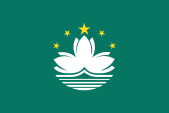
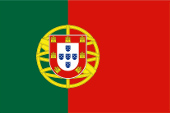
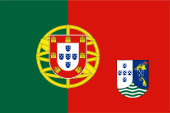
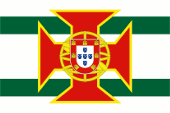
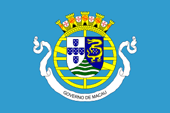
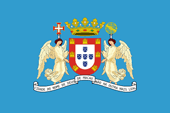
Die heutige Flagge von Macau war schon vor der Übergabe an China inoffiziell eingeführt worden, und war schon damals bei der Bevölkerung sehr beliebt. Sie zeigt auf grünem Hintergrund eine weiße Lotosblüte, darunter eine stilisierte Brücke, darüber ein Bogen aus fünf goldenen, fünfzackigen Sternen. Die Farben der Flagge werden folgendermaßen angegeben, hexadezimal: Grün = #067662, was Pantone 335 entsprechen würde, Gelb = #FFDF1E, was Pantone 108 entsprechen würde. In der Zeit als portugiesische Kolonie wurde ausschließlich die portugiesische Nationalflagge verwendet, da man die Kolonien als fester Bestandteil des Mutterlandes betrachtete, und nicht als Außenbesitzungen. Das bedeutete, das portugiesische Kolonien nie eigene Flaggen hatten, auch wenn es in den sechziger Jahren des 20. Jahrhunderts Bestrebungen gab Flaggen für die Kolonien einzuführen, indem man das Wappen der Kolonie in das fliegende Ende der portugiesischen Nationalflagge platzierte. Diese Pläne wurden jedoch nie realisiert.
Quelle:
Wikipedia (DE),
Wikipedia (EN)
Lage:
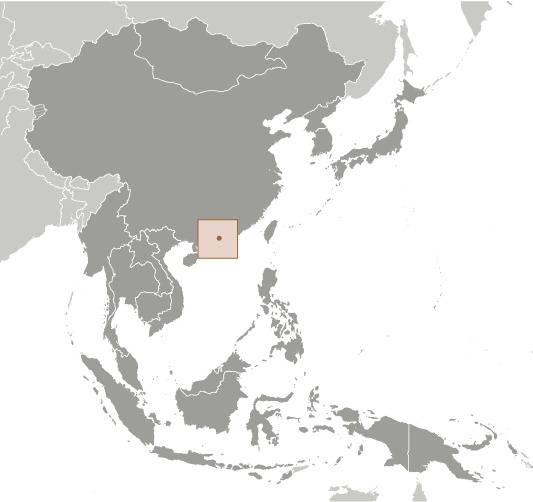
Quelle/Source: CIA World Factbook
Landkarte des Landes:
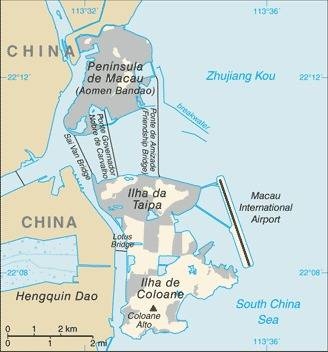
Quelle/Source: CIA World Factbook
Fläche: 30 km², davon Halbinsel Macao 6 km², Insel Taipa 3,8 km², Insel Coloane 7 km²
Einwohner: 646.800 (2015), davon 89% Chinesen, 1% Portugiesen
Religionen: 80% Buddhisten, 4% Katholiken, 1% Protestanten
Bevölkerungsdichte: 21.560 Ew./km²
Amtssprachen: Chinesisch, Portugiesisch
sonstige Sprachen: Englisch
Währung: 1 Pataca (MOP, Pat.) = 100 Avos
Zeitzone: MEZ + 7 h
Quelle:
Wikipedia (DE)
1513 · der portugiesische Seefahrer Jorge Álvares erreicht die Inseln von Macau
1557 · Portugal pachtet die Halbinsel Macau von China
1849 · Portugal besetzt die Inseln Taipa und Coloane und erklärt Macau zu portugiesischem Territorium, der Pachtvertrag erlischt
1887 · China erkennt Macau als portugiesische Kolonie an
1941 · Japan besetzt Macau
1945 · die japanischen Truppen in Macau kapitulieren
1951 · Macau wird portugiesische Überseeprovinz
1974 · Portugal will Macau an China zurückgeben, China lehnt ab
1976 · neuer Status für Macau: "autonomes Chinesisches Territorium unter portugiesischer Verwaltung"
1987 · Vertrag zwischen Portugal und China über die Rückgabe Macaus am 20.12.1999
20.12.1999 · Portugal übergibt Macau an China, Macau wird Besonderes Chinesisches Verwaltungsgebiet (SAR)
Quelle:
Wikipedia (D),
Discovery '97
Der Begriff "Macau" stammt eigentlich aus der chinesischen Sprache. Ursprünglich hieß die Bucht von Macau "A-Ma Gao" was "Bucht der Göttin A-Ma" heißt, und woraus die Portugiesen im 16. Jahrhundert "Macau" gemacht haben. Manchmal wurde auch der Begriff "Macao" verwendet. Der heutige chinesische Name "Aomen" hat damit nichts mehr zu tun. "Aomen" heißt "Tor zur Bucht".
Quelle:
Handbuch der geographischen Namen