| ` | |
|
|
| ` | |
| Übersicht Contents: | |
| Flaggen Flags: |
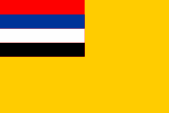
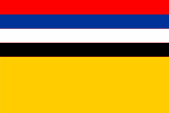
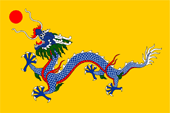
| Die Flagge von Mandschukuo stellt eine Art Kombination zwischen der Flagge des chinesischen Kaiserreichs (bis 1912) und der Flagge der ersten chinesischen Republik (19121928) dar. | The flag of
Manchoukuo is something like a special kind of combination between the flag of the Chinese
Empire (until 1912) and the flag of the first Chinese republic (19121928). |
||
| Die Flagge des Kaiserreichs war gelb mit einem blauen Drachen, der den Osten darstellte. Die Farbe Gelb ist die Farbe der Mandschuren und die Farbe der mandschurischen Qing-Dynastie, die China beherrschte. An ihre Stelle trat 1912 in China eine Flagge mit fünf waagerechten Streifen, welche die fünf Rassen Chinas repräsentieren sollten (Han-Chinesen, Mandschuren, Mongolen, Hui & Turkestaner und Tibeter), wobei Rot, die Farbe der Han, oben lag. |
|
The flag of the empire was yellow with a blue dragon which represents the East. The colour yellow is the colour of the Manchou and the colour of the Manchou Qing-Dynasty which ruled China. Instead of it arised in 1912 in China a flag with five horizontal stripes which should represent the five races of Chinas (Han-Chinese, Manchou, Mongols, Hui & Turkestans abd Tibetans) and red the colour of the Han was positioned uppermost. |
|
| Der gelbe Streifen, die Farbe der Mandschuren lag an zweiter Stelle. Er wurde aus der Farbreihenfolge entfernt und ganz nach unten gesetzt, um so den Platz für die große gelbe Fläche des Flaggentuches zu ermöglichen. | The yellow stripe the colour of the Manchou was positioned on the second place. It was removed from the colour-sequence and inserted lowermost to make possible in this way the space for the large yellow area of the bunting. | ||
| Wappen Coat of Arms: | ||
|
||
| Das Wappen von Mandschukuo ist ohne Zweifel ein sogenanntes Mon, eine im fernöstlichen Raum häufige, oft symmetrische, stark stilisierte bildhafte Darstellung, die als heraldisches Element genutzt wurden und werden. Hier handelt es sich um eine Blüte, möglicherweise inspiriert von der kaiserlich japanischen Chrysantheme. | The coat of arms of Manchoukuo
is doubtless a so named Mon an in the far eastern region spread, mostly symmetrical very
stylized pictorial representation which have beeen and which are used as heraldical
element. This is a blossom, possibly inspired by the imperial Japanese chrysanthemum. |
| Zahlen und Fakten im Jahre 1943 Numbers and Facts in 1943: | |
|
|
|
|
|
|
|
|
|
|
|
|
|
|
|
|
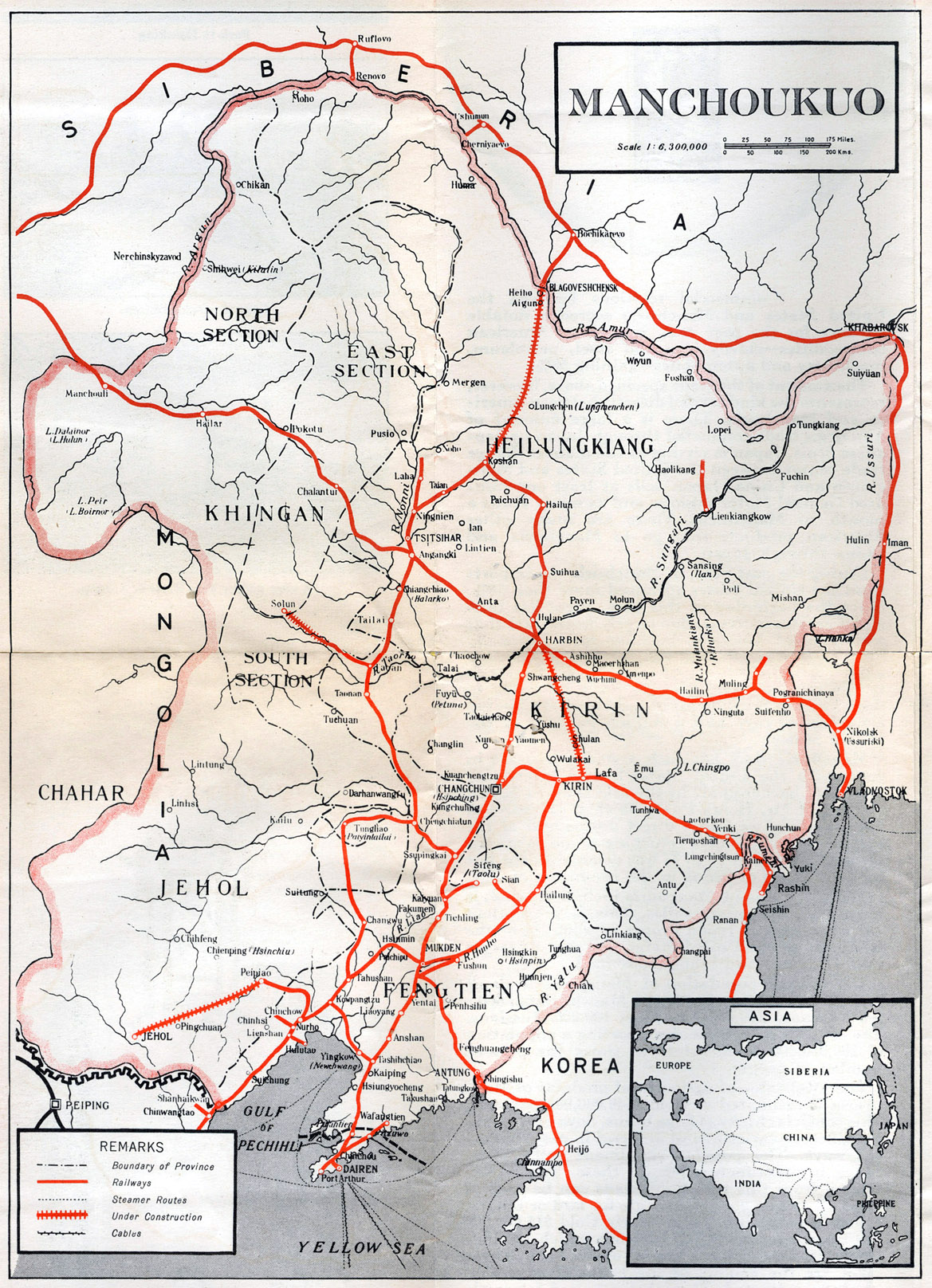
| Antike · Besiedelung durch tungusische
und mongolische Stämme 1368ca.1580 · Ming-Dynastie in China, das Land ist von China abhängig ca.1580 · das tungusische Volk der Mandschu erobert unter dem Feldherrn Nurhadschi von Nordosten kommend die heutige Mandschurei 1644 · die Mandschuren erobern die chinesische Hauptstadt Peking, stürzen die Ming-Dynastie und etablieren die Qing-Dynastie (auch Mandschu-Dynastie, 16441912) ca.1880 · wachsender Einfluss Russlands in der Mandschurei 18941895 · chinesisch-japanischer Krieg 1896 · Russland erhält Eisenbahnbaukonzessionen in der Mandschurei 1900 · Russland besetzt die Mandschurei 19041905 · russisch-japanischer Krieg 1905 · trotz Anerkennung der chinesischen Hoheitsrechte in der Mandschurei durch Russland und Japan teilen beide Länder die Mandschurei in zwei Einflusssphären unter sich auf 1912 · Sturz der Monarchie in China, Proklamation der Republik 19161928 · Bürgerkrieg in China 1918 · der chinesische Marschall Zhang Zuolin bringt die Mandschurei unter seine Kontrolle und wird in der Folgezeit von Japan unterstützt => steigender Einfluss Japans in der Mandschurei 1931 · militärische Intervention Japans in der Mandschurei 1932 · Gründung des Staates Mandschukuo als Japanischer Satellitenstaat, der letzte chinesische Kaiser Pu-Yi aus der mandschurischen Qing-Dynastie wird Regent von Mandschukuo 1933 · Anschluss des chinesischen Rehe-Gebietes an Mandschukuo (zwischen den Flüssen Luan und Liao) 1934 · Pu-Yi wird Kaiser von Mandschukuo August/September 1945 · sowjetische und mongolische Truppen erobern Mandschukuo, stürzen das Kaiserreich, vertreiben die Japaner und übergeben Mandschukuo den kommunistischen chinesischen Partisanen die es als Rückzugs- und Reorganisationsraum nutzen 19451951 · Bürgerkrieg in China (Nationalchinesische Regierung der Guomindang gegen kommunistische Partisanen) 01.10.1949 · Proklamation der Volksrepublik China (unter Einschluss der Mandschurei) durch die überlegenen kommunistischen Partisanen, die mittlerweile den größten Teil Chinas kontrollieren, die Mandschurei wird dabei auf die Provinzen Heilongjiang, Jilin, Liaoning, Hebei und das Gebiet der Inneren Mongolei aufgeteilt |
| ` |
| ` |
| antiquity · settlement by Tungusian
and Mongolian tribes 1368ca.1580 · Ming-Dynasty in China, the country is dependent from China ca.1580 · the Tungusian people of the Manchou conquers coming from the northeast under the General Nurhadji the today's Manchouria 1644 · the Manchou conquer the Chinese capital Peking, unseat the Ming-Dynasty and establish the Qing-Dynasty (as well Manchou-Dynasty, 16441912) ca.1880 · soaring influence of Russia in Manchouria 18941895 · Chinese-Japanese War 1896 · Russia gets railroad construction licences in Manchouria 1900 · Russia occupies Manchouria 19041905 · Russian-Japanese War 1905 · despite the acceptance of the Chinese right of the state in Manchouria by Russia and Japan both countries partition Manchouria in two zones of influence 1912 · overthrow of the monarchy in China, proclamation of the republic 19161928 · civil war in China 1918 · the Chinese Marshal Zhang Zuolin takes Manchouria under his control and gets in the afteryears supported by Japan => soaring influence of Japan in Manchouria 1931 · military intervention of Japan in Manchouria 1932 · establishment of the State of Manchoukuo as Japanese satellite state, the last Chinese Emperor Pu-Yi from the Manchou Qing-Dynasty becomes Regent of Manchoukuo 1933 · annexion of the Chinese Rehe-Area to Manchoukuo (between the rivers Luan and Liao) 1934 · Pu-Yi becomes Emperor of Manchoukuo August/September 1945 · Soviet and Mongol troops invade Manchoukuo, unseat the empire, banish the Japanese and give Manchoukuo up to the communist Chinese partisans which use it as retreating room and for re-organization 19451951 · civil war in China (the National-Chinese government of the Guomindang against communist partisans) 1st of October 1949 · proclamation of the People's Republic of China (under inclusion of Manchouria) by the superior communist partisans which meanwhile control the largest part of China, Manchouria gets with it partitioned under the die provinces of Heilongjiang, Jilin, Liaoning, Hebei and the Territory of the Inner Mongolia |
| Die Bezeichnung "Mandschukuo" meint die chinesischen Worte "Mandju Guo", was soviel heißt wie "Staat der Mandschu" (Mandschurei). | The designation "Manchoukuo" means the Chinese words "Mandju Guo", what something means like "State of the Manchou" (Manchouria). |