mobile Ansicht, to the English Version tap the flag

- Republik Nauru
- präsidiale Republik mit parlamentarischen Ansätzen
- Eigenbezeichnung: Naoero
• Flagge
• historische Flaggen
• Bedeutung/Ursprung der Flagge
• Wappen
• Bedeutung/Ursprung des Wappens
• Landkarte
• Zahlen und Fakten
• Geschichte
• Ursprung des Landesnamens
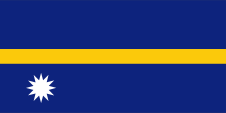
Nationalflagge,
Seitenverhältnis = 1:2,
Quelle, nach: Flags of the World


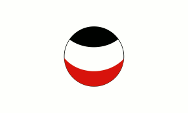
1888–1906,
Flagge der Jaluit-Gesellschaft,
Quelle, nach: Wikipedia (DE)

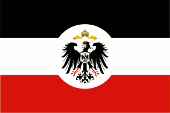
1888–1914,
Deutsches Reich,
Dienstflagge Kolonialamt / Auswärtiges Amt,
Seitenverhältnis = 2:3,
Quelle, nach: Flags of the World
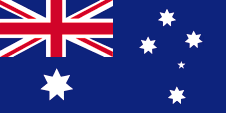
1920–1942, 1945–1968,
Flagge Australiens,
Seitenverhältnis = 1:2,
Quelle, nach: Flags of the World
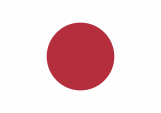
1942–1945,
Flagge Japans,
Seitenverhältnis = 7:10,
Quelle, nach: Wikipedia (EN)
Die am 31.01.1968 (Tag der Erlangung der Unabhängigkeit) eingeführte Flagge zeigt auf blauem Feld einen waagerechten gelben Streifen in der Mitte, sowie im linken unteren Bereich einen zwölfstrahligen weißen Stern. Die Flagge veranschaulicht so die geographische Lage des Inselstaats. Er liegt dicht unter dem Äquator und westlich der internationalen Datumsgrenze. Der zwölfstrahlige weiße Stern steht für die zwölf Stämme von Nauru, von denen jedoch zwei inzwischen ausgestorben sind. Die Farben der Flagge scheinen heute folgendermaßen definiert zu sein, und zwar: Blau = Pantone 280, Gelb = Pantone 123.
Quelle:
Flaggen Wappen Hymnen, Wikipedia (D)
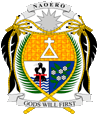
Wappen von Nauru,
Quelle: Princeaus, Public domain,
via Wikimedia Commons
Das Staatswappen von Nauru zeigt auf einem von Palmwedeln umgebenen Schild in der oberen Hälfte das alte alchemistische Symbol für Phosphor, Phosphate waren der wirtschaftliche Reichtum des Landes. In der unteren Hälfte ein Fregattvogel und ein Zweig Tomanoblüten. Über dem Schild, unter einem Band mit dem Namen des Landes, erscheint der zwölf-strahlige Stern, die zwölf Stämme von Nauru symbolisierend. Unterhalb des Wappenschildes erscheint ein Spruchband mit dem Motto des Landes: "Gods will first" → "Gottes Wille zuerst".
Quelle:
Flaggen Wappen Hymnen, Wikipedia (D)
Lage:
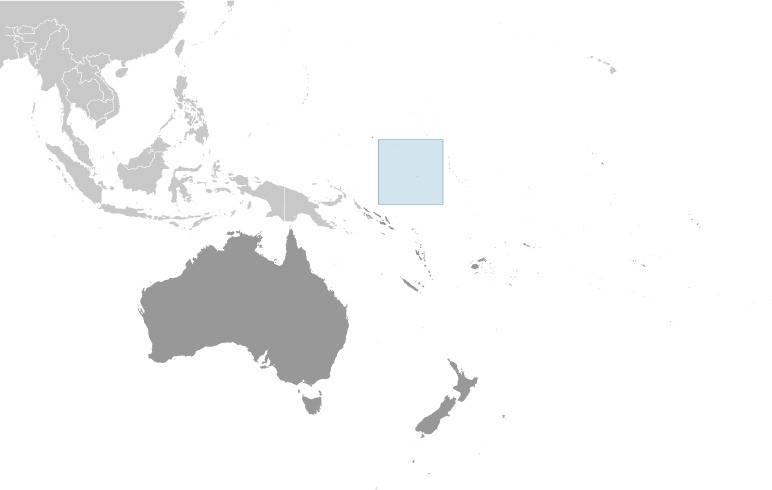
Quelle: CIA World Factbook
Landkarte des Landes:
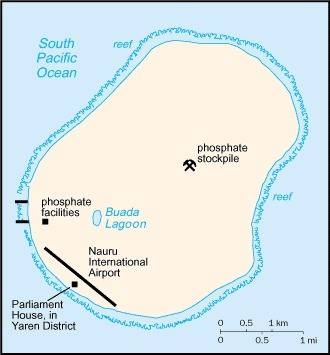
Quelle: CIA World Factbook
Fläche: 21 km²
Einwohner: 11.550 (2019), davon 95% Nauruer, 3% andere Ozeanier
Religionen: 60% Protestanten, 33% Katholiken
Bevölkerungsdichte: 550 Ew./km²
Hauptstadt: Yaren, 810 Ew. (2019)
Amtssprachen: Englisch, Nauruisch
Währung: australische Währung
Zeitzone: MEZ + 11 h
Quelle:
Wikipedia (D)
1798 · Entdeckung der von Polynesiern bewohnten Insel, anschließend vereinzelte private Kolonisierung durch Briten
1830 · Briten siedeln sich an
1878 · Beginn eines Stammeskrieges der einem Drittel der Bevölkerung das Leben kosten wird
1886 · Abkommen von Berlin, das Deutsche Reich und Großbritannien regeln die Aufteilung ihrer Interessensphären im Westpazifik, Nauru wird deutsches Interessengebiet
02.10.1888 · das Deutsche Reich errichtet sein Protektorat über Nauru und beendet den Stammeskrieg, Nauru wird den Marshallinseln angeschlossen, die Verwaltung vor Ort wird von der Deutschen Jaluit-Gesellschaft wahrgenommen
1899 · Beginn der christlichen Missionierung
1906 · die Marshall-Inseln (einschl. Nauru) werden als Bezirk Jap an die Kolonie Deutsch-Neuguinea angeschlossen
1914 · Erster Weltkrieg, britische und australische Truppen besetzen Kaiser-Wilhelm-Land
1920 · Versailler Diktat, das Deutsche Reich verliert alle seine Kolonien, die Insel Nauru wird (wie ganz Kaiser-Wilhelm-Land) ein Mandatsgebiet des Völkerbundes unter australischem Mandat
1942–45 · Zweiter Weltkrieg, Besetzung durch japanische Truppen
1945 · Australien besetzt Nauru erneut
1947 · die Mandatsverwaltung des Völkerbundes endet, Nauru wird als UNO-Treuhandgebiet von Australien weiter verwaltet
31.01.1968 · Unabhängigkeit
01.05.1999 · Nauru wird Vollmitglied des Commonwealth of Nations
Quelle:
Atlas zur Geschichte,
World Statesmen,
Wikipedia (D)
Die Herkunft des Wortes "Nauru" ist nicht geklärt. Die Nauruer nannten ihre Insel damals wie heute "Naoero". Das Wort "Nauru" wurde später aus "Naoero" geschaffen, damit Europäer und Amerikaner den Namen der Insel richtig aussprechen können. Die Insel hatte auch weitere Namen: Die englischen Kolonialisten vor 1888 nannten die Insel "Pleasant Island" oder "Shank Island", die deutschen Kolonialherrscher "Nawodo" oder "Onawero".
Quelle: Wikipedia (D)