mobile Ansicht, to the English Version tap the flag

- ehemaliges österreichisches Kronland: Königreich Dalmatien
- heute Landesteil Kroatiens an der Adriaküste gelegen
- Eigenbezeichnung in Deutsch: Königreich Dalmatien
- Eigenbezeichnung in Kroatisch: Kraljevina Dalmacija
- Eigenbezeichnung in Italienisch: Regno di Dalmazia
• Flagge
• Bedeutung/Ursprung der Flagge
• Wappen
• Bedeutung/Ursprung des Wappens
• Landkarte der früheren Kronländer Österreich-Ungarns (bis 1918)
• Zahlen und Fakten
• Geschichte
• Ursprung des Landesnamens
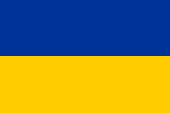
bis 1918,
Landesflagge (Landesfarben),
Seitenverhältnis = 2:3,
Quelle, nach:
Flags of the World



Das Land hatte, wie alle Kronländer der österreichischen Krone, seine eigenen, sogenannten Landesfarben, die unter anderem auf horizontal getreiften zwei- oder dreistreifigen Flaggen gezeigt wurden. Die Landesfarben waren sehr oft dem jeweiligen Wappen des Kronlandes entnommen oder wurden duch eine weitere, nicht im Wappen enthaltene Farbe ergänzt, oder sie gingen auf ältere Modelle des Landeswappens zurück (z.B. Krain). Offiziell waren die Landesfarben aber nie geregelt oder festgelegt worden, so dass deren Reihenfolge in der Praxis of variierte oder die Farben gar an sich abwichen. Der österreichische Heraldiker Hugo Gerard Ströhl (1851–1919) hat sich wohl als erster des Themas angenommen und wahrscheinlich um das Jahr 1890 herum die Landesfarben auf den Flaggen bei den jeweiligen Landesbehörden abgefragt und zusammengestellt. Das Kronland Dalmatien verwendete als Landesfarben eine Flagge die zwei horizontale Streifen in Blau und Gold zeigte. Die Farben stammen vom Wappen Dalmatiens: drei goldene Löwenköpfe auf blauem Schild. Die Farbreihenfolge ist somit heraldisch nicht korrekt.
Quelle: Österreichisch-Ungarische Wappenrolle,
Flags of the World,
Volker Preuß
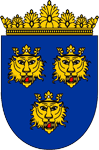
bis 1918,
Wappen von Dalmatien,
Quelle, nach: Ströhl, Wappenrolle Österreich-Ungarns, 1890, via austria-forum.org
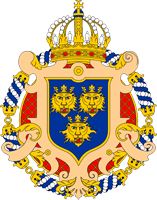
ca.1890–1918,
Wappen Königreich Dalmatien,
Quelle, nach: Ströhl, Wappenrolle Österreich-Ungarns, 1890, via Wikipedia (D)
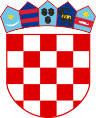
Wappen von Kroatien,
Quelle, nach: Wikipedia (D)
Das Wappen Dalmatiens zeigt drei goldene gekrönte Löwenköpfe auf blauem Schild. Der österreichische Heraldiker Hugo Gerard Ströhl hat das Wappen um 1890 mit einem dekorativen Rand umgeben. Dalmatiens Heraldik erscheint seit 1992 in einem der fünf Regionalwappen im Schildhaupt des Staatswappens von Kroatien, allerdings ist das Wappenschild hellblau.
Quelle: Österreichisch-Ungarische Wappenrolle,
Wikipedia (D),
Volker Preuß
Karte ca. 1910:
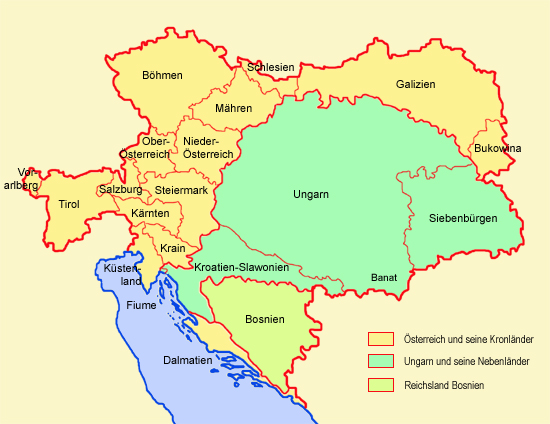
Quelle: Volker Preuß
Fläche: 12.832 km² (1880)
Einwohner: 476.100 (1880), davon 93% Kroaten und Serben, 6% Italiener, 0,7% Deutsche
Bevölkerungsdichte: 37 Ew./km² (1880)
Hauptstadt: Split (ital.: Spalato), 14.500 Ew. (1880)
Sprachen (1890): Serbisch/Kroatisch, Italienisch, Deutsch
Währung: bis 1918 Österreichisch-Ungarische Währung, ab 1918 Jugoslawische Währung, ab 1941 Kroatische Währung, ab 1945 Jugoslawische Währung, ab 1991 Kroatische Währung
Zeitzone: MEZ
Quelle: Meyers Konversationslexikon,
Wikipedia (EN)
200 v. Chr. · die Stadt Dalmium (in der Nähe der heutigen Stadt Split) ist Hauptstadt des Staates Dalmatia
168 v. Chr. · das Römische Reich erobert Dalmatien südlich des Flusses Neretva
156 v. Chr. · das Römische Reich erobert die Küste Dalmatiens
78 v. Chr. · die Eroberung Dalmatiens durch das Römische Reich ist abgeschlossen, jedoch Aufstände und Bürgerkrieg
10 n.Chr. · die Römische Herrschaft ist gefestigt, Bildung der Provinz Illyricum (heutiges Dalmatien, Kroatien, Herzegowina)
395 · bei der Teilung des Römischen Reiches kommt das heutige Dalmatien an das Weströmische Reich
423 · Tod des ersten weströmischen Kaisers Flavius Honorius, Dalmatien kommt an das Oströmische Reich
454–468 · Dalmatien gehört zum Reich des Marcellinus
489–553 · Dalmatien gehört zum Reich der Ostgoten
545–569 · Dalmatien gehört zum Oströmischen Reich
569–598 · Eroberung durch die Awaren
ca. 620 · Inbesitznahme durch einwandernde Kroaten und Serben
ca. 795 · die Kroaten (im Norden Dalmatiens) werden vom Fränkischen Reich abhängig, die Inseln und einige Küstenstädte verbleiben beim Oströmischen Reich
1052 · König Crescimir Peter von Kroatien nimmt den Titel "König von Dalmatien" an
1150 · Aussterben der "Könige von Kroatien und Dalmatien", Erbfolgekriege zwischen Ungarn und Venedig
1242 · Mongoleninvasion
1433 · Waffenstillstand zwischen Ungarn und Venedig, Teilung Dalamtiens, die kroatisch besiedelten Teile kommen an Ungarn, der Rest an Venedig
1462 · beginnende Türkeneinfälle, Venedig kann seine Besitzungen in Dalmatien erfolgreich verteidigen
21.07.1718 · Friede von Passarowitz nach den Türkenkriegen, Venedig dehnt seinen Besitz in Dalmatien bis an die heutige Grenze zwischen Kroatien und Bosnien aus
1797–1809 · Französische Revolutionskriege: ein Teil Österreichs (Steiermark) wird 1797 von den Franzosen besetzt
12.05.1797 · Friede von Campo Formio zwischen Österreich (Haus Habsburg) und Frankreich (Napoléon I.), Dalmatien kommt als Königreich von Venedig an das Haus Habsburg
1809 · Friede von Wien, Österreich verliert Salzburg, das Innviertel, Westgalizien und Teile von Ostgalizien und tritt Istrien, Triest, Görz, Krain, Kärnten, Kroatien, und Dalmatien an Frankreich ab, die 1810 zu den französischen "Illyrischen Provinzen" zusammengefasst werden
1813 · Österreich erklärt Frankreich (Napoléon) den Krieg
1814/1815 · Wiener Kongress, Neuordnung Europas nach der Ära Napoléon, das Kaiserreich Österreich (Haus Habsburg) erhält die 1809 verlorenen Gebiete zurück; Istrien, Triest, Görz, Kärnten und Krain werden zum Habsburgischen Königreich Illyrien zusammengefasst, Dalmatien und Kroatien werden wieder an Ungarn (unter den Habsburgern, Teil des Kaiserreichs Österreich) angeschlossen
1848/1849 · Revolution in Wien, Bürgerkrieg zwischen Ungarn und Kroaten, Aufstände in Prag, Mailand und Venedig, daraufhin dankt Kaiser Ferdinand I. ab und Franz Joseph I. von Habsburg wird neuer Kaiser, die Aufstände werden niedergeschlagen und er erlässt eine neue Verfassung: die Titular-Erblande der Habsburger im Kaiserreich Österreich werden zu Kronländern mit eigenen Landtagen umgewandelt, der dalmatische Landtag lehnt den Anschluss an Kroatien ab, das Königreich Dalmatien wird ein eigenes Kronland der österreichischen Krone, Kroatien und Slawonien werden zum "Königreich Kroatien und Slawonien" vereinigt, das als Nebenland bei der ungarischen Krone verbleibt, Auflösung des Königreichs Illyrien: Aufteilung in die Kronländer Krain, Kärnten, Küstenland, Kroatien und Slawonien und Dalmatien
1861 · Forderungen der Slawen in Dalmatien nach der Bildung eines "dreieinigen Königreichs" aus Kroatien, Slawonien und Dalmatien (einschl. Bosnien und Herzegowina)
08.02.1867 · Österreichisch-Ungarischer Ausgleich, gleiches Recht für beide Landesteile, Entstehung der Doppelmonarchie Österreich-Ungarn, Österreich: bestehend aus den österreichischen Kronländern, Ungarn: bestehend aus Ungarn selbst und seinen Nebenländern, das Haus Habsburg stellt in einer Person den Kaiser von Österreich und den König von Ungarn, Einrichtung von gemeinsamen Ministerien in Außenpolitik, Finanzen und Verteidigung
1868 · Ungarisch-Kroatischer Ausgleich, Kroatien und Slawonien verbleiben zusammen als Königreich "Kroatien-Slawonien" unter der ungarischen Krone, Fiume wird freie Stadt (quasi Kronland) innerhalb Ungarns
1869 · Aufstand in Càttaro (Kotor)
1878 · Österreich-Ungarn besetzt Bosnien und Herzegowina
1881 · erneut Aufstand in Càttaro (Kotor)
1918 · Ende des Ersten Weltkriegs, Zusammenbruch der Kaiserlich-Königlichen Monarchie, Zerfall von Österreich-Ungarn in Nationalstaaten, Dalmatien und Slawonien kommen an Kroatien, Vereinigung von Kroatien, Slowenien, Serbien und Montenegro zum "Königreich der Serben, Kroaten und Slowenen" (ab 1929 Jugoslawien genannt)
Quelle: Atlas zur Geschichte,
Wikipedia (D),
RetroBib Retrobibliothek,
Discovery '97,
Volker Preuß
Der Name "Dalmatien" geht auf die antike Stadt "Dalmium" (auch "Delminium" genannt) in der Nähe der heutigen Stadt Split zurück. In dem Wort selbst steckt das illyrische Wort "dhal", was "Schaf" heißt.
Quelle: Meyers Konversationslexikon,
Indogermanisches Etymologisches Woerterbuch
weitere Seiten zu Österreich (historische Flaggen und Wappen):
• Reich der Österreichischen Habsburger (bis 1804)
• Kaiserreich Österreich (1804–1867)
• Österreich-Ungarn (1867–1918)
• Republik Österreich (seit 1918)