mobile Ansicht, to the English Version tap the flag

- Krain, slowenisch: Kranjska
- ehemaliges österreichisches Kronland: Herzogtum Krain
- heute zentraler Landesteil Sloweniens
• Flaggen
• Bedeutung/Ursprung der Flagge
• Wappen
• Bedeutung/Ursprung des Wappens
• Landkarte der früheren Kronländer Österreich-Ungarns (bis 1918)
• historische Landkarten zu Krain
• Zahlen und Fakten
• Geschichte
• Ursprung des Landesnamens
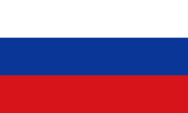
1848–1919,
Landesflagge (Landesfarben),
Seitenverhältnis = 2:3,
Quelle, nach:
Wikipedia (EN)


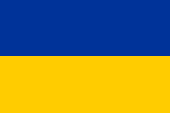
bis 1848,
Landesflagge (Landesfarben),
Quelle, nach:
Wikipedia (D)


Das Land hatte, wie alle Kronländer der österreichischen Krone, seine eigenen, sogenannten Landesfarben, die unter anderem auf horizontal getreiften zwei- oder dreistreifigen Flaggen gezeigt wurden. Die Landesfarben waren sehr oft dem jeweiligen Wappen des Kronlandes entnommen oder wurden duch eine weitere, nicht im Wappen enthaltene Farbe ergänzt, oder sie gingen auf ältere Modelle des Landeswappens zurück (z.B. Krain). Offiziell waren die Landesfarben aber nie geregelt oder festgelegt worden, so dass deren Reihenfolge in der Praxis of variierte oder die Farben gar an sich abwichen. Der österreichische Heraldiker Hugo Gerard Ströhl (1851–1919) hat sich wohl als erster des Themas angenommen und wahrscheinlich um das Jahr 1890 herum die Landesfarben auf den Flaggen bei den jeweiligen Landesbehörden abgefragt und zusammengestellt.
Das Herzogtum Krain verwendete als Landesfarben ursprünglich die Farben Blau und Gold. Die Farben stammen vom Wappen Krains aus dem 16. Jahrhundert. Im Jahre 1836 stellte Kaiser Ferdinand I. von Österreich das Landeswappen in seiner ursprünglichen Färbung mit dem silbernen Schild wieder her. Die Landesfarben verblieben jedoch unverändert in Blau und Gold. Auf Initative des Kommandanten der Nationalgarde von Laibach, des Slowenischen Vereins und mehrerer krainischer Reichstagsabgeordenten entstanden 1848 neue Landesfarben. Auf der Flagge waren sie als drei horizontale Streifen in Weiß, Blau und Rot angeordnet. Das Innenministerium des Kaiserreichs Österreich empfahl am 23.09.1848 (Eröffnung, Aktenzeichen Z. 2778) die Farben anzunehmen, jedoch nur, wenn Wappen und Siegel unverändert bleiben und keinerlei andere Rechte daraus abgeleitet werden. Das illyrische Landespräsidium setzte die Entscheidung am 29.09.1848 ger Gesetz um (Aktenzeichen Z. 241/P), was im Amtsblatt "Laibacher Zeitung" vom 03.10.1848, Seite 599 bekannt gegeben wurde. Einerseits nahmen die Krainer damit die Farben des Herzogtums Krain aus der Zeit vor 1463 als die ihren an, andererseits nahmen sie eine Flagge in den "Panslawische Farben" an – eine exakte Kopie der russischen Flagge. Krain ist das Kernland des heutigen Slowenien, das diese Farben noch immer nutzt.
Quelle: Wikipedia (D),
Wikipedia (EN),
Österreichisch-Ungarische Wappenrolle
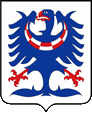
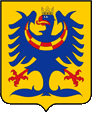
bis 1463,
Wappenschild von Krain,
Quelle, nach: Wikipedia (D)
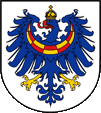
1463–1836,
Wappenschild von Krain,
Quelle, nach: Wikipedia (D)
1836–1919,
Wappenschild von Krain,
Quelle, nach:
Wikipedia (EN)
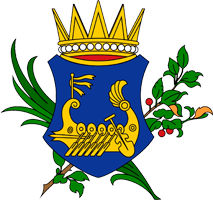
1816–1849,
Krain gehört zum Habsburgischen Königreich Illyrien,
Quelle, nach: Ströhl, Wappenrolle Österreich-Ungarns, 1890, via Wikipedia (D)
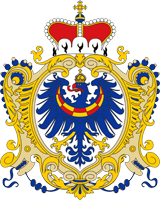
ca.1890–1918,
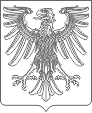
Wappen Herzogtum Krain,
Quelle, nach: Ströhl, Wappenrolle Österreich-Ungarns, 1890, via Wikipedia (D)
Das Wappen Krains zeigte ursprünglich einen blauen Adler mit roter Bewehrung auf silbernem Schild, belegt mit einem zehnmal in Rot und Silber geschachten Brustmond (auch Spange genannt). Im Jahre 1463 wurde das Wappen auf Veranlassung von Kaiser Friedrich III. geändert. Die Krainer standen Kaiser Friedrich III. im Jahre 1462 bei, als er in der Wiener Burg von seinem Bruder Albrecht VI. belagert wurde. Zum Dank besserte er das Wappen des Herzogtums. Das Wappen Krains zeigte nun einen blauen Adler mit roter Bewehrung auf goldenem Schild. Die Farben des Brustmonds wechselten zu Rot und Gold und der Adler trägt eine Krone. Im Jahre 1836 stellte Kaiser Ferdinand I. von Österreich das Landeswappen in seiner ursprünglichen Färbung mit dem silbernen Schild wieder her. Als Habsburgisches Kronland trug das Wappen einen Fürstenhut.
Quelle: Wikipedia (D),
Wikipedia (EN),
Österreichisch-Ungarische Wappenrolle
Lesen Sie hier:
Hintergründe, Geschichte und Fakten zum Thema "Der Adler in der Heraldik"; Ausführungen, Varianten und Entwicklung.
Karte ca. 1910:
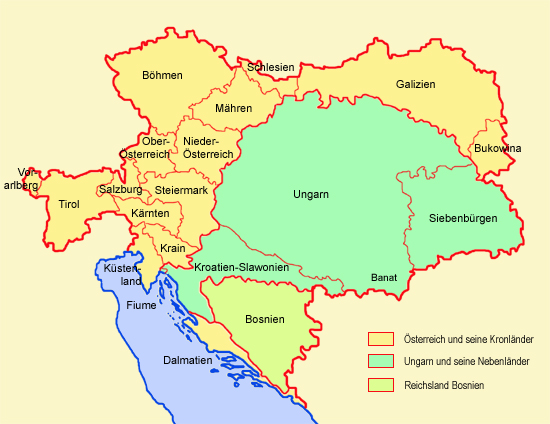
Quelle: Volker Preuß
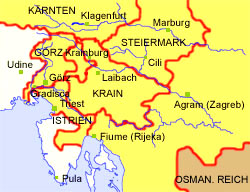
ca. 1526
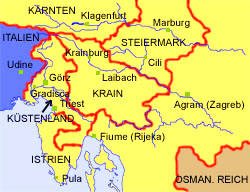
1849
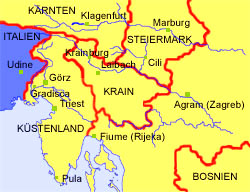
1880
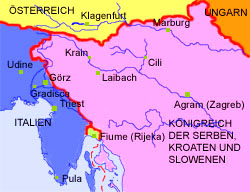
1921
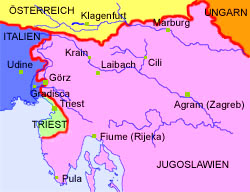
1950
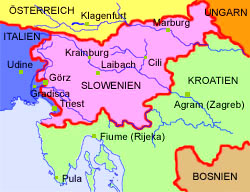
2005
Landkarte: Volker Preuß
Fläche: 10 033 km² (1880)
Einwohner: 481 250 (1880), davon 92% Slowenen, 6% Deutsche, 2% Kroaten
Bevölkerungsdichte: 48 Ew./km² (1880)
Hauptstadt: Laibach (heutiger Name: Ljubljana), 26.284 Ew. (1880), 284.355 Ew. (2019)
Sprachen (1880): Slowenisch, Deutsch
Währung: bis 1918 Österreichische Währung, ab 1918 Jugoslawische Währung, ab 1941 Deutsche/Italienische Währung, ab 1945 Jugoslawische Währung, ab 1991 Slowenische Währung
Zeitzone: MEZ
Quelle: Meyers Konversationslexikon,
zeitzonen.de
ca. 15 n.Chr. · die Eroberung des heutigen Krain durch das Römische Reich ist abgeschlossen, zur Provinz Pannonia Superior
395 · bei der Teilung des Römischen Reiches kommt das heutige Krain an das Weströmische Reich
476–489 · Krain gehört zum Reich des Odoaker
489–553 · Krain gehört zum Reich der Ostgoten
6. Jhd. · Besiedlung durch Slawische Stämme
569–598 · Eroberung durch die Awaren
ca. 800 · das heutige Krain wird durch das Frankenreich der Karolinger unterworfen, Bildung der "Mark Krain", Verwaltung durch den Markgrafen und Herzog von Friaul
934 · die Mark Krain kommt zu Bayern
976 · Krain kommt zum Herzogtum Kärnten
1394 · Krain (einschl. Istrien) wird selbstständiges Habsburgisches Herzogtum
1797–1809 · Französische Revolutionskriege: ein Teil Österreichs (Steiermark) wird 1797 von den Franzosen besetzt
1809 · Friede von Wien, Österreich verliert Salzburg, das Innviertel, Westgalizien und Teile von Ostgalizien und tritt Istrien, Triest, Görz, Krain, Kärnten, Kroatien, und Dalmatien an Frankreich ab, die 1810 zu den französischen "Illyrischen Provinzen" zusammengefasst werden
1813 · Österreich erklärt Frankreich (Napoléon) den Krieg
1814/1815 · Wiener Kongress, Neuordnung Europas nach der Ära Napoléon, das Kaiserreich Österreich (Haus Habsburg) erhält die 1809 verlorenen Gebiete zurück, sie werden zum Habsburgischen Königreich Illyrien zusammengefasst, Krain wird Teil des Habsburgischen Königreichs Illyrien, Dalmatien und Kroatien werden wieder an Ungarn (unter den Habsburgern, Teil des Kaiserreichs Österreich) angeschlossen
1848/1849 · Revolution in Wien, Bürgerkrieg zwischen Ungarn und Kroaten, Aufstände in Prag, Mailand und Venedig, daraufhin dankt Kaiser Ferdinand I. ab und Franz Joseph I. von Habsburg wird neuer Kaiser, die Aufstände werden niedergeschlagen und er erlässt eine neue Verfassung: die Titular-Erblande der Habsburger im Kaiserreich Österreich werden zu Kronländern mit eigenen Landtagen umgewandelt, der dalmatische Landtag lehnt den Anschluss an Kroatien ab, das Königreich Dalmatien wird ein eigenes Kronland der österreichischen Krone, Kroatien und Slawonien werden zum "Königreich Kroatien und Slawonien" vereinigt, das als Nebenland bei der ungarischen Krone verbleibt, Auflösung des Königreichs Illyrien: Aufteilung in die Kronländer Krain, Kärnten, Küstenland, Königreich Kroatien und Slawonien und Dalmatien
1914–1918 · Erster Weltkrieg, danach Zusammenbruch der Kaiserlich-Königlichen Monarchie, Zerfall von Österreich-Ungarn in Nationalstaaten
10.09.1919 · Friedensvertrag von Saint-Germain nach dem Ersten Weltkrieg, Österreich muss Krain und Teile Kärntens und Steiermarks an das "Königreich der Serben, Kroaten und Slowenen" (ab 1929 Jugoslawien genannt) abtreten, Krain wird dabei das Kernland der Banschaft Drau (das spätere Slowenien)
1939–1945 · Zweiter Weltkrieg, Jugoslawien ist zwischen 1941 und 1946 Schauplatz eines erbarmungslosen Partisanen- und Bürgerkriegs zwischen Kommunisten (unter J.P.Tito), Republikanern, Monarchisten und Nationalisten, die Kommunisten setzen sich durch
06.04.1941 · Einmarsch deutscher und italienischer Truppen
17.04.1941 · Kapitulation Jugoslawiens, Jugoslawien wird aufgelöst: der König flieht ins Exil, einige Gebiete müssen an Nachbarstaaten abgetreten werden (Makedonien, Kosovo, Banat und Slowenien), die Provinz Bosnien-Herzegowina wird Kroatien angeschlossen, Kroatien und Montenegro werden unabhängig, Serbien kommt unter deutsche Militärverwaltung, die Banschaft Drau wird zwischen dem Deutschen Reich (Nordteil) und Italien (Südteil) aufgeteilt
13.10.1943 · Kapitulation Italiens, daraufhin besetzt Deutschland unter anderem auch den Südteil Sloweniens, die "Provinz Laibach / Ljubljanska Pokrajina"
19.02.1944 · Gründung von Bundes-Slowenien durch den Kommunistischen Widerstand
1945 · Eroberung und Besetzung der Region durch jugoslawische Partisanen, Vertreibung und teilweise auch Ermordung des größten Teils der im Lande verbliebenen deutschen Zivilbevölkerung
29.11.1945 · Ausrufung der "Föderativen Volksrepublik Jugoslawien" durch Tito
31.01.1946 · Gründung der Volksrepublik Slowenien (innerhalb des kommunistischen Jugoslawiens)
07.04.1963 · Ausrufung der Sozialistischen Republik Slowenien (innerhalb des kommunistischen Jugoslawiens)
08.03.1990 · Ausrufung der Republik Slowenien
25.06.1991 · Slowenien erklärt seine Unabhängigkeit von Jugoslawien
Quelle:
Atlas zur Geschichte,
Wikipedia (D),
Meyers Konversationslexikon,
Discovery '97,
Volker Preuß
Der Landesname "Krain" geht auf die Stadt "Krainburg" zurück. Sie liegt am Oberlauf des Flusses Save. Im dortigen Schloss Kieselstein residierten die Markgrafen und Herzöge von Krain. Die Stadt Krainburg wird in Slowenisch heute "Kranj" genannt. Das Wort "Krain" hat seine Wurzeln im südslawischen Wort "Krajina", was "Grenze" heißt.
Quelle: Handbuch der geographischen Namen
weitere Seiten zu Österreich (historische Flaggen und Wappen):
• Reich der Österreichischen Habsburger (bis 1804)
• Kaiserreich Österreich (1804–1867)
• Österreich-Ungarn (1867–1918)
• Republik Österreich (seit 1918)