mobile Ansicht, to the English Version tap the flag

- Steiermark
- slowenisch: Stajerska
- Bundesland der Republik Österreich
- ehemaliges österreichisches Kronland: Herzogtum Steiermark
• Flaggen
• historische Flagge
• Bedeutung/Ursprung der Flagge
• Wappen
• Bedeutung/Ursprung des Wappens
• Landkarte der Bundesländer Österreichs
• Landkarte der früheren Kronländer Österreich-Ungarns (bis 1918)
• Zahlen und Fakten
• Geschichte
• Ursprung des Landesnamens
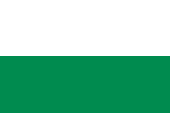
Landesflagge (Landesfarben),
Seitenverhältnis = 2:3,
Quelle, nach: Wikipedia (D),
Färbung, nach: Dr. Peter Diem www.peter-diem.at


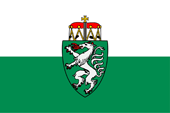
Dienstflagge,
Seitenverhältnis = 2:3,
Quelle, nach: Wikipedia (D),
Färbung, nach: Dr. Peter Diem www.peter-diem.at



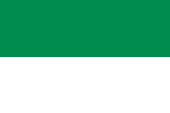
19. Jhd. bis 1960,
Landesflagge (Landesfarben),
Seitenverhältnis = 2:3,
Quelle, nach: Flaggen Enzyklopädie
Die Flagge von Steiermark zeigt zwei Streifen in Weiß und Grün und wurde in dieser Anordnung der Farben im Jahre 1960 angenommen. Die Farben der Flagge leiten sich aus den Farben des Wappens ab (silberner Panther auf Grün). Vom 19. Jhd. bis 1960 wurde die Flagge mit umgekehrter Farbreihenfolge verwendet.
In der Zeit der Monarchie hatte das Land, wie alle Kronländer der österreichischen Krone, seine eigenen, sogenannten Landesfarben, die unter anderem auf horizontal getreiften zwei- oder dreistreifigen Flaggen gezeigt wurden. Die Landesfarben waren sehr oft dem jeweiligen Wappen des Kronlandes entnommen oder wurden duch eine weitere, nicht im Wappen enthaltene Farbe ergänzt, oder sie gingen auf ältere Modelle des Landeswappens zurück (z.B. Krain). Offiziell waren die Landesfarben aber nie geregelt oder festgelegt worden, so dass deren Reihenfolge in der Praxis of variierte oder die Farben gar an sich abwichen. Der österreichische Heraldiker Hugo Gerard Ströhl (1851–1919) hat sich wohl als erster des Themas angenommen und wahrscheinlich um das Jahr 1890 herum die Landesfarben auf den Flaggen bei den jeweiligen Landesbehörden abgefragt und zusammengestellt. Für Steiermark wurden Grün und Weiß als Landesfarben für das Kronland ermittelt.
Österreich trat 1938 als ein Land dem Deutschen Reich bei. Die föderalen Strukturen spielten keine Rolle, sie wurden komplett durch die Gaue der NSDAP abgelöst, die Länder wurden abgeschafft. Ämter und Behörden hatten ab jetzt die Dienstflagge des Reiches zu verwenden. Die entsprechenden Landesfarben existierten möglicherweise weiter, auf jeden Fall aber nicht in Form von Flaggen. Sie wurden möglicherweise vereinzelt an Uniformen der SA oder bei bestimmten Dienstgraden der Hitlerjugend in der Brustschnur verwendet.
Die Flaggen der Österreichischen Bundesländer werden mit oder ohne Wappen gezeigt. Amtlich verwendet, tragen sie immer das Wappen, jedoch darf auch die Bevölkerung Flaggen mit Wappen verwenden.
Für die Farben der Flaggen der österreichischen Bundesländer scheint es keine gesetzlichen Regelungen zu geben, sie werden, da offenbar nicht definiert, in der Praxis in einem gewissen Standardbereich wiedergegeben. Der österreichische Publizist und Medienwissenschaftler Dr. Peter Diem gibt aber Empfehlungen für die Wiedergabe der Farben: Für Steiermark ein helles Grün, am ehesten Pantone 348 entsprechend.
Quelle: Dr. Peter Diem austria-forum.org,
Wikipedia (D),
Flaggen Enzyklopädie,
Volker Preuß,
Österreichisch-Ungarische Wappenrolle
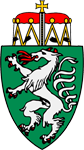
seit 1926,
Wappen der Steiermark,
Quelle, nach: Wikipedia (D)
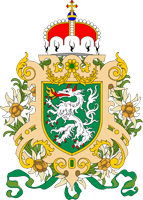
ca.1890–1918,
Wappen Herzogtum Steiermark,
Quelle, nach: Ströhl, Wappenrolle Österreich-Ungarns, 1890, via Wikipedia (D)
Das grüne Wappen der Steiermark mit dem silbernen Panther stammt aus dem 13. Jahrhundert. Er geht auf das Haus Sponheim zurück, dass im Jahre 1122 zu Herzögen der Steiermark wurde. Die Krone auf dem Wappen war zur Zeit der Monarchie ein üblicher Fürstenhut. Im Jahre 1926 wurde er durch den historischen Steirischen Fürstenhut ersetzt. Der österreichische Heraldiker Hugo Gerard Ströhl hat das Wappen um 1890, in seiner letzten bekannten Ausführung, mit landestypischer Flora umgeben. Für das Herzogtum Steiermark war das Edelweiß, welches die Bedeutung des Landes als Bergregion hervorheben sollten.
Quelle: Wikipedia (D),
Flaggen Enzyklopädie, Sponheim,
Österreichisch-Ungarische Wappenrolle
Lesen Sie hier:
Hintergründe, Geschichte und Fakten zum Thema "Der Löwe in der Heraldik". Ausführungen, Varianten, Entwicklung, sowie Panther und Leoparden.
 ← mehr zum Panther, hier!
Die Bundesländer Österreichs:
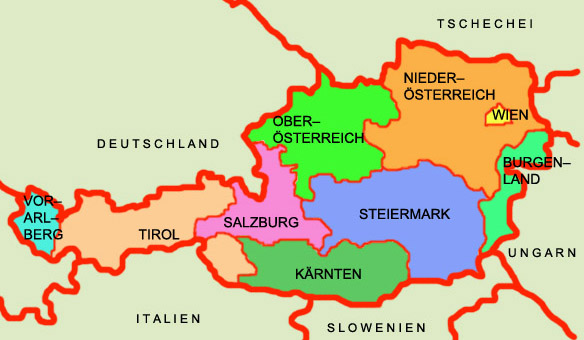
Quelle: Volker Preuß
• Burgenland
• Kärnten
• Niederösterreich
• Oberösterreich
• Salzburg
• Steiermark
• Tirol
• Vorarlberg
• Wien
Karte ca. 1910:
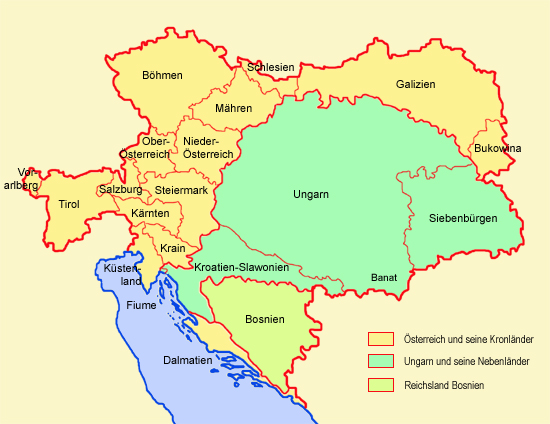
Quelle: Volker Preuß
Fläche: 16.401 km²
Einwohner: 1.243.000 (2019)
Bevölkerungsdichte: 76 Ew./km²
Hauptstadt: Graz (früherer Name: Bayrisch-Grätz), 288.800 Ew. (2019)
Amtssprache: Deutsch
Währung: 1 Euro = 100 Cent
Zeitzone: MEZ
Quelle: Wikipedia (D)
400 v.Chr. · Besiedlung durch Kelten
15 v.Chr.–46 n.Chr. · beginnende römische Eroberung, Errichtung der Provinz Noricum
4./5. Jhd. · Invasion der Goten
409–452 · Hunneneinfälle
476 · Absetzung des letzten römischen Kaisers Romulus Augustulus, Ende des (West)Römischen Reiches, Besiedlung durch Bajuwaren
6. Jhd. · Besiedlung durch Slawen, insbesondere durch den slawischen Stamm der Karantanen
ca. 740 · Herzog Odilo von Bayern unterstützt die Karantanen gegen die Awaren
ca. 750 · Herzog Tassilo III. von Bayern erobert das heutige Kärnten und Steiermark
788 · Bayern wird durch das Frankenreich der Karolinger unterworfen
803 · Einrichtung der "Karantanischen Mark"
907 · Einfälle der Ungarn
976 · Bildung des Herzogtums Kärnten, dabei Angliederung der Marken Istrien und Krain, und der "Mark an der mittleren Mur", der "Mark an der Drau" und der "Mark an der Sann"
1050 · Ottokar aus Steyr wird Markgraf der "Mark an der mittleren Mur", der "Mark an der Drau" und der "Mark an der Sann" (daher Steyrische Marken, Steiermark)
1077 · das Haus Eppenstein erhält die Herzogswürde über Kärnten
1122 · das Haus Sponheim erhält die Herzogswürde über Kärnten
1180 · die Steiermark wird von Kärnten und Bayern abgetrennt und zum Herzogtum unter dem Haus der Traungauer erhoben
1192 · Aussterben der Traungauer, die Steiermark kommt als Erbschaft an das Haus Babenberg von Österreich
1246 · Aussterben der Babenberger, Österreich und Steiermark kommen an die böhmischen Premysliden
1273 · Rudolf von Habsburg wird deutscher König
1278 · Rudolf von Habsburg besiegt die böhmischen Premysliden und erwirbt Österreich und Steiermark
13./14. Jhd. · Besiedlung durch Deutsche
15. Jhd. · Türkeneinfälle
1797–1809 · Französische Revolutionskriege: die Steiermark wird 1797 von den Franzosen besetzt
1848/1849 · Revolution, neue Verfassung: die Titular-Erblande der Habsburger im Kaiserreich Österreich werden zu Kronländern mit eigenen Landtagen umgewandelt, das Herzogtum Steiermark wird so ein Kronland des Kaiserreichs Österreich
1914–1918 · Erster Weltkrieg
12.11.1918 · Proklamation von Deutsch-Österreich zur Republik Österreich, Steiermark wird österreichisches Bundesland
10.09.1919 · Friedensvertrag von Saint-Germain, Südsteiermark wird an das Königreich der Serben, Kroaten und Slowenen (Jugoslawien) angeschlossen
13.03.1938 · Anschluss ganz Österreichs an das Deutsche Reich, an die Stelle des Landes Steiermark tritt der "NS-Gau Steiermark"
27.04.1945 · Proklamation der Republik Österreich "Zweite Republik", Steiermark wird erneut österreichisches Bundesland, bleibt jedoch bis 1955 von britischen Truppen besetzt
1955 · Abzug der Besatzungstruppen
Quelle: Atlas zur Geschichte,
Wikipedia (D),
World Statesmen,
RetroBib Retrobibliothek,
Discovery '97,
Volker Preuß
Der Name des Landes "Steiermark" geht auf das Haus der Ottokare zurück, die seit 1050 Markgrafen über die "Mark an der mittleren Mur", die "Mark an der Drau" und über die "Mark an der Sann" waren, und 1188 (kurz vor ihrem Aussterben) sogar noch Herzöge. Der Stammsitz der Ottokare lag in Steyr. Der Name des Herkunftsortes der Grafen hat sich später auf ihr ganzes Land übertragen.
Quelle: Wikipedia (D)
weitere Seiten zu Österreich (historische Flaggen und Wappen):
• Reich der Österreichischen Habsburger (bis 1804)
• Kaiserreich Österreich (1804–1867)
• Österreich-Ungarn (1867–1918)
• Republik Österreich (seit 1918)