mobile Ansicht, to the English Version tap the flag


- Vorarlberg
- Bundesland der Republik Österreich
- ehemaliges österreichisches Kronland: Land Vorarlberg, bestehend aus: Grafschaft Bregenz, Grafschaft Feldkirch, Grafschaft Bludenz, Grafschaft Sonnenberg, Grafschaft Hohenems, Herrschaft Blumenegg
• Flaggen
• Bedeutung/Ursprung der Flagge
• Wappen
• Bedeutung/Ursprung des Wappens
• Landkarte der Bundesländer Österreichs
• Landkarte der früheren Kronländer Österreich-Ungarns (bis 1918)
• Zahlen und Fakten
• Geschichte
• Ursprung des Landesnamens

Landesflagge (Landesfarben),
Seitenverhältnis = 2:3,
Quelle, nach: Wikipedia (D),
Färbung, nach: Dr. Peter Diem www.peter-diem.at


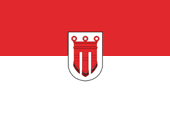
Dienstflagge,
Seitenverhältnis = 2:3,
Quelle, nach: Wikipedia (D),
Färbung, nach: Dr. Peter Diem www.peter-diem.at



Die Flagge von Vorarlberg stammt aus dem 19. Jahrhundert und zeigt zwei Streifen in Rot und Weiß. Sie wurde zuletzt im Jahre 1946 offiziell bestätigt. Die Farben der Flagge leiten sich aus den Farben des Wappens ab (rotes Gonfanon auf Silber).
In der Zeit der Monarchie hatte das Land, wie alle Kronländer der österreichischen Krone, seine eigenen, sogenannten Landesfarben, die unter anderem auf horizontal getreiften zwei- oder dreistreifigen Flaggen gezeigt wurden. Die Landesfarben waren sehr oft dem jeweiligen Wappen des Kronlandes entnommen oder wurden duch eine weitere, nicht im Wappen enthaltene Farbe ergänzt, oder sie gingen auf ältere Modelle des Landeswappens zurück (z.B. Krain). Offiziell waren die Landesfarben aber nie geregelt oder festgelegt worden, so dass deren Reihenfolge in der Praxis of variierte oder die Farben gar an sich abwichen. Der österreichische Heraldiker Hugo Gerard Ströhl (1851–1919) hat sich wohl als erster des Themas angenommen und wahrscheinlich um das Jahr 1890 herum die Landesfarben auf den Flaggen bei den jeweiligen Landesbehörden abgefragt und zusammengestellt. Für Vorarlberg wurden Rot und Weiß als Landesfarben für das Kronland ermittelt.
Österreich trat 1938 als ein Land dem Deutschen Reich bei. Die föderalen Strukturen spielten keine Rolle, sie wurden komplett durch die Gaue der NSDAP abgelöst, die Länder wurden abgeschafft. Ämter und Behörden hatten ab jetzt die Dienstflagge des Reiches zu verwenden. Die entsprechenden Landesfarben existierten möglicherweise weiter, auf jeden Fall aber nicht in Form von Flaggen. Sie wurden möglicherweise vereinzelt an Uniformen der SA oder bei bestimmten Dienstgraden der Hitlerjugend in der Brustschnur verwendet.
Die Flaggen der Österreichischen Bundesländer werden mit oder ohne Wappen gezeigt. Amtlich verwendet, tragen sie immer das Wappen, jedoch darf auch die Bevölkerung Flaggen mit Wappen verwenden. Für die Farben der Flaggen der österreichischen Bundesländer scheint es keine gesetzlichen Regelungen zu geben, sie werden, da offenbar nicht definiert, in der Praxis in einem gewissen Standardbereich wiedergegeben. Der österreichische Publizist und Medienwissenschaftler Dr. Peter Diem gibt aber Empfehlungen für die Wiedergabe der Farben: Für Vorarlberg ein mittleres Rot, am ehesten Pantone 1795 entsprechend.
Quelle: Dr. Peter Diem austria-forum.org,
Wikipedia (D),
Flaggen Enzyklopädie,
Flags of the World,
Volker Preuß,
Österreichisch-Ungarische Wappenrolle

seit 1918,
Wappen von Vorarlberg,
Quelle, nach: See page for author / Public domain
Wikipedia (D),
Färbung nach: Dr. Peter Diem www.peter-diem.at
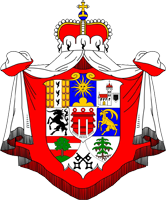
ca.1890–1918,
Wappen von Vorarlberg,
Quelle: Joseph von Bergmann, nach: Ströhl, Wappenrolle Österreich-Ungarns, 1890, via Wikipedia (D)
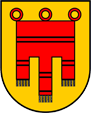
1146–1667,
Wappen der Pfalzgrafen von Tübingen,
Quelle: Wikipedia (D)

1259–1534,
Wappen der Grafen von Werdenberg,
Quelle, nach: Wikipedia (D)
Das Wappen von Vorarlberg zeigt ein rotes Gonfanon auf silbernen Grund. Ein Gonfanon ist eine Frühform von Fahnen, die sich bis in die heutigen Tage als Kirchenfahne erhalten hat. In dem Wort Gonfanon findet sich das althochdeutsche Wort "gundfano", was Kampftuch heißt. Das Wappen wird in der Legaldefinition des § 3 Abs. 2 des Gesetzes über die Landessymbole von Vorarlberg folgendermaßen beschrieben: "Auf dem silbernen Schild ruht das mit drei gleich breiten, schwarz befransten Lätzen versehene rote Montfortische Banner, das am oberen Rande drei rote Ringe trägt. Das obere Feld des Banners ist mit zwei, die Lätze sind mit drei schwarzen Querlinien durchzogen." Die Grafen von Montfort waren ein schwäbisch-vorarlbergisches Grafengeschlecht, die ursprünglichen Pfalzgrafen von Tübingen, benannt nach der Burg Montfort bei Weiler in Vorarlberg, das im Jahre 1787 ausstarb. Die Familie verzweigte sich stark in zahlreiche Nebenlinien, die alle das Wappen der Pfalzgrafen von Tübingen in farblicher Variation fortführten. Die Variation mit dem roten Gonfanon auf Silber wurde noch 1918 als das „Montfortische rote Kriegsbanner“ bezeichnet, während die Ortschaft Feldkirch, die ein schwarzes Gonfanon auf Silber verwendet, sich ausdrücklich auf die "Friedensfahne der Montforter" bezieht. Allerdings verwendeten auch die Grafen von Werdenberg aus dem Hause Montfort die schwarz-weiße Variante. Das Territorium von Vorarlberg wurde von Tirol verwaltet, gehörte zwischen 1806 und 1814 zu Bayern, und wurde 1861 ein eigenes Kronland der Habsburger Monarchie. Es wurde jedoch weiterhin in vielen Bereichen von Tirol aus verwaltet. Der Landeshistoriker Joseph von Bergmann entwarf das Wappen für das Kronland, das 1864 angenommen wurde. Das Wappen war in seiner letzten Fassung auf einem rot-weißen(!) Wappenmantel platziert und hatte neun Felder. Die drei Felder in der ersten Reihe zeigten die Wappenbilder von Bregenz, Sonnenberg und Feldkirch, die nächste Reihe zeigte Bludenz und Hohenems, die unteren drei Felder Dornbirn, Montafon und Bregenzerwald. Das Herzschild zeigte das Wappen der Montfort in seiner rot-weißen Version. Das Wappen war mit einem Fürstenhut bekrönt. Nach dem Ende der Monarchie im Jahre 1918 wurde das Wappen des Landes auf das ungekrönte Herzschild des bisherigen Wappens beschränkt und bis heute beibehalten.
Quelle: Wikipedia (D),
Flaggen Enzyklopädie,
austria-forum.org,
Volker Preuß
Die Bundesländer Österreichs:
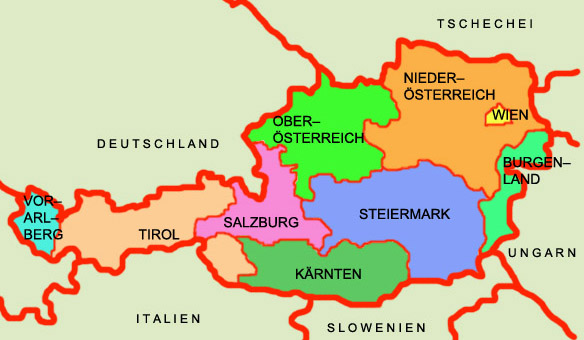
Quelle: Volker Preuß
• Burgenland
• Kärnten
• Niederösterreich
• Oberösterreich
• Salzburg
• Steiermark
• Tirol
• Vorarlberg
• Wien
Karte ca. 1910:
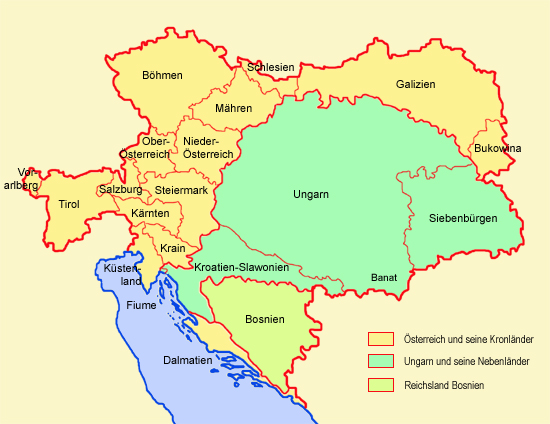
Quelle: Volker Preuß
Fläche: 2.601 km²
Einwohner: 397.100 (2020)
Bevölkerungsdichte: 153 Ew./km²
Hauptstadt: Bregenz, 29.700 Ew. (2020)
Amtssprache: Deutsch
Währung: 1 Euro = 100 Cent
Zeitzone: MEZ
Quelle: Wikipedia (D)
Antike · im heutigen Land Vorarlberg siedeln Kelten
ab 15 v.Chr. · römische Eroberung, Errichtung der Provinz Raetia
260 · Einfälle der Alemannen
476 · Absetzung des letzten römischen Kaisers Romulus Augustulus, Ende des (West)Römischen Reiches, das heutige Vorarlberg kommt zum Reich der Ostgoten
536 · Eroberung durch das Frankenreich
843/870/880 · bei der Teilung des Frankenreiches kommt Vorarlberg zum Ostfänkischen Königreich (später Deutsches Reich genannt)
1146 · Hugo I., Graf von Nagold, wird Pfalzgraf von Tübingen
1150 · sein Sohn Hugo heiratet Elisabeth, Erbtochter von Graf Rudolf von Bregenz und Churrätien, Erbin von Bregenz, Montfort und Sigmaringen
1152 · Tod von Hugo I., sein Sohn Hugo wird als Hugo II. Pfalzgraf von Tübingen
1182 · Tod von Hugo II., sein Sohn Rudolf I. wird Pfalzgraf von Tübingen, sein zweiter Sohn Hugo III. erbt Tübingen und Montfort
1200 · Hugo III. nennt sich Hugo von Montfort und wird so zum Stammvater des Hauses Montfort, er errichtet die Schattenburg bei Feldkirch, einem Dorf, das künftig zur Stadt heranwächst, der zugehörige Besitz (der 1375 an Habsburg verkauft wird) und die Familienlinie werden Montfort-Feldkirch genannt, um sich von den zahlreichenden abzweigenden Linien von Montfort zu unterscheiden (Montfort-Bregenz [bis 1338], Montfort-Bregenz-Peggau [bis 1574], Montfort-Werdenberg [bis 1258], Montfort-Werdenberg-Heiligenberg [bis 1535], Montfort-Werdenberg-Sargans [bis 1505], Montfort-Werdenberg-Vaduz [bis 1416], Montfort-Tettnang [bis 1787], die zeitweise umfangreiche Besitzungen entlang des Vorderrheins im Osten und Norden des Bodensees ihr eigen nennen
1363–1532 · das Haus Habsburg erwibt nach und nach: die Herrschaften Neuburg am Rhein (1363), Feldkirch (1375), Bludenz (Montafon, 1394), Jagdberg (1397), Bregenz (1451 und 1523), Tannberg, Sonnenberg (1474), Hohenems, die lange Zeit einzeln über Vögte verwaltet werden, jedoch bilden sich gemeinsame Landstände heraus die in Steuer- oder Verteidigungsfragen durch den Landesherren angehört wurden, die ab 1722 als "vorarlbergische Stände" (vor dem Arlberg liegend) bezeichnet wurden, die in der "Landvogtei Bregenz" zusammengefasst waren
1751 · die Landvogtei Bregenz wird erstmals als Landvogtei Vorarlberg bezeichnet
1765 · Erwerb der Grafschaft Hohenems – der letzten Grafschaft der Montforts – durch das Haus Habsburg, die Landvogtei Vorarlberg wird erstmals als Land Vorarlberg bezeichnet
1779/1780 · auf Grund finanzieller Probleme verkauft die Linie Montfort-Tettnang ihren restlichen Besitz an das Haus Habsburg
1786 · Errichtung des Tirolischen Kreisamts Vorarlberg
1787 · Tod von Graf Anton IV. von Montfort-Tettnang, das Haus Montfort stirbt aus
1803 · Reichsdeputationshauptschluß, die Herrschaften Blumenegg und St. Gerold werden säkularisiert und den Gebieten des Hauses Habsburg angeschlossen
26.12.1805 · Friede von Preßburg nach dem Dritten Koalitionskrieg, Österreich muss Tirol (und damit Vorarlberg) an Bayern abtreten
1805–1814 · Tirol (und damit auch Vorarlberg) gehört zu Bayern
1814–1815 · Wiener Kongreß zur Neuordnung Europas nach Napoléon, ganz Tirol (und damit Vorarlberg) kommt an das Kaiserreich Österreich, auch der ehemalige Reichshof Lustenau wird den Tiroler Gebieten des Hauses Habsburg angeschlossen
1861 · Ende des Kreisamts Vorarlberg, das Kreisamt Vorarlberg wird ein Kronland des Kaiserreichs Österreich mit eigenem Parlament, die Unterteilung in Grafschaften und Herrschaften bleibt aber nominell bestehen, das Land wird weiterhin in vielen Bereichen von Tirol aus verwaltet
12.11.1918 · Proklamation von Deutsch-Österreich zur Republik Österreich, Vorarlberg wird österreichisches Bundesland, ab dem 14.03.1919 mit einer eigenen Verfassung, die Tiroler Verwaltung wird beendet und Vorarlberg quasi unabhängig, eine Volksabstimmung in Vorarlberg zum Anschluss an die Schweiz ergibt 80% Ja-Stimmen
10.09.1919 · Friedensvertrag von Saint-Germain, Vorarlberg muss ein Teil Österreichs bleiben
1923 · neue Verfassung
13.03.1938 · Anschluss ganz Österreichs an das Deutsche Reich, an die Stelle des Landes Vorarlberg tritt der "NS-Gau Tirol-Vorarlberg"
27.04.1945 · Proklamation der Republik Österreich "Zweite Republik", Vorarlberg wird erneut österreichisches Bundesland, bleibt jedoch bis 1955 von französischen Truppen besetzt
1955 · Abzug der Besatzungstruppen
Quelle: Atlas zur Geschichte,
Wikipedia (D),
World Statesmen,
RetroBib Retrobibliothek,
Discovery '97,
Land Vorarlberg,
Alois Niederstätter,
Volker Preuß
Der Name "Vorarlberg" ist ein geographischer Begriff, der die Lage des Landes "vor dem Arlberg", einem 1 793 Meter hohen Paß zwischen "Klostertal" und "Stanzer Tal", an der Grenze zwischen Vorarlberg und Tirol beschreibt.
Quelle: Wikipedia (D)
weitere Seiten zu Österreich (historische Flaggen und Wappen):
• Reich der Österreichischen Habsburger (bis 1804)
• Kaiserreich Österreich (1804–1867)
• Österreich-Ungarn (1867–1918)
• Republik Österreich (seit 1918)