mobile Ansicht, to the English Version tap the flag
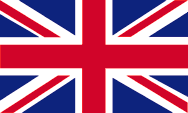

- Republik Sierra Leone
- präsidiale Republik unter Militärherrschaft
- Eigenbezeichnungen: Republic of Sierra Leone
• Flaggen
• historische Flaggen
• Bedeutung/Ursprung der Flagge
• Wappen
• Bedeutung/Ursprung des Wappens
• Flugzeugkokarde
• Landkarte
• Zahlen und Fakten
• Geschichte
• Ursprung des Landesnamens
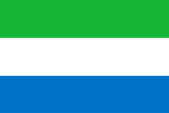
National-, Handels-, Staats- und Kriegsflagge,
Seitenverhältnis = 2:3,
Quelle, nach: Flags of the World



Marineflagge,
Seitenverhältnis = 2:3,
Quelle, nach: Flags of the World

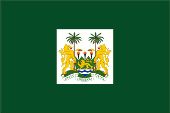
Flagge des Präsidenten,
Seitenverhältnis = 2:3,
Quelle, nach: Flags of the World

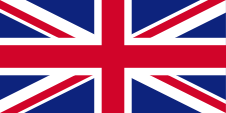
1787–1961,
Union Flag → quasi Nationalflagge,
Flagge von Großbritannien,
Seitenverhältnis = 1:2,
Quelle, nach: Wikipedia (EN)
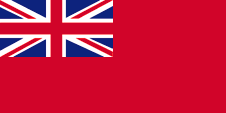
1865–1961,
Handelsflagge,
Seitenverhältnis = 1:2,
Quelle, nach: Flags of all Nations
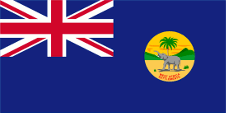
1866–1888,
Britisch Westafrika, West Africa Settlements,
Flagge der Regierung (Staatsflagge),
Seitenverhältnis = 1:2,
Quelle, nach: Flags of the World
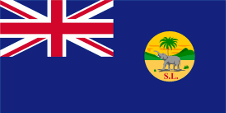
1889–1914,
Flagge der Regierung (Staatsflagge),
Seitenverhältnis = 1:2,
Quelle, nach: Flags of the World
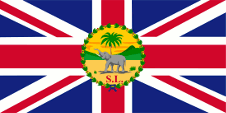
1889–1914,
Flagge des Gouverneurs,
Seitenverhältnis = 1:2,
Quelle, nach: Flags of the World
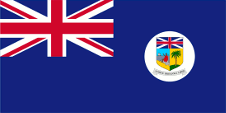
1914–1961,
Flagge der Regierung (Staatsflagge),
Seitenverhältnis = 1:2,
Quelle, nach: Flags of the World
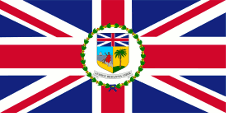
1914–1961,
Flagge des Gouverneurs,
Seitenverhältnis = 1:2,
Quelle, nach: Flags of the World
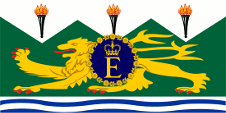
1961–1971,
Flagge der Königin,
Seitenverhältnis = 1:2,
Quelle, nach: Flags of the World

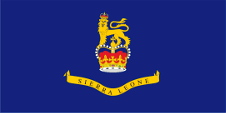
1961–1971,
Flagge des Generalgouverneurs,
Seitenverhältnis = 1:2,
Quelle, nach: Flags of the World
Die heutige Flagge von Sierra Leone wurde am 27.04.1961 aus Anlass der Unabhängigkeit eingeführt. Sie zeigt drei waagerechte Streifen in Grün, Weiß und Blau. Die Farben stammen aus dem Wappen des Landes. Grün steht für die Landwirtschaft, den Naturreichtum und die Berge. Weiß steht für Einigkeit, Gerechtigkeit, Tugend und Frieden, Blau steht für das Meer und unterstreicht die wirtschaftliche Bedeutung des Hafens von Freetown. Über die genaue Definition der Farbtöne ist nichts bekannt, nur dass es sich um recht helle Farben handeln soll. Bezugnehmend auf ein Foto des Botschafters von Sierra Leone bein der UNO, dass neben der Landesfahne aufgenommen wurde, lässt sich sagen, dass die beim Druck dieser Flagge verwendeten Farben der folgenden Festlegung am nächsten kommen: Blau = pt 3005 c, Grün = pt 361 c. In der Flaggengeschichte des Landes weißt der Union Jack auf die früheren Verbindungen zu Großbritannien hin. Großbritannien hatte in Jahr 1864 ein Flaggensystem eingeführt, in dem:
• Kriegsschiffe einen sogenannten "White Ensign" (Marineflagge), eine weiße Flagge oft mit durchgehendem roten Georgskreuz und mit dem Union Jack in der Oberecke,
• Handelsschiffe einen "Red Ensign" (auch "Civil Ensign" → Bürgerflagge genannt, die eigentl. Handelsflagge), eine rote Flagge mit dem Union Jack in der Oberecke, und
• Dienstschiffe einen "Blue Ensign" (Regierungsflagge → die eigentl. Staatsflagge), eine blaue Flagge mit dem Union Jack in der Oberecke führten.
Seit 1865 durften Schiffe von Kolonialregierungen einen Blue Ensign mit einem Badge (Abzeichen) im fliegenden Ende führen. Die jeweiligen Regierungen sollten entsprechene Bagdes zur Verfügung stellen. Handelsschiffe und seefahrende Privatpersonen aus Kolonien dürfen nur dann einen Red Ensign mit Badge führen, wenn von der britischen Admiralität eine entsprechende Erlaubnis für die Kolonie erteilt wurde. Ein solches Badge war oft eine auf einer Scheibe platzierte regionale landschaftliche Darstellung, zeigte oft Schiffe, historische Begebenheiten oder konnte auch nur eine Art Logo sein.
Das 1889 eingeführte Emblem (Badge) zeigte einen Elefanten mit drohender Gebärde vor einer Palme inmitten einer afrikanischen Landschaft. Unten auf dem Badge waren die Buchstaben "S.L." in Rot zu sehen. Im Jahre 1914 wurde ein neues Badge eingeführt. Es zeigte einen Schild, in dessen Schildhaupt der vor 1801 verwendete Union Jack zu sehen war. Das gespaltene Schild zeigte rechts eine Palme auf Gold und links einen am Meeresufer sitzenden in die Freiheit entlassenen schwarzen Sklaven der einem britischen Schiff hinterherwinkt. Unterhalb des Schildes, befand sich in einem silbernen Spruchband das damalige Motto des Landes: "AUSPICE BRITANNIA LIBER" → "Frei unter dem Schutz Britanniens". Dieses Badge wurde bis 1960 verwendet.
An Land repräsentierten der einzelne Bürger und auch die Behörden ihren Status als Bürger oder Organe der britischen Nation, verkörpert im United Kingdom, durch die Verwendung des Union Jack, dann „Union Flag“ genannt. Zur See war somit für den britischen Bürger die britische Handelsflagge, der Red Ensign (Rote Flagge) vorgesehen. In einigen wenigen Fällen wurde den Bürgern einer Kolonie durch die Admiralität erlaubt, auf See einen eigenen Red Ensign mit dem Badge der Kolonie zu verwenden. Für Sierra Leone lag eine solche Erlaubnis jedoch nicht vor.
Quelle:
un.slmission.gov.sl,
Die Welt der Flaggen,
Flaggen und Wappen der Welt,
Wikipedia (EN),
Flags of the World,
Flaggen Wappen Hymnen,
Volker Preuß
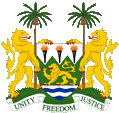
seit 1960,
Wappen von Sierra Leone,
Quelle: Corel Draw 4
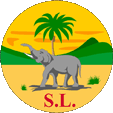
1889–1914,
Emblem (Badge) von Sierra Leone,
Quelle: Flags of the World
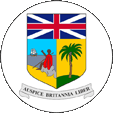
1914–1961,
Emblem (Badge) von Sierra Leone,
Quelle: Flags of the World
Das Staatswappen wurde am 01.12.1960 von Königin Elisabeth II. verliehen. Es zeigt im Schildhaupt drei Fackeln auf Silber, in der Mitte einen goldenen Löwen auf Grün, und in der Schildspitze blaue Wellenlinien auf Silber. Schildhalter sind Löwen und Palmen. Unterhalb des Wappens ein silbernens Spruchband mit dem Motto des Landes: "Unity, Freedom, Justice" → "Einheit, Freiheit, Gerechtigkeit". Die drei Fackeln sind Symbole der Freiheit. Der Löwe weist auf den Landesnamen ("Löwengebirge") und die frühere britische Kolonialherrschaft hin. Die Wellenlinien repräsentieren das Meer.
Quelle:
Die Welt der Flaggen,
Flaggen und Wappen der Welt,
Wikipedia (EN),
Flaggen Wappen Hymnen,
Volker Preuß

Flugzeugkokarde,
Quelle, nach: Wikipedia (EN)
Lage:
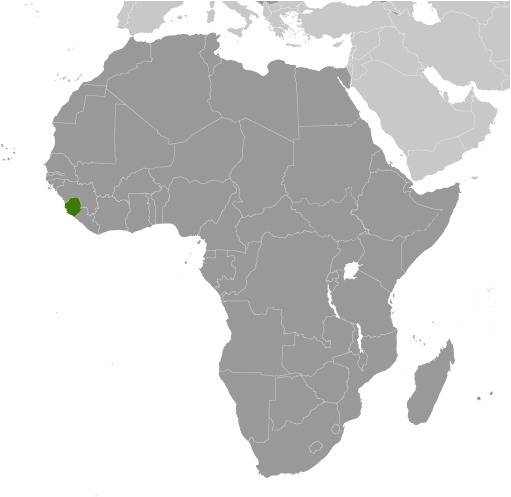
Quelle: CIA World Factbook
Landkarte des Landes:
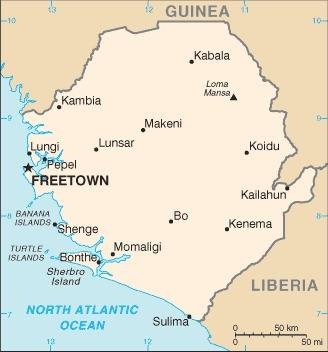
Quelle: CIA World Factbook
Fläche: 71.740 km²
Einwohner: 7.548.702 (2021), davon 32% Mende, 31% Temne, 9% Limba, 5% Kono
Religionen: 77% Moslems, 18% Protestanten, 2% Katholiken
Bevölkerungsdichte: 105 Ew./km²
Hauptstadt: Freetown, 609.174 Ew. (2021)
Amtssprache: Englisch
sonstige Sprachen: Krio, Mende, Temne, ...
Währung: 1 Leone (SLE, Le) = 100 Cents
Zeitzone: MEZ – 1 h
Quelle:
Wikipedia (DE)
Mittelalter · Besiedlung der Region des heutigen Sierra Leone durch das Volk der Bulom
14.–15. Jahrhundert · Einwanderung der Völker der Krim, Gola, Mende und Temne
1462 · Entdeckung der Küste des heutigen Sierra Leone durch den portugiesischen Seefahrer Pedro de Cintra, er gibt dem Land den Namen "Serra da Leão", einige Jahre später wird durch die Portugiesen an der Küste der Sklavenhandelsstützpunkt Mitombo errichtet
1562 · Landung englischer Truppen, Vertreibung der Portugiesen, England übernimmt den gesamten Küstenhandel, im Hinterland erobert das Volk der Temne große Teile des Landes
1650 · Errichtung englischer Faktoreien
1787 · Philanthropen aus Großbritannien kaufen Land an der Küste von Sierra Leone um in Westindien freigelassene schwarze Sklaven hier anzusiedeln und einen Beitrag zur Abschaffung des Sklavenhandels zu leisten, Gründung der Stadt Freetown durch die Sierra Leone Society
1808 · das Küstenland von Sierra Leone wird britische Kronkolonie
1825 · Anschluss der Insel Sherbro und von Teilen des Hinterlands an die britische Kolonie
1866–1888 · Sierre Leone gehört zu Britisch Westafrika, den "West Africa Settlements"
1895–1896 · Grenzverträge mit Frankreich, Sierra Leone erreicht seine heutige Größe
1951 · neue Verfassung
1956 · allgemeine und freie Wahlen
1958 · Großbritannien gewährt Sierra Leone innere Selbstverwaltung
27.04.1961 · Großbritannien gewährt Sierra Leone die Unabhängigkeit als konstitutionelle Monarchie im Rahmen des Commonwealth of Nations
1967–1971 · diverse Militärputsche
19.04.1971 · Proklamation der Republik
1978 · Einführung des Einparteiensystems (APC-Partei)
1991 · der Bürgerkrieg im Nachbarland Liberia dehnt sich auf Sierra Leone aus, Wiedereinführung des demokratischen Mehrparteiensystems
1992 · Militärputsch unter V. Strasser
1996 · Militärputsch unter J. M. Bio
1996 · Friedensverhandlungen im Bürgerkrieg, Parlaments- und Präsidentschaftswahlen
1997 · Putsch durch die RUF-Miliz
1997 · Stationierung der Friedenstruppe ECOMOG
1999 · Waffenstillstandsabkommen, Stationierung einer UNO Friedenstruppe
2000 · Eingreifen britischer Truppen
2002 · Ende des Bürgerkriegs
Source: Atlas zur Geschichte,
Wikipedia (D),
World Statesmen
Als der portugiesische Seefahrer Pedro de Cintra und seine Begleiter im Jahre 1462 die heutige Halbinsel Sierra Leone erreichten und am dortigen Küstengebirge vorbeikamen, hielten sie das Heulen des Sturms im Gebirge für Löwengebrüll und nannten es deshalb "Serra da Leão", also "Löwengebirge". Die spanische(!) Entsprechung dieses Namens – Sierra Leone – setzte sich schließlich auch als Bezeichnung für das gesamte Hinterland durch.
Source: Handbuch der geographischen Namen