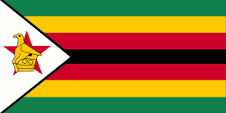
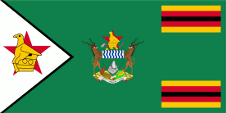
Die heutige Flagge von Simbabwe wurde am 18.04.1980 eingeführt. Sie zeigt sieben schmale waagerechte Streifen in Grün, Gelb, Rot, Schwarz, Rot, Gelb und Grün, und hat am Mast ein weißes, schwarzgerändertes Dreieck mit einem gelbem (goldenen) Vogel auf einem rotem Stern in der Mitte. Die Gestaltung der Flagge geht auf das Design der Flagge der ZANU-Partei zurück, die aus konzentrischen Feldern von außen nach innen in den Farben Grün, Gelb, Rot und Schwarz besteht. Weiß steht für den Frieden, den die schwarze Regierung mit der weißen Minderheit früher anstrebte. Rot, Gelb und Grün sind die panafrikanischen Farben, und das Schwarz deutet auf die schwarze Mehrheit des Volkes hin. Der rote Stern steht für Internationalismus und Sozialismus. Die Farben der heutigen Flagge sind am 18.04.1980 von der Southern African Vexillological Assosiation protokolliert worden, und zwar: Rot = Pantone 185, Gelb = Pantone 123 und Grün = Pantone 348. In den Jahren davor waren die Farben der Flaggen den üblichen britischen Festlegungen unterworfen, z.B. Rot = Pantone 186, Blau = Pantone 280, Azurblau = Pantone 549 und Grün = Pantone 357.
Grün, Gelb und Rot sind auch als die "Panafrikanischen Farben" bekannt: Etwa 1900 setzte die Panafrika-Bewegung ein, die Gemeinsamkeiten aller Menschen mit schwarzer Hautfarbe hervorheben wollte. Der Farbendreiklang Grün-Gelb-Rot, den viele afrikanische und auch amerikanische Staaten nach Erlangung ihrer Unabhängigkeit in ihre Flaggen übernahmen, steht für die politische Einheit Afrikas, ja aller Schwarzen. Das erste Land war Ghana im Jahr 1957. Als Ursprung gelten die Landesfarben von Athiopien (Abessinien), dem ältesten unabhängigen Staat Afrikas. Der goldene Vogel wird Simbabwe-Vogel oder auch Blitzvogel genannt. Goldene Abbilder dieses auf einem Podest sitzenden Vogels wurden 1888 in der legendären Ruinenstadt Simbabwe (20 km südöstlich von Fort Victoria) gefunden. Der Simbabwe-Vogel ist seit 1924 Teil der Heraldik Rhodesiens.
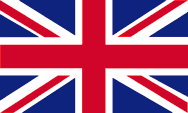
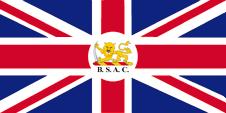
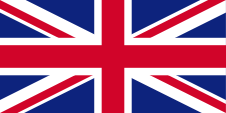
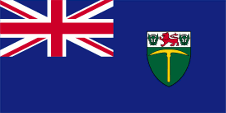
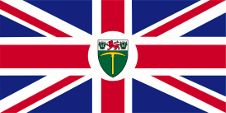
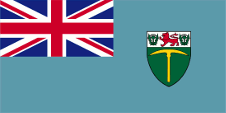
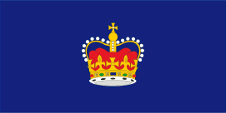
Wenige Jahre nach der Ankunft der Briten wurde das Land 1893 ein Protektorat der Britisch-Südafrikanischen Gesellschaft (BSAC), und bis 1923 wurde deren Flagge verwendet. Die Flagge der BSAC zeigte den britischen Union Jack mit dem Logo der BSAC in der Mitte der Flagge auf einer weißen Scheibe. Das Logo zeigte einen goldenen Löwen der einen Elefanten-Stoßzahn in seiner rechten Pranke hielt. Er stand auf einem rot-goldenen Wulst. Darunter das Kürzel der Company: B.S.A.C. Am 01.10.1923 wurde Südrhodesien eine britische Kronkolonie mit eingeschränkter Selbstverwaltung (Dominion), und diese bekam am 11.08.1924 ein eigenes Wappen verliehen. Das Schild des Wappens wurde – wie bei britischen Kolonien manchmal üblich – als Badge in das wehende Ende der blauen britischen Dienstflagge aufgenommen. An Land repräsentierten der einzelne Bürger und auch die Behörden ihren Status als Bürger oder Organe der britischen Nation, verkörpert im United Kingdom, durch die Verwendung des Union Jack, dann „Union Flag“ genannt. Zur See war somit für den britischen Bürger die britische Handelsflagge, der Red Ensign (Rote Flagge) vorgesehen. In einigen wenigen Fällen wurde den Bürgern einer Kolonie durch die Admiralität erlaubt, auf See einen eigenen Red Ensign mit dem Badge der Kolonie zu verwenden. Für die Südrhodesien lag eine solche Erlaubnis jedoch nicht vor.
Großbritannien hatte in Jahr 1864 ein Flaggensystem eingeführt, in dem:
• Kriegsschiffe einen sogenannten "White Ensign" (Marineflagge), eine weiße Flagge oft mit durchgehendem roten Georgskreuz und mit dem Union Jack in der Oberecke,
• Handelsschiffe einen "Red Ensign" (auch "Civil Ensign" → Bürgerflagge genannt, die eigentl. Handelsflagge), eine rote Flagge mit dem Union Jack in der Oberecke, und
• Dienstschiffe einen "Blue Ensign" (Regierungsflagge → die eigentliche Staatsflagge), eine blaue Flagge mit dem Union Jack in der Oberecke führten.
Seit 1865 durften Schiffe von Kolonialregierungen einen Blue Ensign mit einem Badge (Abzeichen) im fliegenden Ende führen. Ein solches Badge war oft eine auf einer Scheibe platzierte regionale landschaftliche Darstellung, zeigte oft Schiffe, historische Begebenheiten oder konnte auch nur eine Art Logo sein. Dieses Badge war für Südrhodesien der Wappenschild des 1924 verliehenen Wappens. Es war einfarbig grün mit einer goldenen Hacke darin. Im Schildhaupt ein roter Löwe zwischen zwei Disteln.
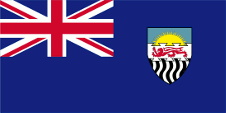
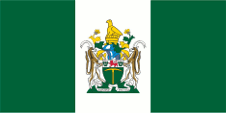
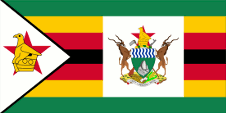
Im Jahre 1953 wurde Nordrhodesien mit Südrhodesien und Njassaland zur Zentralafrikanischen Föderation zusammengeschlossen. Die Föderation hatte eine eigene Flagge, einen Blue Ensign mit dem Wappen der Föderation im fliegenden Ende. Die Föderation wurde 31.12.1963 aufgelöst und Nordrhodesien wurde 24.10.1964 unabhängig. Bereits im Vorfeld des Zerfalls der Föderation hatte man sich auch in Südrhodesien auf die bevorstehende eigene Unabhängigkeit vorbereitet und schon am 08.04.1964 eine neue Flagge angenommen. Sie zeigte das Bild der Flagge der britischen Kolonie zwischen 1924 und 1953, jedoch wurde das Dunkelblau des Flaggentuchs des Blue Ensign als Zeichen der Unabhängigkeit durch Hellblau ersetzt. Am 11.11.1968 wurde ein neue Flagge angenommen, welche die Trennung von Großbritannien besser verdeutlichen sollte. Sie zeigte drei vertikale Streifen in Grün, Weiß und Grün und in der Mitte das Staatswappen. Grün stand für die Hoffnung und Weiß für Frieden.
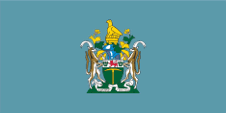
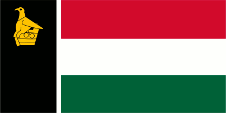
Am 01.06.1979 wurde die Republik Simbabwe- Rhodesien proklamiert und am 02.09.1979 eine neue Flagge angenommen. Die Schwarzen waren jetzt an der Regierung beteiligt und die neue Flagge erhielt ein bunteres, afrikanischeres Aussehen. Sie zeigte drei waagerechte Streifen in Rot, Weiß und Grün und am Liek einen etwas breiteren schwarzen Streifen, der durch eine dünne weiße Linie vom Rest der Flagge getrennt war. Im oberen Teil des schwarzen Streifens erschien ein goldener Simbabwe-Vogel. Die Republik Simbabwe-Rhodesien wurde jedoch international nicht anerkannt. Am 17.04.1980 wurde dann die Republik Simbabwe proklamiert – die international anerkannt wurde – und am 18.04.1980 wurde die heutige Flagge eingeführt.
Quelle:
Die Welt der Flaggen,
Flaggen und Wappen der Welt,
Wikipedia (EN),
Flags of the World,
Flaggen Wappen Hymnen,
SAVA,
Volker Preuß
Wappen von Simbabwe,
Quelle, nach: Flags of the World
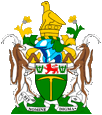
1924–1953, 1963–1980,
Wappen von Südrhodesien,
Quelle: Corel Draw 4
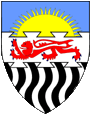
1953–1963,
Wappenschild der Föderation Rhodesien und Njassaland,
Quelle, nach: Flags of the World
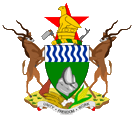
Das heutige Staatswappen wurde – wie die Flagge – am 18.04.1980 eingeführt. Es zeigt ein grünes Schild mit einer Abbildung der Ruinen der alten Stadt Simbabwe. Im Schildhaupt ein silbernes Feld mit sieben blauen Wellenlinien. Das Grün steht für den natürlichen Reichtum den der fruchtbare Boden des Landes hervor bringen könnte. Die blauen Wellen stehen für das lebenswichtige Wasser. Hinter dem Schild ein Gewehr und eine Hacke. Sie sollen den Übergang vom Kampf zur schaffenden Arbeit darstellen. Oberhalb des Schildes, vor einem roten fünfzackigen Stern, ein golden-grüner Wulst, der für die Bodenschätze und den Naturreichtum steht. Auf dem Wulst ein goldener Simbabwe-Vogel. Der goldene Vogel wird Simbabwe-Vogel oder auch Blitzvogel genannt. Goldene Abbilder dieses auf einem Podest sitzenden Vogels wurden 1888 in der legendären Ruinenstadt Simbabwe (20 km südöstlich von Fort Victoria) gefunden. Der Simbabwe-Vogel ist seit 1924 Teil der Heraldik Rhodesiens. Schildhalter sind zwei Kudu-Antilopen. Das Wappenschild ruht auf einem goldenen Podest, auf dem Produkte des Landes präsentiert werden: Kornähren, Baumwolle und Mais. Ganz unten ein silbernes Spruchband mit dem Motto des Landes: Unity, Freedom, Work → Einheit, Freiheit, Arbeit. Das Wappen von Britisch-Südrhodesien wurde dem Land am 11.08.1924 verliehen und blieb über die Kolonialzeit hinaus bis zum 17.04.1980 für Rhodesien gültig. Es zeigte ein einfarbig grünes Schild mit einer goldenen Hacke darin. Die Hacke stand für den Bergbau und die Farbe Grün für die damals überaus ertragreiche und fruchtbare Landwirtschaft. In einem sibernen Schildhaupt befand sich ein roter Löwe zwischen zwei Disteln. Der Löwe und die Disteln stammten aus dem persönlichen Wappen von Cecil Rhodes, dem Gründer und Förderer des Landes. Oberhalb des Schildes befand sich ein Helm mit goldenen und grünen Decken, darauf ein golden-grüner Wulst mit einem goldenen Simbabwe-Vogel. Schildhalter waren zwei Säbelantilopen. Das Schild ruhte auf einem grünen Podest mit einem silbernen Spruchband. Darin das lateinische Motto des Landes: "Sit nomine digna" → "Sei es des Namens würdig" Eine Reminiszens an den Namen Cecil Rhodes. In der Zeit der Zentralafrikanischen Föderation, in der Nordrhodesien mit Südrhodesien und Njassaland zwischen 1953 und 1963 zusammengeschlossen war wurde das Wappen der Föderation verwendet. Dieses bestand aus einem zweimal geteilten Schild, dessen drei Teile durch einen Schwalbenschwanzschnitt voneinander getrennt waren. Im Schildhaupt eine Sonne (Njassaland), im Mittelteil ein roter Löwe (Südrhodesien) und im Schildfuß silberne Wellenlinien auf schwarzem Grund (Nordrhodesien). Der Schwalbenschwanzschnitt – eine Art Verzahnung – soll die enge Verbindung der drei Landesteile verdeutlichen.
Quelle:
Die Welt der Flaggen,
Flaggen und Wappen der Welt,
Wikipedia (EN),
Flaggen Wappen Hymnen,
Volker Preuß
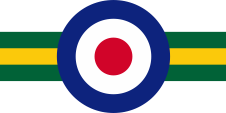
1939–1954,
Flugzeugkokarde,
Quelle/Source, nach/by: Wikipedia (EN)
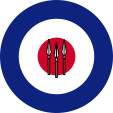
1954–1963,
Flugzeugkokarde,
Quelle/Source, nach/by: Wikipedia (EN)
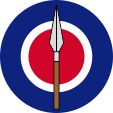
1963–1970,
Flugzeugkokarde,
Quelle/Source, nach/by: Wikipedia (EN)
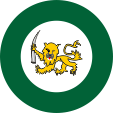
1970–1980,
Flugzeugkokarde,
Quelle/Source, nach/by: Wikipedia (EN)

seit 1980,
Flugzeugkokarde,
Quelle/Source, nach/by: Wikipedia (EN)
Lage:
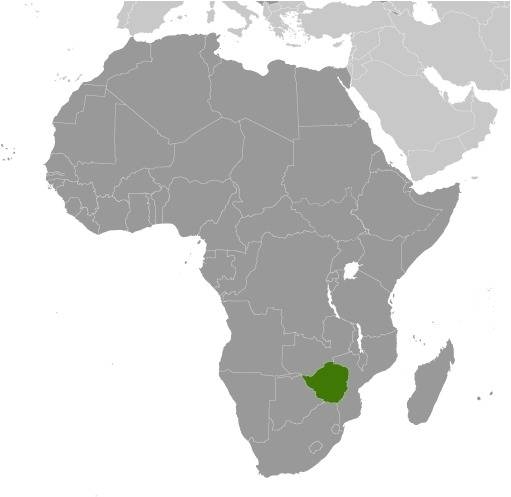
Quelle/Source: CIA World Factbook
Landkarte des Landes:
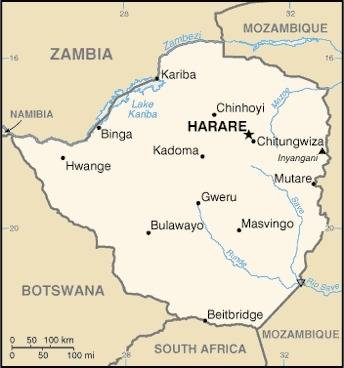
Quelle/Source: CIA World Factbook
Fläche: 390.757 km²
Einwohner: 15.418.674 (2022), davon 82% Shona, 14% Ndebele, 0,5% Asiaten und Inder, 0,22% Afrikaner (Rhodesier)
Religionen: 69% Protestanten, 8% Katholiken, 7% andere Christen, 4% Animisten, 0,7% Moslems, 10% Nicht-Religiöse
Bevölkerungsdichte: 39 Ew./km²
Hauptstadt: Harare (Salisbury), 2.013.048 Ew. (2020)
Amtssprachen: Chewa, Chibarwe, English, Kalanga, Khoisan, Nambya, Ndau, Nord-Ndebele, Shangani, Shona, Gebärdensprache, Sotho, Tonga, Tswana, Venda, Xhosa
Währungen (seit 2009):
• 1 Euro (EUR, €) = 100 Cent
• 1 US-Dollar (USD, $) = 100 Cent
• 1 Pfund Sterling (£) = 100 Pence
• 1 Südafrikanischer Rand (R) = 100 Cents
• 1 Pula (BWP, P) = 100 Thebe
• 1 Australischer Dollar ($A, A$, AU$, AUD) = 100 Cents
• 1 Renminbi Yuan (RMB) = 10 Jiao = 100 Fen
• 1 Indische Rupie (INR, iR) = 100 Paise
• 1 Yen (JPY, ¥) = 100 Sen
Währung (1980–2009): 1 Simbabwe-Dollar (Z§) = 100 Cents
Zeitzone: MEZ + 1 h
Quelle: Wikipedia (EN)
Mittelalter · Besiedlung durch aus Norden einwandernde Bantu (Ndebele und Shona)
1100 · Entstehung der Stadt Simbabwe mit den legendären Steinbauten
14.–15. Jahrhundert · zum Bantu Königreich Monomotapa
1837 · Entstehung eines Matabele-Königreichs, Krieg gegen die Mashona
Februar 1888 · das Königreich der Matabele wird als "Matabeleland" Protektorat der Britischen Südafrika-Gesellschaft (BSAC)
Oktober 1888 · die Briten nennen das Land "Sambesia"
1889 · das Gebiet der Mashona wird als "Mashonaland" Protektorat der Britischen Südafrika-Gesellschaft (BSAC)
1893 · Matabeleaufstand
1894 · Matabeleland und Mashonaland werden zu "Südsambesia" zusammengefasst
1895 · Südsambesia und Nordsambesia (das heutige Sambia) werden zum Protektorat "Rhodesien" vereinigt, Zuzug von europäischen Siedlern
1896–1897 · Matabele- und Mashonaaufstand
01.10.1923 · Südrhodesien wird britische Kronkolonie mit eingeschränkter Selbstverwaltung durch die Europäischen Siedler
01.08.1953 · Nordrhodesien, Südrhodesien und Njassaland werden zur "Föderation Rhodesien und Njassaland" zusammengefasst (auch Zentralafrikanische Föderation), das von Europäern beherrschte Südrhodesien dominierte in den Folgejahren die Föderation, wogegen sich in Nordrhodesien zunehmend Widerstand formierte
1960 · Gründung des ANC (African National Council), sofortiges Verbot
1961 · Gründung der Matabele-ZAPU-Partei (Zimbabwe African People's Union)
1963 · Gründung der Mashona-ZANU-Partei (Zimbabwe African National Union)
31.12.1963 · Nordrhodesien tritt aus der Zentralafrikanischen Föderation aus, Auflösung der Föderation
24.10.1964 · Nordrhodesien wird als "Republik Sambia" unabhängig
11.11.1965 · Südrhodesien erklärt als "Rhodesien" seine Unabhängigkeit von Großbritannien (international nicht anerkannt), die UNO beschließt einen Boykott Rhodesiens, Verhängung des Ausnahmezustands
1966 · ZANU und ZAPU beginnen mit dem bewaffneten Kampf
02.03.1970 · neue Verfassung, Rhodesien verlässt den Commonwealth of Nations und wird Republik
1976 · ZANU und ZAPU arbeiten in der Patriotic Front zusammen
1979 · neue Verfassung, allgemeines und gleiches Wahlrecht (mit Sonderrechten für die Weißen), Wahlen
01.06.1979 · Proklamation der Republik Simbabwe-Rhodesien unter Premierminister Abel Muzorewa (international nicht anerkannt)
10.–21.12.1979 · Simbabwe-Konferenz in London, Lancasterhouse-Abkommen, Verhandlungen zwischen Simbabwe-Rhodesien, Großbritannien und der Patriotic Front über Waffenstillstand, Verfassung und Wahlen
12.12.1979 · Simbabwe-Rhodesien wird für einen Übergangszeitraum wieder britische Kolonie
17.04.1980 · Unabhängigkeit, Proklamation der Republik Simbabwe
1987 · Verfassungsänderung, die für Weiße reservierten Sitze im Parlament werden abgeschafft, Vereinigung der Parteien ZANU und ZAPU zur ZANU-PF, Wahl von Robert Mugabe zum Staatspräsidenten, Einführung des Ein-Parteien-Systems
25.07.1990 · Ende des Ausnahmezustands
1991 · Wirtschaftsreformen, tiefe soziale Krise
1992 · beginnende Enteigungen der weißen Einwohner
1992 · Gründung der Oppositionspartei "United Front"
1993 · Korruptionsskandal in der Regierung
1997 · Enteignung von 1734 Farmen weißer Einwohner, 4,6 Millionen Hektar Ackerland werden aufgeteilt, Rückgang der landwirtschaftlichen Produktion, Versorgungskrise
2000 · Präsident Mugabe erklärt die weißen Simbabwer zu Staatsfeinden, hunderte von Farmen weißer Einwohner werden belagert und niedergebrannt, die Farmer interniert und teilweise gelyncht, das Land wird aufgeteilt
2001 · weiterer Rückgang der landwirtschaftlichen Produktion, Hunger
2002 · Simbabwe bittet bei der UNO um Lebensmittelhilfe
2007 · die letzten 500 weißen Farmer werden aufgefordert das Land zu verlassen
2014 · Präsident Mugabe erklärt, dass Weiße in Simbabwe kein Land besitzen dürfen
2015 · Präsident Mugabe lässt bei den vertriebenen weißen Farmern anfragen, ob sie nicht zurückkommen wollen
2016 · Simbabwe verlangt 1,5 Milliarden US-Dollar an Lebensmittelhilfe um eine Hungerkatastrophe zu verhindern
2017 · Simbabwe bittet die weißen Farmer zurück ins Land
14.11.2017 · Militärputsch, Mugabe tritt nach einem Amtsenthebungsverfahren am 21.11. zurück
2018 · der neue Präsident Mnangagwa erklärt, dass Simbabwe ohne die weißen Farmer verloren ist
2019 · Simbabwe zahlt zurückkehrenden weißen Farmern eine Entschädigung
Quelle: Atlas zur Geschichte,
Wikipedia (EN),
World Statesmen,
reddit.com
Der Landesname "Simbabwe" bezieht sich auf die 20 km südöstlich von Fort Victoria gelegene legendäre Ruinenstadt. Ihr Name wurde ihr von den Matabele-Bantus gegeben. Er bedeutet "Häuser aus Stein". Der Landesname "Rhodesien" bzw. "Südrhodesien" bezieht sich auf den britischen Kolonialpolitiker Cecil John Rhodes (1853–1902) den Gründer und Förderer des Landes.
Quelle: Atlas der wahren Namen, Volker Preuß