mobile Ansicht, to the English Version tap the flag

- sezessionistische Region in Kongo-Kinshasa
- 1960–1962 unabhängig
• Flagge
• Bedeutung/Ursprung der Flagge
• Wappen
• Bedeutung/Ursprung des Wappens
• Landkarte
• Zahlen und Fakten
• Geschichte
• Ursprung des Landesnamens
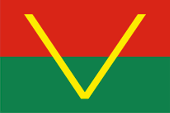
Nationalflagge,
Seitenverhältnis = 2:3,
Quelle, nach: Wikipedia (EN)


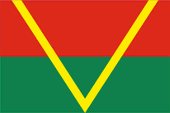
Nationalflagge,
Variante,
Seitenverhältnis = 2:3,
Quelle, nach: Flags of the World
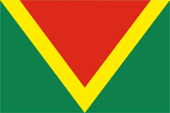
fehlerhafte und häufig gebrauchte Variante der Nationalflagge,
Quelle, nach: Flags of the World

Die Flagge von Südkasai zeigte zwei horizontale Streifen in Rot und Grün und in der Mitte der Flagge ein gelbes "V". Einige Quellen zeigen das gelbe V bis an den Rand der Flagge reichend, andere (so auch Fotos) zeigen es nicht bis zum Rand reichend. Grün, Gelb und Rot sind auch als die "Panafrikanischen Farben" bekannt: Etwa 1900 setzte die Panafrika-Bewegung ein, die Gemeinsamkeiten aller Menschen mit schwarzer Hautfarbe hervorheben wollte. Der Farbendreiklang Grün-Gelb-Rot, den viele afrikanische und auch amerikanische Staaten nach Erlangung ihrer Unabhängigkeit in ihre Flaggen übernahmen, steht für die politische Einheit Afrikas, ja aller Schwarzen. Das erste Land war Ghana im Jahr 1957. Als Ursprung gelten die Landesfarben von Athiopien (Abessinien), dem ältesten unabhängigen Staat Afrikas. Von der Flagge Südkasais gibt es eine fehlerhafte Variante, die Rot und Grün ober- bzw. unterhalb des "V" zeigt. Sie ist wahrscheinlich auf eine falsche mündliche Interpretation zurückzuführen. Dennoch ist sie häufig zu sehen.
Quelle: Flags of the World, Volker Preuß

1960–1962,
Wappen von Süd-Kasai,
Quelle, nach: www.congoposte.be,
Dank an: antemister
Das Wappen von Südkasai zeigte einen Leopardenkopf. Die obige Darstellung wurde einer Briefmarke nachempfunden, die das gleiche Wappen trug wie die Verfassung des Landes.
Quelle: www.congoposte.be, Dank an: antemister
Lage:
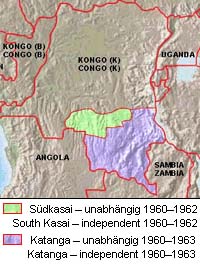
Quelle/Source: Freeware, University of Texas Libraries,
modyfied by: Volker Preuß
Fläche: ca. 30.000 km²
Einwohner: ca. 1.000.000 (1960)
Hauptstadt: Bakwanga (Name ab 1966: Mbuji-Mayi), ca. 136.000 Ew. (1960)
Amtssprache: Französisch
sonstige Sprachen: Bantusprachen (Luba, Kuba ...)
Währung: 1 Kongo-Franc (CDF, F, FC) = 100 Centimes
Zeitzone: MEZ + 1 h
Quelle: Wikipedia (D), www.congoposte.be
Vor der Eroberung des Kongo durch die Belgier existierte in Kasai zwischen dem 15. und 19. Jahrhundert das Reich der Kuba und die südlichen Landesteile gehörten zum Lubareich von Katanga. Kasai wurde dann eine Provinz von Belgisch-Kongo (heute Kongo-Kinshasa [Zaire]). Im Zuge der Bürgerkriegswirren vor und nach der Unabhängigkeitserklärung von Kongo-Kinshasa (30.06.1960) erklärte sich der an Bodenschätzen reiche Süden der Kasai-Provinz am 14.06.1960 als "Autonomer Staat Südkasai" unter dem Lubaführer Albert Kalonji für unabhängig. Am 08.08.1960 wurde der "Autonome Bergbaustaat Südkasai" proklamiert. Zur Hauptstadt wurde Bakwanga (das heutige Mbuji-Mayi) erklärt. Am 12.04.1961 wurde der Vater von Albert Kalonji von den Luba als König eingesetzt, der sein Amt sofort an seinen Sohn übergab. Präsident Kalonji nannte sich jetzt Mulopwe (König) Albert I. Kalonji. Durch Angriffe der Truppen des Kongo-Ministerpräsidenten Lumumba bzw. dessen Nachfolgers Gizenga gingen die Städte Bakwanga und Loulabourg verloren und Albert I. geriet in Gefangenschaft. In der Zwischenzeit unterlagen die Truppen Gizengas den Truppen von Joseph Mobuto und Moise Tschombe. Am 07.09.1962 gelang es Albert I. aus der Gefangenschaft zu fliehen und er kehrte an die Spitze seines ums Überleben kämpfenden Staates zurück, jedoch musste Südkasai nur einen Monat später kapitulieren. Die Regierung Mobuto teilte die Provinz Kasai in eine Ostprovinz (Hauptstadt Mbuji-Mayi) und eine Westprovinz Hauptstadt (Luluabourg/Kananga).
Quelle: Wikipedia (D), Volker Preuß
Der Landesname "Kasai" bzw. "Süd-Kasai" geht auf den Fluss Kasai zurück, der im Lundaland in Angola seine Quelle hat. Er fließt zunächst nordwärts und dann Richtung Nordwesten und vereinigt sich als "Kwa" bei der Ortschaft Kwamouth mit dem Fluss Kongo.
Quelle: Volker Preuß