mobile Ansicht, to the English Version tap the flag


- auch: Galizien
- Autonome Region Spaniens
- 9. bis 11. Jhd. Königreich Galicien
- bis 1833 nominelles Königreich als Teil Spaniens
• Flagge
• historische und andere Flaggen
• Bedeutung/Ursprung der Flagge
• Wappen
• historische Wappen
• Bedeutung/Ursprung des Wappens
• Landkarte der autonomen Regionen Spaniens
• Landkarte der historischen Königreiche auf der Iberischen Halbinsel
• Zahlen und Fakten
• Geschichte
• Ursprung des Landesnamens
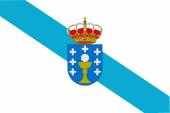
seit 1984,
Flagge von Galicien,
Seitenverhältnis = 2:3,
Quelle, nach: Flags of the World


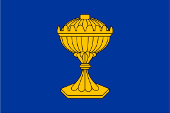
16. Jahrhundert,
angebliche Flagge des Königreiches Galicien,
Quelle, nach: Wikipedia (ES)

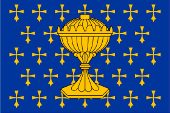
16. Jahrhundert,
angebliche Flagge des Königreiches Galicien,
Quelle, nach: Wikipedia (ES)
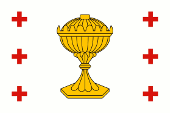
18. Jahrhundert,
Flagge des Königreiches Galicien,
Quelle, nach: Wikipedia (ES)

1845–1891,
Flagge der Provinz La Coruña,
Seitenverhältnis – ratio = 2:3,
Quelle, nach: Wikipedia (ES)

ab 1891,
Flagge der Provinz La Coruña,
Seitenverhältnis – ratio = 2:3,
Quelle, nach: Wikipedia (ES)

1977–1984,
Flagge von Galicien,
Seitenverhältnis – ratio = 2:3,
Quelle, nach: World Statesmen

Flagge linksgerichteter lokaler Nationalisten,
Seitenverhältnis – ratio = 2:3,
Quelle, nach: Wikipedia (EN)
Die heutige Flagge Galiciens wurde am 29.05.1984 eingeführt. Sie ist einfarbig weiß mit einem diagonalen, blauen Schrägrechtsbalken. Sie geht auf die historische See-Flagge der Stadt und Provinz La Coruña zurück. Diese zeigte ab 1845 ein blaues Diagonalkreuz auf weißem Grund, jedoch wurde sie im Jahre 1891 auf einen Schrägrechtsbalken reduziert um Verwechslungen mit der Russischen Marineflagge auszuschließen. Weiß und Blau gelten als die Farben der Jungfrau Maria. In der Mitte der Flagge das Wappen des Landes mit eine Königskrone darüber. Wappen aus der Frühzeit des Königreichs sind nicht bekannt, das Land kam 1071 an Kastilien-Leon, jedoch blieb das Land bis 1833 ein nominelles Königreich. Erste Wappen tauchten im 13. Jahrhundert auf. Sie zeigen auf blauem Grund einen oder mehrere goldene Kelche. Man geht davon aus, dass das Wappen nachträglich als "redend" interpretiert wurde, denn das spansische Wort "Cáliz" bedeutet Kelch, so das ein Kelch als Landessymbol von "Galicien" angenommen wurde. Ab dem 15. Jahrhundert wurde der Kelch als Hostienkelch (Ziborium) dargestellt, weil man das Gefäß im Wappen mit dem außergewöhnlichen Privileg der Kathedrale von Lugo in Verbindung brachte, die Hostie oder den Leib Christi öffentlich zur Schau zu stellen. Ab dem 16. Jahrhundert wurden goldene Kreuze um das Wappen gestreut. Ähnlich wird man die Wappenbanner bebildert haben, die Vorgänger der heutigen Flaggen. Verbindliche Flaggendarstellungen gibt es seit dem 18. Jahrhundert, hier ist die Flagge weiß, zeigt in der Mitte den Hostienkelch und links und rechts davon je drei rote Kreuze. Das ist erstaunlich, denn diese Farben weichen erheblich von denen der damals verwendeten Wappen ab. Unter der der Regierung des Generals Franco (1936–1975) waren alle regionalen Flaggen verboten. Nach Francos Tod (1975) wurden die regionalen Flaggen wieder eingeführt, auch in Galicien, wenn auch zunächst inoffiziell, da Galicien bis 1981 noch keinen Autonomiestatus hatte. Jedoch trug die Flagge bis 1984 kein Wappen. In den meisten autonomen Regionen Spaniens begann die neuere Flaggengeschichte bereits in den Jahren vor der Vergabe des Autonomiestatuts mit einer Flagge ohne Wappen, weil die Wappen oftmals noch gar nicht beschlossen waren. Immerhin hat sich meist durchgesetzt, dass die Flagge mit dem Wappen von den regionalen Behörden oder zu offiziellen Anlässen verwendet wird und die Flagge ohne Wappen quasi zu privaten, dekorativen Zwecken verwendet werden soll. Die Vorschrift "Die Farbtöne der Flagge von Galicien" vom 16.02.2022 regelt die Farben der Flagge und gibt folgende Pantone-Töne vor: Hellblau = pt 801, Mittelblau = pt 300, Rot = pt 186, Gold = pt 3975. Linke politische Gruppen, die für Galicien die Unabhängigkeit anstreben, verwenden die Flagge Galiciens ohne das Wappen, jedoch in der Mitte ergänzt um einen roten, fünfzackigen Stern.
Quelle:
Wikipedia (ES),
Wikipedia (GL),
Flags of the World,
Volker Preuß
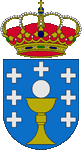
seit 1984,
Wappen von Galicien,
Quelle, nach:
Wikipedia (GL)
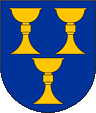
13. Jahrhundert,
Wappen von Galicien,
Quelle, nach:
Wikipedia (ES)
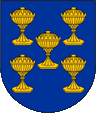
15. Jahrhundert,
Wappen von Galicien,
Quelle, nach:
Wikipedia (ES)
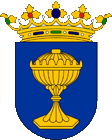
16. Jahrhundert,
Wappen von Galicien,
Quelle, nach:
Wikipedia (ES)
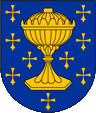
16. Jahrhundert,
Wappen von Galicien,
Quelle, nach:
Wikipedia (ES)
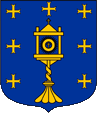
18. Jahrhundert,
Wappen von Galicien,
Quelle, nach:
Wikipedia (ES)
Das heutige Wappen Galiciens wurde am 29.05.1984 per Gesetz eingeführt. Der Wappenschild ist dunkelblau und zeigt einen goldenen Abendmahlskelch, eine silberne Hostie sowie sieben silberne gleicharmige Kreuze. Darüber eine Königskrone. Das Wappen orientiert sich an an älteren Versionen des Wappens von Galicien. Wappen aus der Frühzeit des Königreichs sind nicht bekannt. Das Land kam 1071 an Kastilien-Leon, jedoch blieb Galicien bis 1833 ein nominelles Königreich. Erste Wappen tauchten im 13. Jahrhundert auf. Sie zeigen auf blauem Grund einen oder mehrere goldene Abendmalskelche. Man geht davon aus, dass das Wappen nachträglich als "redend" interpretiert wurde, denn das spansische Wort "Cáliz" bedeutet Kelch, so das ein Kelch als Landessymbol von "Galicien" angenommen wurde. Ab dem 15. Jahrhundert wurde der Kelch als Hostienkelch (Ziborium) dargestellt, weil man das Gefäß im Wappen mit dem außergewöhnlichen Privileg der Kathedrale von Lugo in Verbindung brachte, die Hostie oder den Leib Christi öffentlich zur Schau zu stellen. Ab dem 16. Jahrhundert wurden goldene Kreuze um das Wappen gestreut. Deren Form änderte sich immer wieder, jedoch stand die Anzahl der Kreuze irgendwann bei sieben fest, wobei sie für die sieben historischen Provinzen des Landes standen: Santiago, Betanzos, Mondoñedo, Tuy, Lugo, Orense, La Coruña. Ab dem 18. Jahrhundert erschien der Hostienkelch als Tabernakel. Das heutige Wappen ist insofern als Produkt der Neuzeit zu erkennen, denn es vereinigt den Abendmalskelch der frühen Heraldik mit den sieben Kreuzen des 18. Jahrhunderts.
Quelle:
Wikipedia (ES),
Wikipedia (GL),
Volker Preuß
Die autonomen Regionen Spaniens:
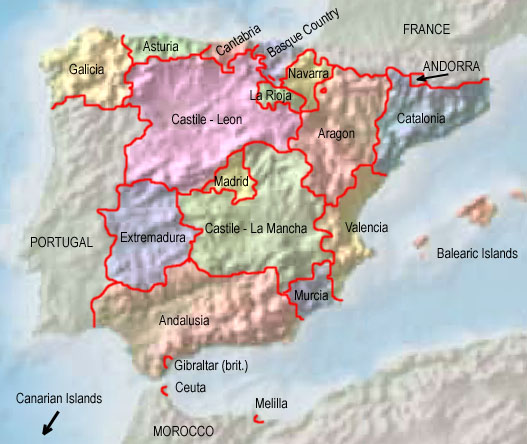
Quelle/Source: Freeware, University of Texas Libraries, modyfied by: Volker Preuß
Karte der historischen Königreiche auf der Iberischen Halbinsel (ca. 1220):
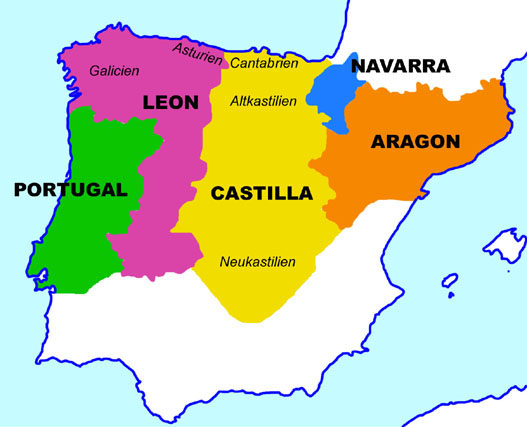
Landkarte/Map: Volker Preuß
Fläche: 29.574 km²
Einwohner: 2.696.161 (2022), Galicier und Kastillier
Bevölkerungsdichte: 91 Ew./km²
Hauptstadt: Santiago de Compostela, 98.179 Ew. (2022)
Amtssprachen: Spanisch (Kastilisch), Galicisch (Galicisch: Galego, span.: Gallego)
sonstige Sprachen: Portugiesisch
Währung: spanische (Euro-)Währung
Zeitzone: MEZ
Quelle: Wikipedia (DE)
Frühzeit · Besiedlung durch Iberer
ca. 600 v.Chr. · Einwanderung von Kelten, Vermischung mit den Iberern, Herausbildung der Keltiberer (darunter der Stamm der Galläker)
218–201 v.Chr. · Zweiter Punischer Krieg, das Römische Reich erwirbt die Besitzungen Karthagos in Iberien, Unterwerfung der ganzen Iberischen Halbinsel bis zum Jahre 19 v.Chr., römische Besiedlung, Romanisierung, das heutige Galicien kommt zur römischen Provinz Hispania Tarraconensis
ca. 400 · Völkerwanderung, Durchzug germanischer Sweben, Vandalen und Westgoten
ca. 410 · Entstehung des Reiches der Sueben im heutigen Portugal und Galicien unter König Hermerich
411 · das Reich der Sueben wird weströmischer Föderat
583–583 · Erb- und Thronfolgekriege
585 · das Reich der Sueben wird von den benachbarten Westgoten erobert
711–714 · Vernichtung des Westgotenreichs durch von Nordafrika kommende Araber, die Westgoten ziehen sich nach Asturien zurück
716 · Ankunft der Araber in Galicien, das Land wird jedoch nicht besetzt, nicht dem Emirat Cordoba angegliedert und nicht arabisch besiedelt
813 · in der Ortschaft Compostela werden die Gebeine des Apostels St. Jakob (spanisch Santiago) gefunden
882 · Fürst Pelayo von Oviedo (Asturien) befreit die Stadt Leon von den Moslems und besetzt ganz Galicien, Errichtung des Königreichs Oviedo
910 · Tod von König Alfons III. von Oviedo, Erbteilung seines Reiches unter seinen Söhnen, sein Sohn Garcia I. wird König von Leon, sein Sohn Ordoño II. wird König von Galizien, sein Sohn Fruela II. erbt Asturien
914 · Tod von König Garcia I., sein Bruder König Ordoño II. von Galizien erbt Leon
914–924 · Herrschaft von König Ordoño II. von Galizien und Oviedo (Asturien)
924 · Tod von König Ordoño II., das Erbe fällt an König Fruela II. von Oviedo (Asturien), er verlegt seine Residenz von Oviedo nach Leon, das Land wird ab jetzt Königreich Leon genannt
931–950 · Herrschaft von König Ramiro II., ein Sohn von Ordoño II., Vereinigung von Galicien, Asturien und Leon unter einer Krone (Königreich Leon), erfolgreiche Kriege gegen die Araber, Ausdehnung des Reiches
1037 · Aussterben der Dynastie Pelayo, das Königreich Leon erbt König Ferdinand von Kastillien, Kastilien und León werden unter einer Krone vereinigt
1060–1071 · Galicien ist kurzzeitig wieder ein eigenes Königtum unter Don García, danach wieder an Kastilien-Leon (bzw. Spanien)
1808–1813 · Galicien ist durch französische Truppen besetzt
1833 · die bis dato in Spanien bestehenden Teilkönigreiche und Regionen werden in Provinzen aufgeteilt, das Königreich Galicien in die Provinzen Lugo, Orense, Pontevedra und La Coruña
1936–1939 · Spanischer Bürgerkrieg, Galicien kämpft an der Seite der Franco-Truppen gegen die sozialistische Zentralregierung
28.04.1981 · Galicien erhält das Autonomiestatut innerhalb Spaniens (unter Zusammenfassung der Provinzen Lugo, Orense, Pontevedra und La Coruña), Gründung der "Autonomen Gemeinschaft Galicien"
Quelle:
Wikipedia (ES),
World Statesmen,
Volker Preuß
Der Name "Galicien" geht auf den keltiberischen Stamm der Galläker (auch Kallaiker) zurück, der hier siedelte. Die Römer nannten den Stamm "Callaici" und das Land "Gallaecia". Dieser Landesname blieb auch unter der Herrschaft der Sueben und Westgoten erhalten, hat sich jedoch über die Jahre zum heutigen "Galicia" verändert. Um Verwechslungen mit der osteuropäischen Region Galizien zu vermeiden wird für das spanische Galizien häufig die Schreibweise Galicien angewandt.
Quelle: RetroBib Retrobibliothek, Volker Preuß