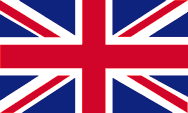
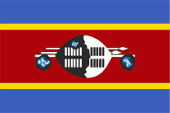
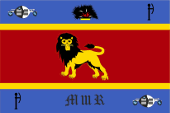
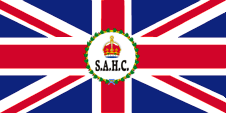
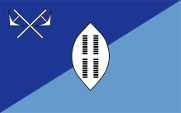
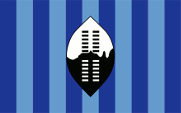
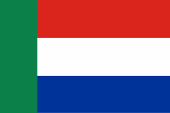
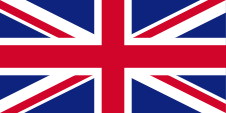
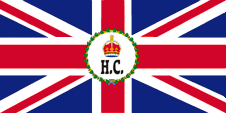
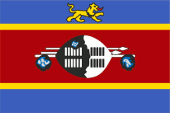
Die Flagge von Swasiland (das Land hieß bis 2018 so) wurde am 30.10.1967 erstmals gehisst. Sie zeigt fünf waagerechte Streifen in Blau, Gelb, Purpur, Gelb und Blau, im Verhältnis 3:1:8:1:3. In der Mitte des purpurroten Streifens erscheint ein Swasi-Kampfschild mit zwei Lanzen und einem Kampfstock, verziert mit blauen Federbüscheln. Die Farben der Flage sind von der britischen Admiralität festgelegt: Purpur = T816, Gelb T820, Blau T813. Es gibt aber auch eine Übertragung in den RGB-Farbraum, als Rot 177-12-12, Gelb 255-217-0, Blau 62-94-185, was in etwa folgenden Pantone-Farbtönen entsprechen würde: Rot = pt 1797 c, Gelb = pt 109 c, Blau = pt 7455 c. Das Blau steht für den Frieden, Gelb für den Reichtum des Landes an Bodenschätzen und das Purpurrot die ruhmreichen Schlachten der Vergangenheit. Die Federbüschel an Schild und Kampfstock sind ein königliches Emblem. Die Gestaltung des Schildes geht auf das Emasotsha-Regiment zurück, das derartige Schilde benutzte. Das Design der Flagge geht auf die Fahne des Swasi-Pionierkorps (Swazi Pioneer Corps) zurück, das im Ersten Weltkrieg, nach anderen Quellen erst im Jahre 1941 aufgestellt wurde. In den Zeiten Swasilands als Protektorat Großbritanniens bzw. der Südafrikanischen Republik (Transvaal) wurde der britische Union Jack bzw. die "Vierkleur" verwendet. Der britische Hohe Kommissar hatte seit 1878 seine eigene Flagge. Es handelte sich um die für Hohe Kommissare übliche Flagge, den Britischen Union Jack mit dem Abzeichen des Hohen Kommissars in der Mitte, eine von einem Kranz umgebene Abkürzung mit der britischen Krone darüber. Bis 1931 war der Britische Hohe Kommissar für Südafrika (Abkürzung: S.A.H.C.) für Swasiland zuständig. Nach dem Westminsterstatut wurde Südafrika 1931 unabhängig, und der Hohe Kommissar war nur noch für Betschuanaland, Basutoland und Swasiland zuständig (Abkürzung: H.C.). Im Jahre 1953 änderte sich nur noch die Form der Krone. Jedoch hatte das Königreich, dem Großbritannien von Anfang an Autonomie zugesichert hatte, schon ab 1890 eine eigene Flagge. Sie war diagonal zwischen Dunkelblau und Hellblau geteilt und zeigte in der Mitte den Swasi-Kampfschild in weiß. Von 1894 bis 1902 war die Flagge mehrfach in Dunkelblau und Hellblau gestreift, und zeigte in der Mitte den Swasi-Kampfschild in Weiß uns Schwarz. Die Flagge des Königs ähnelt der Nationalflagge, erst recht das bis 1982 gültige Modell mit einem Löwen am oberen Rand. Ab 1982 erscheint der Löwe zentral.
Quelle:
Die Welt der Flaggen,
Flaggen Wappen Hymnen,
Volker Preuß
seit 1968,
Wappen von Swasiland (Eswatini),
Quelle: Corel Draw 4
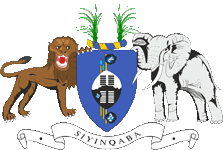
Das Wappen von Swasiland (das Land hieß bis 2018 so) wurde 1968 anlässlich der Unabhängigkeit angenommen. Es zeigt ein blaues Wappenschild mit dem Swasi-Kampfschild und seinem Zierrat, so wie auf der Flagge, jedoch senkrecht angeordnet. Oberhalb des Schildes ein gelb-blauer Wulst mit dem Kopfschmuck des Emasotsha-Regiments, den Schwanzfedern des Witwenvogels. Schildhalter sind ein Löwe und ein Elefant, die für den König und die Königinmutter stehen. Das Motto auf dem Band lautet "Siyinquaba" → "Wir sind die Festung".
Quelle:
Die Welt der Flaggen,
Flaggen Wappen Hymnen,
Volker Preuß
Lage:
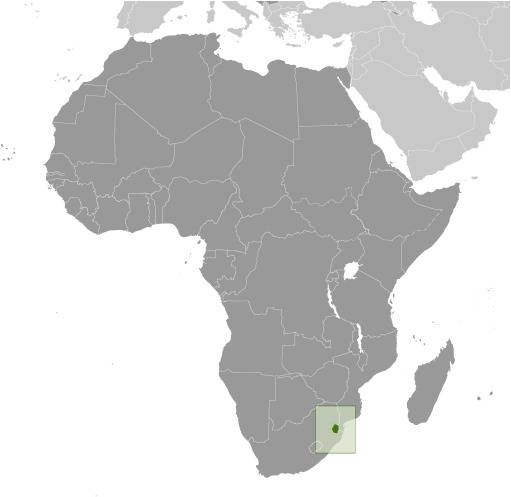
Quelle/Source: CIA World Factbook
Landkarte des Landes:
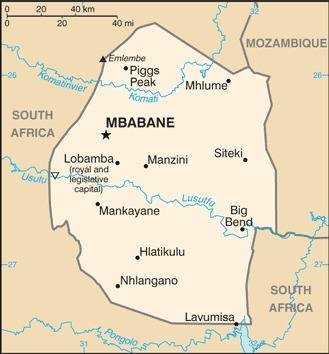
Quelle/Source: CIA World Factbook
Landkarte der Staaten in Südlichen Afrika,
die ehemaligen Burenrepubliken und die ehemalige Britische Kapkolonie
heutige Grenzen in Rot:
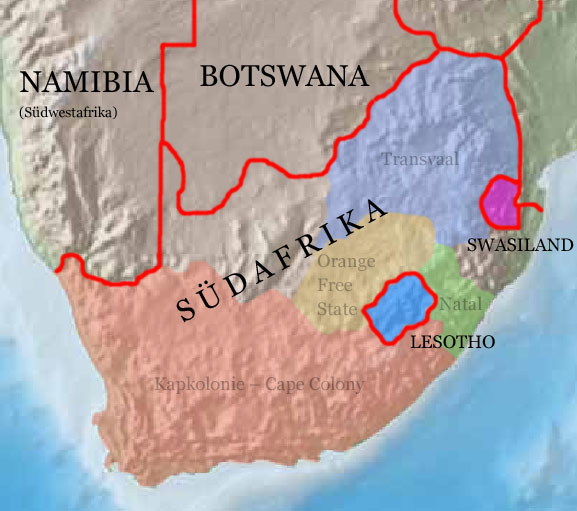
Quelle/Source: Freeware, University of Texas Libraries, modyfied by: Volker Preuß
Fläche: 17.363 km²
Einwohner: 1.172.000 (2021), davon 97 % Swasi, 3 % andere Afrikaner, Asiaten, Europäer
Religionen: 90 % Christen (davon 20 % Katholiken), 2 % Moslems
Bevölkerungsdichte: 67 Ew./km²
Hauptstadt: Mbabane, 90.000 Ew. (2018)
Residenz des Königs: Lobamba, 5.800 Ew. (2018)
Amtssprachen: Englisch, Siswasi
Währung: 1 Lilangeni (Plural: Emalengeni, SZL, E) = 100 Cents
Zeitzone: MEZ + 1 h
Quelle:
Wikipedia (D),
CIA World Factbook
15./16. Jahrhundert · Einwanderung des Bantu-Volkes der Swasi
1820 · das Bantu-Volk der Zulu unter König Sobhuza (Tschaka) attackiert die Swasi, Herausbildung des Swasi-Reiches
1833 · Aufhebung der Sklaverei in der Britischen Kapkolonie
1836–1885 · die Buren verlassen in langen Treks das Kapland in Richtung Osten und Nordosten und gründen mehrere Burenrepubliken
1868 · Einwanderung der ersten Buren in Swasiland
1877 · Einwanderung von Briten
1877 · Festlegung der heutigen Grenzen
1894 · Swasiland wird Protektorat der Südafrikanischen Republik (Transvaal)
1899–1902 · Burenkrieg, Großbritannien unterwirft die Burenstaaten Oranje-Freistaat und Transvaal, beide werden Britische Kolonien
1903 · Swasiland wird britisches Protektorat
1967 · eigene Verfassung, Großbritannien gewährt Selbstverwaltung
06.09.1968 · Großbritannien gewährt Unabhängigkeit
1973 · Swasiland wird absolute Monarchie
19.04.2018 · König Mswati III. benennt Swasiland in Eswatini um
Quelle:
Wikipedia (DE),
Volker Preuß
Am 19.04.2018 benannte König Mswati III. sein Land, Swasiland, in "Eswatini" um. Der König begründete seinen Entschluss damit, dass es in Afrika schon zu Verwechslungen mit Switzerland (Schweiz) gekommen sei und der Name Swasiland bzw. Swaziland (Land der Swasi) auf die englische Sprache zurückginge und nicht auf die authentischere offizielle Amtssprache Siswati. Daher lautet auch der volle offizielle Staatsname Umbuso we-Swatini. "Swasiland" heißt "Land der Swasi". Es trägt den Namen des Bantu-Volkes, welches im 19. Jahrhundert diesen Staat gründete. Manchmal wird der Name "Ngwana" verwendet. Diesen Namen sollte das Land eigentlich nach der Unabhängigkeit erhalten, jedoch konnte sich diese Idee nicht durchsetzen.
Quelle: Volker Preuß

Mit freundlicher Untersützung von: E. Hoheisel (D)