mobile Ansicht, to the English Version tap the flag


- Republik Tuwa
- Föderaler Bestandteil der Russischen Föderation (Russland)
- Eigenbezeichnung: Respublika Tywa
- frühere Namen: Urjanchai, Tannu-Tuwa
• Flagge
• historische Flaggen
• Bedeutung/Ursprung der Flagge
• Wappen
• Bedeutung/Ursprung des Wappens
• Landkarte
• Zahlen und Fakten
• Geschichte
• Ursprung des Landesnamens
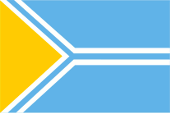
seit 2002,
Nationalflagge,
Seitenverhältnis = 2:3,
Quelle, nach:
Flags of the World


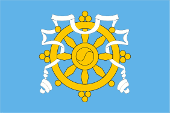
1914–1921,
Flagge des Russischen Protektorats Urjanchai,
Quelle, nach:
Wikipedia (EN)
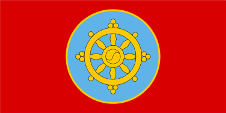
1921–1926,
Flagge der Volksrepublik Tannu-Tuwa,
Seitenverhältnis = 1:2,
Quelle, nach:
vectorization by Orange Tuesday,
Public domain, via Wikimedia Commons
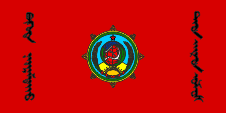
1926–1930,
Flagge der Volksrepublik Tannu-Tuwa,
Seitenverhältnis = 1:2,
Quelle, nach:
Lumia1234,
Public domain, via Wikimedia Commons

1930–1935,
Flagge der Volksrepublik Tannu-Tuwa,
Seitenverhältnis = 1:2,
Quelle, nach:
Lumia1234,
Public domain, via Wikimedia Commons

1935–1941,
Flagge der Volksrepublik Tannu-Tuwa,
Seitenverhältnis = 1:2,
Quelle, nach:
Lumia1234,
Public domain, via Wikimedia Commons
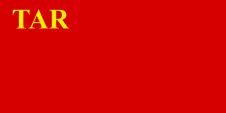
1941–1943,
Flagge der Volksrepublik Tannu-Tuwa,
Seitenverhältnis = 1:2,
Quelle, nach:
World Statesmen
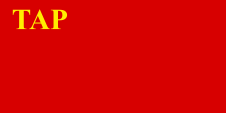
1943–1944,
Flagge der Volksrepublik Tannu-Tuwa,
Seitenverhältnis = 1:2,
Quelle, nach:
World Statesmen
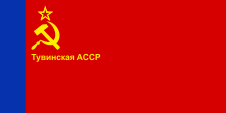
1962–1971,
Flagge der Tuwinischen Autonomen Sozialistischen Sowjetrepublik,
Seitenverhältnis = 1:2,
Quelle, nach:
World Statesmen
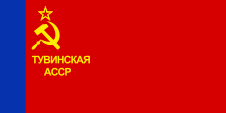
1971–1978,
Flagge der Tuwinischen Autonomen Sozialistischen Sowjetrepublik,
Seitenverhältnis = 1:2,
Quelle, nach:
World Statesmen
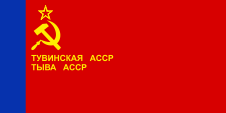
1978–1992,
Flagge der Tuwinischen Autonomen Sozialistischen Sowjetrepublik,
Seitenverhältnis = 1:2,
Quelle, nach:
World Statesmen
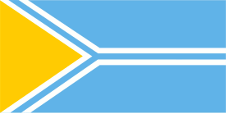
1992–2002,
Nationalflagge,
Seitenverhältnis = 1:2,
Quelle, nach:
World Statesmen
siehe auch:
Flaggengeschichte der Sowjetrepubliken der UdSSR
Die heutige Flagge von Tuwa wurde am 17.09. oder 18.09.1992 eingeführt. Sie zeigt ein hellblaues Grundtuch und ein gelbes gleichschenkliges Dreieck am Mast. Das Dreieck wird eingefasst durch ein hellblaues, weiß umrandetes Ypsilon, dass sich über die Mitte der Flagge bis zum wehenden Ende fortsetzt. Die Farben der Flagge sollen wahrscheinlich an die ersten Flagge von Tuwa erinnern, als das Land mit Unterstützung Russlands im Jahre 1914 die Unabhängigkeit von China erreichte. Gelb steht für Wohlstand und ist die Farbe des Buddhismus, Blau steht für Mut und Kraft und für den Himmel und ist die Farbe der Turkvölker, Tataren und Mongolen, Weiß steht für Silber, Tugend und Reinheit. Das Ypsilon symbolisiert den Zusammenfluss von Großem und Kleinem Jenissei nahe der Hauptstadt Kysyl. Am 08.02.2002 wurde das Format der Flagge von 1:2 (früher in der Sowjetunion üblich) auf 2:3 abgeändert.
Die Farbtöne der Farben der Flagge scheinen definiert zu sein, zumindest lassen sich folgende HEX-Farbangaben finden, aus denen sich Pantone-Farbtöne ableiten lassen: Hellblau #63B3E6 = Pantone 2915 C, Gelb #FECC00 = Pantone 123 C. In der Praxis sind aber auch Flaggen zu sehen, die ein dunkleres Blau zeigen.
Kurz nach Erlangen der Unabgängigkeit von China wurde eine Flagge eingeführt, die ein einfarbiges hellblaues Grundtuch zeigte, darauf ein goldenes Khorlo, das buddhistische Rad der Lehre, welches mit weißen Bändern geschmückt war. Bis zum Jahr 1930 wurde die buddhistische Symbolik Schritt für Schritt von den verwendeten, immer mehr kommunistisches Rot zeigenden Flaggen verdrängt. Ab 1930 war nur noch kommunistische Symbolik zu sehen, und ab 1941 sogar nur noch die Initialen des Landes als drei goldene Buchstaben im Obereck einer roten Flagge.
Die Flaggen, die zu Sowjet-Zeiten verwendet wurden, entsprachen alle dem immer gleichen Schema, wie es für Sowjetische Republiken vorgesehen war: oft nur ein einfabiges rotes Flaggentuch mit einer goldenen Inschrift, die den Landesnamen zeigte. Manchmal nur als Abkürzung, manchmal mit vollem Namen, manchmal nur in Russisch oder auch mehrsprachig. Ab etwa 1937 wurden manchmal noch Hammer, Sichel und Stern ergänzt. Ab etwa der Mitte der 50-er Jahre wurden mehrfarbige Flaggen für die Republiken der Sowjetunion eingeführt, deren Strickmuster die untergeordneten Autonomen Sowjetrepubliken zu übernehmen hatten. Für Tuwa hieß das, dass es sich an der Flagge der Russischen Föderativen Sowjetrepublik (Sowjetrussland) zu orientieren hatte.
Quelle:
Flaggen Enzyklopädie,
1.) Wikipedia (EN),
2.) Wikipedia (EN),
Volker Preuß
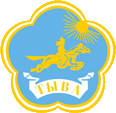
Wappen der Republik Tuva,
Quelle, nach:
Wikipedia (RU)
Das heutige Wappen von Tuwa wurde am 17.09.1992 angenommen. Die Form des Wappens ist ein stilisiertes Bild, das die Vorstellungen der alten Turkvölker über den Aufbau der Welt darstellt. In der Mitte ein tuwinischer Reiter, der der Sonne entgegenreitet. Er steht für die traditionelle Lebensweise und die grundlegende wirtschaftliche Tätigkeit der Einwohner. Die Sonne steht für den Wunsch der Tuwiner nach hohen Idealen, Frieden und Wohlergehen. Das Spruchband, das den Staatsnamen in kyrillischen Buchstaben in Gold trägt, ist ein "Kadak", ein ritueller langer Schal, das die Gastfreundschaft und Freundlichkeit der Menschen der Republik Tuwa widerspiegelt. Die Farben haben auch ihre Bedeutung: Blau symbolisiert klaren Himmel, hohe Ziele, gegenseitigen Respekt und Harmonie in der Gesellschaft und es ist die Farbe der Turkvölker, Tataren und Mongolen. Weiß steht für Reinheit, Tugend, Offenheit und Unabhängigkeit. Gelb (Gold) steht für Wohlstand und ist die Farbe des Buddhismus. Ein ähnliches Wappen war, ergänzt um kommunistische Symbole, bereits zwischen den Jahren 1933 und 1941 in Verwendung und auch die benachbarte Mongolei verwendet ein ähnliches Bild im Wappen.
Quelle:
Wikipedia (EN),
Wikipedia (RU),
Volker Preuß
geographische Lage in Russland:
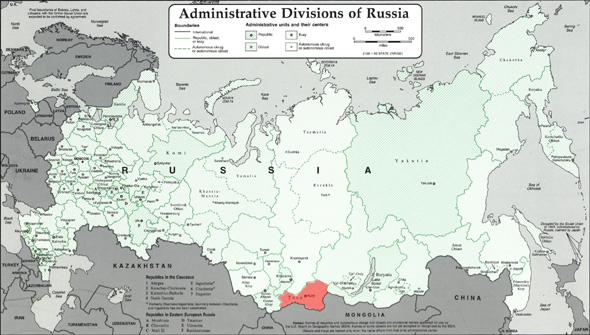
Quelle: Freeware, russiamap.org, modyfied by: Volker Preuß
vergrößern – hier klicken
Landkarte des Landes:
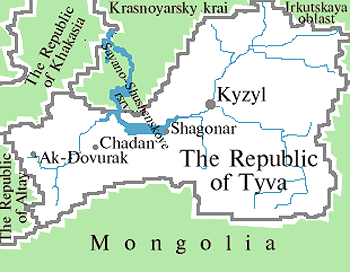
Quelle/Source: Russiatrek
Fläche: 168.604 km²
Einwohner: 308.000 (2010), davon 89% Tuwiner, 10% Russen, 1% Komi, Chakassen, Chinesen, Mongolen
Religionen: meist Buddhisten (Tibetischer Buddhismus), einige altgläubige russisch-orthodoxe Christen, orthodoxe Christen, wenige Animisten
Bevölkerungsdichte: 2 Ew./km²
Hauptstadt: Kysyl, ca. 110.000 Ew. (2010)
Amtssprachen: Tuwinisch, Russisch
Währung: russische Währung
Zeitzone: MEZ + 6 h
Quelle: Wikipedia (DE)
Antike · Herausbildung des Tuwinischen Volkes aus skythischen, mongolischen und türkischen Stämmen
1207 · Eroberung durch die Mongolen unter Dschingis Khan
1227 · Tod des Dschingis Khan, Aufteilung des Reiches unter seinen vier Söhnen, sein Sohn Ügedei erhielt das heutige China, Korea, die heutige Mongolei, Tuwa und Mandschurei und wurde zum Nachfolger und Großkhans ernannt, sein Sohn Kublai Khan bedründete die Chinesische Yuan-Dynastie
14.–15. Jahrhundert · China verliert die Kontrolle über Tuwa, Herrschaft von Uiguren, Kirgisen, Oiraten und Mongolen
1696 · die chinesische Mandschu-Dynastie erobert die Gebiete der Mongolen, und damit auch Tuwa, Tuwa wird Provinz Tannu-Urjanchai
10.10.1911 · Sturz der Monarchie in China, Unruhen, separatistische Bestrebungen
Oktober bis Dezember 1912 · Unabhängigkeit für Tibet, Ostturkestan (Dschungarei) und die Äußere Mongolei (einschließlich der Provinz Tannu-Urjanchai)
1912 · Abspaltung (unterstützt von Russland) von Tannu-Urjanchai von China, Staat Tannu-Tuwa
1914 · Tannu-Tuwa wird russisches Protektorat (Protektorat Urjanchai-Region), ein späterer Vertrag zwischen Russland und China gewährt Tannu-Tuwa die Unabhängigkeit unter nomineller chinesischer Oberhoheit
1917 · Leninputsch in Russland, Tannu-Tuwa erklärt erneut seine Unabhängigkeit
1917–1921 · Bürgerkrieg in Tannu-Tuwa, Sieg der russischen Bolschewisten
14.08.1921 · Proklamation der Volksrepublik Tannu-Tuwa als Satellitenstaat Sowjetrusslands
1925 · Kuular Donduk wird Präsident des Landes, Buddhismus wird Staatsreligion
1926 · Garantievertrag zwischen der Sowjetunion, der Mongolei und Tannu-Tuwa
Januar 1929 · Kuular Donduk wird auf Befehl Stalins ermordet
1930 · Einführung der lateinischen Schrift
1940 · Einführung der kyrillischen Schrift
1930–1944 · Kollektivierung, Sowjetisierung, Verdrängung von Buddhismus und Schamanismus
11.10.1944 · Tannu-Tuwa beantragt die Aufnahme in die Sowjetunion, Tannu-Tuwa wird Autonomes Gebiet innerhalb Sowjetrusslands
10.10.1961 · das Tuwinische Autonome Gebiet wird Autonome Sozialistische Sowjetrepublik innerhalb Sowjetrusslands
November 1991 · Tuwa proklamiert seine Unabhängigkeit
31.12.1991 · die Sowjetunion löst sich auf, die Verfassung der Russischen Sozialistischen Föderativen Sowjetrepublik (RSFSR, Russland), ein ehemaliger Teilstaat der Sowjetunion bleibt vorerst in Kraft
25.12.1993 · eine neue Verfassung für Russland (Russische Föderation) tritt in Kraft, das Verhältnis zu den Gliedern der Föderation wird damit neu geregelt
Quelle:
Atlas zur Geschichte,
World Statesmen,
Russiatrek,
Die Völker der Erde,
Wikipedia (D)
Der Name "Tuwa" ist russischen Ursprungs und bezieht sich auf die Tuwiner, das hier lebende Turkvolk. Die Tuwiner nennen sich selbst "Tywa-Kischi" und ihr Land "Tywa". Ältere Bezeichnungen für die Tuwiner sind: "Sojonen" und "Urjanchai". Der Name "Tannu-Tuwa" meint "Land der Tuwiner im Tannu-Ola-Gebirge", denn weitere Tuwiner leben in der Mongolei, in Russland, in China und im Hochaltai.
Quelle:
Die Völker der Erde, Volker Preuß
Surftipp: