mobile Ansicht, to the English Version tap the flag

- bundesstaatliche präsidiale Republik
- Eigenbezeichnung: United States of America
• Flaggen
• historische Flaggen
• Bedeutung/Ursprung der Flagge
• Wappen
• Bedeutung/Ursprung des Wappens
• Flugzeugkokarde
• Landkarte
• Bundesstaaten
• Außenbesitzungen
• Zahlen und Fakten
• Geschichte
• Ursprung des Landesnamens
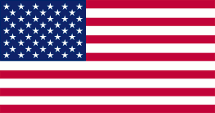
seit 1960,
National-, Staats-, Handels- und Marineflagge,
Seitenverhältnis = 10:19,
Quelle, nach:
Flags of the World,
Corel Draw 4


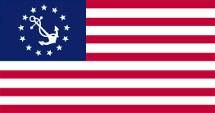
Flagge für Wassersportfahrzeuge (Yachtflagge),
Seitenverhältnis = 10:19,
Quelle, nach: Flags of the World

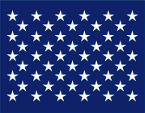
1960–2002, seit 2019,
Gösch,
Seitenverhältnis = 71:100,
Quelle, nach: Flags of the World
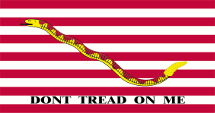
2002–2019,
Gösch,
Seitenverhältnis = 2:3,
Quelle, nach: Flags of the World
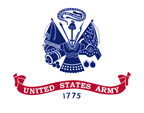
Flagge des Heeres,
Seitenverhältnis = 63:80 (?),
Quelle, nach: United States Institute of Heraldry,
Public domain, via Wikimedia Commons
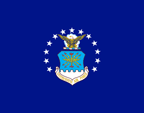
Flagge der Luftwaffe,
Seitenverhältnis = 63:80 (?),
Quelle, nach: Dorothy G. Gatchell,
Public domain, via Wikimedia Commons
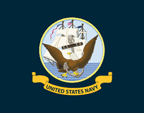
Flagge der Marine,
Seitenverhältnis = 63:80 (?),
Quelle, nach: United States Department of the Navy,
Public domain, via Wikimedia Commons
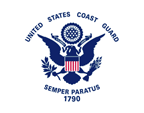
Flagge der Küstenwache,
Seitenverhältnis = 63:80 (?),
Quelle, nach: U.S. Army Institute of Heraldry,
Public domain, via Wikimedia Commons
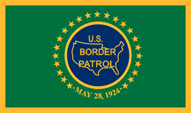
Flagge des Grenzschutzes,
Seitenverhältnis = 7:12,
Quelle, nach: United States Border PatrolVectored by FOX 52.,
Public domain, via Wikimedia Commons
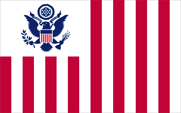
Flagge des Zoll,
Seitenverhältnis = 11:18,
Quelle, nach: Ibagli,
Public domain, via Wikimedia Commons
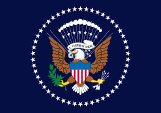
Flagge des Präsidenten,
Seitenverhältnis = 7:10,
Quelle, nach: Flags of the World,
Corel Draw 4
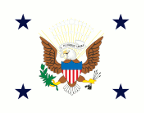
Flagge des Vizepräsidenten,
Seitenverhältnis = 63:80,
Quelle, nach: Flags of the World,
Corel Draw 4

Die Flagge der USA, mit ihren Sternen und Streifen, wurde in dieser Grundform am 14.06.1777 eingeführt. Sie zeigt heute dreizehn waagerechte weiße und rote Streifen. Die Oberecke ist blau und zeigt fünfzig weiße fünfzackige Sterne. Die dreizehn Streifen stehen für die dreizehn britischen Kolonien, die sich im Jahre 1775 zur Wahrung der ihnen ihrer Meinung nach zustehenden Rechte gegenüber Großbritannien in einer Union zusammenschlossen hatten. Seit 1818 wird die Anzahl der zur dieser Union gehörenden Staaten durch die Anzahl der weißen Sterne im blauen Feld repräsentiert. Seit dem 04.07.1960 (Aufnahme von Hawaii in die USA) sind es fünfzig Stück. Die Farben Blau, Weiß und Rot haben ihren Ursprung im Britischen "Union Jack", der sogar noch ein Jahr lang (bis 1777) in der Flagge der USA zu sehen war. Die Farben haben heute folgende Bedeutung: Blau steht für Gerechtigkeit und Ausdauer, Weiß für Reinheit und Bescheidenheit, Rot für Stärke und Mut.
Die US-Vorschrift "DDD-F-416F" bestimmt die genauen Farbtöne für Rot, Weiß und Blau, so wie sie von Bundesbehörden verwendet und umgesetzt werden müssen. Es handelt sich dabei um Koordinaten des CIE-Farbraums, die in HEX-Werte übertragbar sind und folgende Werte ergeben: #FFFFFF für Weiß, #B22234 für Rot und #3C3B6E für Blau. Ergänzend gibt es die "Standard Color Reference of America", in ihrer 10. Ausgabe, eine Reihe von Mustern gefärbter Seidenstoffe, die als Referenz herangezogen werden. Die sich daraus ergebenden Echt-Farben sind folgende: Weiß Nr. 70001, Old Glory Red Nr. 70180 und Old Glory Blue Nr. 70075. Daraus lassen sich folgende Pantone-Farbtöne ableiten: Rot = pt 187 c und Blau = pt 5265 c, was aber keine offiziellen oder amtlichen Farbwerte sind. Die Flagge des Staates Texas muss farblich exakt der Flagge der USA entsprechen, von daher wurden für Texas offizielle Pantone-Farbtöne festgelegt: Rot = pt 193 c und Blau = pt 281 c.
Die Yachtflagge ist keine offizielle Flagge und darf nur in den Küstengewässern benutzt werden. Sie war usprünglich eine im Jahre 1848 geschaffene Sonderflagge für Privatfahrzeuge, die damit kenntlich machen konnten, dass sie sich nicht bei den Zollbehörden eines Hafens melden müssen. Die Präsidentenflagge wurde in ihrer heutigen Form am 29.05.1946 eingeführt. Sie ist einfarbig blau und zeigt das Siegel des Präsidenten in einem Kreis aus fünfzig Sternen. Die Flagge des Vizepräsidenten wurde in ihrer heutigen Form am 07.10.1975 nach einigen Änderungen eingeführt. Sie ist weiß, zeigt das Siegel Präsidenten in der Mitte und in den Ecken der Flagge je einen dunkelblauen fünfzackigen Stern.
→ Flaggenschichte ←
Quelle:
Flags of the World,
Wikipedia (EN),
Die Welt der Flaggen,
Flaggen Wappen Hymnen,
Flaggen und Wappen der Welt,
Volker Preuß
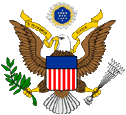
Wappen der USA,
Quelle: Corel Draw 4
Das Staatswappen der USA wurde am 20.06.1782, nach anderen Quellen am 20.07.1782, als Staatssiegel angenommen. Es wurde von William Barton und Charles Thomson geschaffen und zeigt einen Weißkopfadler mit einem Olivenzweig und dreizehn silbernen Pfeilen in seinen Krallen. Sie symbolisieren, dass der amerikanische Kongress über Krieg oder Frieden entscheiden kann, und, sie stehen, genau wie die dreizehn Sterne in dem blauen Feld über den Kopf des Adlers, für die dreizehn ursprünglichen Kolonien, aus denen die Vereinigten Staaten hervorgingen. Links und rechts des Adlerkopfes ein goldenes Spruchband mit der Inschrift "E pluribus unum" → "Aus vielen eines".
Quelle:
Die Welt der Flaggen,
Flaggen Wappen Hymnen,
Flaggen und Wappen der Welt,
Volker Preuß

seit 1947,
Flugzeugkokarde,
Quelle/Source, nach/by: Wikipedia (EN)

1918–1919,
Flugzeugkokarde,
Quelle/Source, nach/by: Wikipedia (EN)

1919–1942,
Flugzeugkokarde,
Quelle/Source, nach/by: Wikipedia (EN)

1942–1943,
Flugzeugkokarde,
Quelle/Source, nach/by: Wikipedia (EN)

1943,
Flugzeugkokarde,
Quelle/Source, nach/by: Wikipedia (EN)

1943–1947,
Flugzeugkokarde,
Quelle/Source, nach/by: Wikipedia (EN)
Lage:
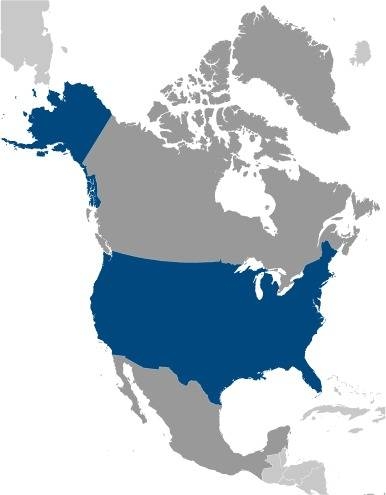
Quelle: CIA World Factbook
Landkarte des Landes:
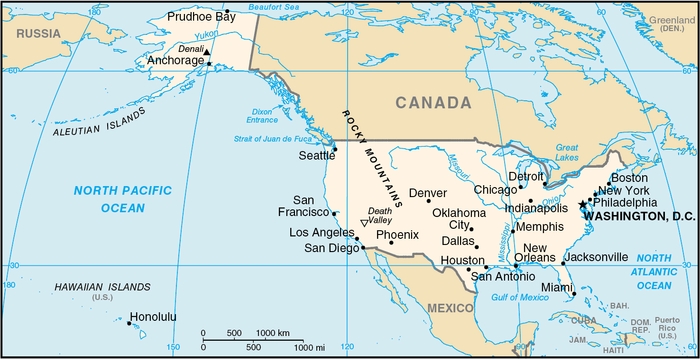
Quelle/Source: CIA World Factbook
Die Bundesstaaten:
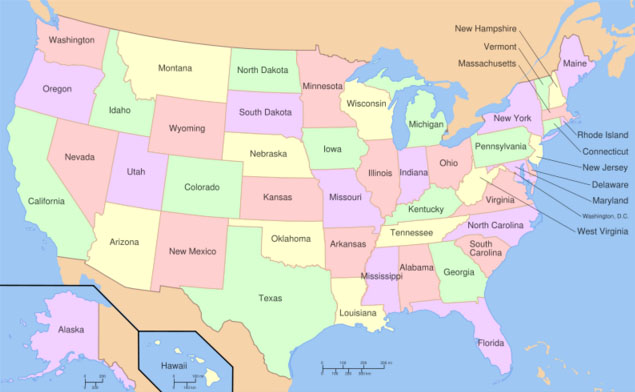
Quelle/Source: Printable Maps
Alabama
Alaska
Arizona
Arkansas
Colorado
Connecticut
Delaware
Bezirk Columbia (District of Columbia)
Florida
Georgia
Hawaii
Idaho
Illinois
Indiana
Iowa
Kalifornien (California)
Kansas
Kentucky
Louisiana
Maine
Maryland
Massachusetts
Michigan
Minnesota
Mississippi
Missouri
Montana
Nebraska
Nevada
Neu Hampshire (New Hampshire)
Neu Jersey (New Jersey)
Neumexiko (New Mexico)
Neu York (New York)
Nordkarolina (North Carolina)
Norddakota (North Dakota)
Ohio
Oklahoma
Oregon
Pennsylvanien (Pennsylvania)
Rhode-Insel (Rhode Island)
Südkarolina (South Carolina)
Süddakota (South Dakota)
Tennessee
Texas
Utah
Vermont
Virginia
Washington
West Virginia
Wisconsin
Wyoming
Guam
Jungferninseln der USA
Nordmarianen
Puerto Rico
Midway-Inseln
Wake
Fläche: 9.525.067 km²
Einwohner: 334.914.895 (2023), davon 58% Weiße, 19% Hispanics und Latinos, 12% Schwarze, 6% Asiaten, 0,7% Indianer und Eskimos
Religionen: 43% Protestanten, 20% Katholiken, 2% Mormonen, 2% Juden, 1% Moslems, 1% Hindus, 1% Buddhisten, 26% Nicht-Religiöse
Bevölkerungsdichte: 35 Ew./km²
Hauptstadt: Washington, 689.545 Ew. (2020)
Sprachen: Englisch, Spanisch, Französisch, Deutsch — mehr Infos? hier klicken
Währung: 1 US-Dollar (USD, US$, $) = 100 Cent
Zeitzone: MEZ –6 bis –11 h
Quelle:
Wikipedia (DE)
15.000 v.Chr. · Besiedlung von Asien aus, über Alaska südwärts
ca. 1000 n.Chr. · der Wikinger Leif Eriksson entdeckt Amerika
1394 · der venezianische Seefahrer Zeno entdeckt Amerika erneut
1492 · der genuesische Seefahrer in spanischen Diensten Christoph Kolumbus entdeckt Amerika erneut (Bahamas)
24.06.1497 · der italienische Seefahrer in englischen Diensten Giovanni Caboto (John Cabot) entdeckt das amerikanische Festland (Labrador)
1498 · der italienische Seefahrer in englischen Diensten Giovanni Caboto (John Cabot) segelt entlang der Ostküste der heutigen USA
1513 · Spanien nimmt Florida in Besitz
1542 · der spanische Seefahrer Cabrillo erreicht von Mexiko aus die Westküste der heutigen USA (Kalifornien), der spanische Forscher und Eroberer Coronado erreicht das heutige Neumexiko auf dem Landweg, der der spanische Forscher und Eroberer de Soto durchreist die heutigen Staaten Florida, Süd Carolina, Alabama und Mississippi auf dem Landweg
1565 · der spanische Seefahrer Urdaneta erreicht von den Philippinen aus die Westküste der heutigen USA (Kalifornien)
1578 · der englische Seefahrer Francis Drake erkundet die Westküste der heutigen USA (Kalifornien)
1578 · der englische Seefahrer Walter Raleigh erkundet die Ostküste der heutigen USA
1585 · der englische Seefahrer Walter Raleigh gründet am Roanoke River eine erste englische Kolonie an der Ostküste, sie wird später jedoch aufgegeben
1600–1670 · Frankreich kolonisiert entlang des St.-Lorenz-Stromes und erreicht von Norden kommend die Großen Seen
1607 · Gründung von Jamestown an der Küste Virginias, unter dem Namen Virginia die erste englische Kolonie an der Ostküste
1609 · der englische Seefahrer Henry Hudson erkundet die Ostküste der heutigen USA
1613 · Gründung von Neu Amsterdam (später Neu York) am Hudson River, die erste niederländische Siedlung im Norden der Ostküste der heutigen USA, später Mittelpunkt der niederländischen Kolonie Neu-Niederlande
1638 · Gründung von Neuschweden (später Delaware), die erste schwedische Siedlung an der Ostküste der heutigen USA
1650–1680 · Spanien nimmt den Süden heutigen USA in Besitz, in etwa die heutigen Staaten Kalifornien, Arizona, Neumexiko, Texas, Louisiana, das allmählich kolonisiert wird, ferner Land an der Westseite des Mississippi, in etwa die heutigen Staaten Arkansas, Missouri, Iowa, Minnesota, das nur mäßig, bzw. gar nicht kolonisiert wird
1655 · Neuschweden wird niederländischer Besitz
1664 · Neuschweden (Delaware) wird britischer Besitz
1664 · Neu-Niederlande wird britischer Besitz
1670–1690 · Frankreich kolonisiert südlich der Großen Seen und entlang des Mississippi, in etwa in den heutigen Staaten Michigan, Indiana, Wisconsin, Monnesota, Iowa, Missouri, Illinois, Arkansas, Louisiana, Mississippi
1695–1720 · Frankreich kolonisiert an der Mündung des Mississippi
1733 · Gründung der königlichen Kolonie Georgia, damit gibt es an der Ostküste insgesamt dreizehn britische Kolonien, die sogenannten Neuenglandkolonien (Neu Hampshire, Massachusetts, Connecticut, Rhode Insel), die Mittelkolonien (Neu York, Delaware, Neu Jersey, Pennsylvanien) und die Südkolonien (Virginia, Maryland, Nord- und Südkarolina, Georgia)
1754–1763 · Siebenjähriger Krieg, Auseinandersetzungen zwischen Großbritannien und Frankreich, Frankreich muss 1763 alle Gebiete in Kanada und östlich des Mississippi an Großbritannien abtreten, jedoch durften sich die dreizehn britischen Kolonien nicht nach Westen ausdehnen, und hatten die wirtschaftlichen Folgen des Krieges zu tragen
1764 · Molasses Act, Handelsverbot für die britischen Kolonisten mit Frankreich und Spanien
1765 · Großbritannien führt die Stempelsteuer ein
1765 · Gründung der Widerstandsbewegung "Sons of Liberty", ein Kongress der Kolonien beschließt den Boykott britischer Waren
16.12.1773 · "Bostoner Teesturm", britische Waren werden ins Meer geworfen
1774 · Großbritannien gliedert die ehemals französischen Besitzungen zum Ohio an Kanada an, Revolte in Massachusetts, Großbritannien verhängt den Ausnahmezustand (Aufhebung der Verfassung), die Kolonisten organisieren dagegen den 1. Kontinentalkongress, Beendigung des Handels mit Großbritannien, Bildung der Minutemen-Miliz, Terror gegen dem König loyale Kolonisten
19.04.1775 · Gefechte von Lexington und Concord, Beginn des Unabhängigkeitskrieges (bis 1783)
04.07.1776 · Unabhängigkeitserklärung
17.10.1777 · Schlacht von Saratoga, schwere Niederlage der britischen Truppen
15.11.1777 · Verabschiedung der Konföderationsartikel (Bildung der USA)
1778 · die USA verbünden sich mit Frankreich
1778 · die USA verbünden sich mit Spanien
1780 · die USA verbünden sich mit den Niederlanden
19.10.1781 · Schlacht von Yorktown, Kapitulation der britischen Truppen
30.11.1782 · der Separatvertrag mit Großbritannien erkennt die Unabhängigkeit der USA an
03.09.1783 · Vertrag von Paris, die Unabhängigkeit der USA wird bestätigt
1788 · erste Verfassung
1791 · Ergänzung der Verfassung um die "Bill of Rights"
1803 · die USA kaufen dessen Kolonie Louisiana von Frankreich (die heutigen Staaten Montana, der Südwesten von Nord-Dakota, der Nordosten von Wyoming, Süd-Dakota, Minnesota, Iowa, Nebraska, der Nordosten von Colorado, Kansas, Missouri, Oklahoma, Arkansas und Louisiana)
1804–1807 · Versuche Neuengland mit britischer Unterstützung von den USA abzuspalten
1810–1813 · die USA annektieren Westflorida
1812–1814 · US-amerikanisch-britischer Krieg, ohne Ergebnisse
1814 · Hartfordkongress, erneuter Versuch Neuengland mit britischer Unterstützung von den USA abzuspalten
1818 · Großbritannien tritt den Nordosten des heutigen Nord-Dakota an die USA ab
1819 · die USA erwerben Florida von Spanien
1836 · die USA Unterstützen die Abspaltung des Staates Texas von Mexiko
1845 · Texas tritt der USA bei
1846 · Großbritannien tritt das Oregon Gebiet an die USA ab (die heutigen Staaten Oregon, Washington und Idaho)
1846–1848 · Krieg gegen Mexiko, Annexion mexikanischen Staatsgebiets (die heutigen Staaten Kalifornien, Nevada, Utah, Arizona, sowie Teile Wyomings, Colorados und Neumexikos)
1853 · die USA erwerben den Süden des heutigen Arizona von Mexiko (Gadsen-Kauf)
1854 · Gründung der Republikanischen Partei
06.11.1860 · Wahl von Abraham Lincoln (Republikaner) zum Präsidenten der USA
20.12.1860 · Südkarolina erklärt gemäß der Verfassung der USA seinen Austritt aus der Union
Januar bis Februar 1861 · Austritt weiterer zehn Staaten
08.02.1861 · Gründung der Konföderierten Staaten von Amerika (CSA, Südstaaten)
04.03.1861 · Amtsantritt von Lincoln
12.–14.04.1861 · "Beschuss von Fort Sumter", in Wirklichkeit ein Schusswechsel mit einigen Leichtverletzten
15.04.1861 · Lincoln ruft 75.000 Freiwillige zu den Waffen, de facto Kriegserklärung an die CSA, Beginn des Sezessionskriegs
09.04.1865 · General Lee kapituliert bei Appomattox (Virginia) als Kommandeur der konföderierten Armee von Nord-Virginia, die anderen CSA-Armeen kapitulieren nach und nach bis Juli 1865
18.12.1865 · der im Januar 1865 vom US-Kongreß beschlossene 13. Zusatzartikel zur Verfassung erlangt Rechtskraft, damit wird die Sklaverei auf dem Gebiet der USA endgültig abgeschafft.
1865–1877 · "Rekonstruktion", erzwungene Rückkehr der CSA-Staaten in die Union
1867 · die USA erwerben Alaska von Russland
April bis August 1898 · rätselhafte Explosion des US-amerikanischen Kriegsschiffs „Maine“ vor Havanna, US-amerikanische Militärintervention, spanisch-US-amerikanischer Krieg, Frieden von Paris: Spanien muss sein Kolonialreich zum größten Teil an die USA abtreten (Kuba, Philippinen, Puerto Rico)
07.07.1898 · Annexion von Hawaii
1903 · Kuba wird Protektorat der USA, Panama tritt die Kanalzone an die USA ab
1905 · US-Militärintervention in Honduras
1906–1909 · US-Militärintervention in Kuba
1907 · US-Militärintervention in Honduras
1911 · US-Militärintervention in Honduras
1912–1932 · US-Militärintervention in Nikaragua
1913 · US-Militärintervention in Honduras
1914 · US-Militärintervention in Mexiko
1915 · US-Militärintervention in Haiti
1916 · US-Militärintervention in Mexiko und in der Dominikanischen Republik, Kauf der Jungferninseln von Dänemark
06.04.1917 · Kriegserklärung an das Deutsche Reich, die USA beteiligen sich am Ersten Weltkrieg (bis November 1918)
1918 · US-Militärintervention in Sibirien
1919 · US-Militärintervention in Kostarika
1919–1924 · US-Militärintervention in Kuba
1924 · US-Militärintervention in Honduras
08.12.1941 · Kriegserklärung an Japan, die USA beteiligen sich am Zweiten Weltkrieg (bis September 1945)
25.06.1950 · US-Militärintervention in Korea (bis Juli 1953), US-Militärintervention in Taiwan
1958 · US-Militärintervention im Libanon
1962 · US-Militärintervention in Thailand
1963 · US-Militärintervention in Vietnam (bis 1973)
1983 · US-Militärintervention in Grenada
1989 · US-Militärintervention in Panama
1991 · US-Militärintervention im Irak (Zweiter Golfkrieg)
1994 · US-Militärintervention in Haiti
2001–2021 · US-Militärintervention in Afghanistan
20.03.2003 · US-Militärintervention im Irak (Dritter Golfkrieg)
Quelle:
Atlas zur Geschichte,
Wikipedia (D),
World Statesmen,
Discovery '97,
Weltgeschichte,
Volker Preuß

Der Name "Vereinigte Staaten von Amerika" erinnert daran, dass die USA ein Staatenbund sind, und durch den Zusammenschluss von dreizehn britischen Kolonien entstanden sind. Die USA nennen sich selbst gern nur "Amerika", auch offiziell, als stünden sie für den ganzen Kontinent.
Quelle:
Volker Preuß