mobile Ansicht, to the English Version tap the flag

- Republik Usbekistan
- präsidiale Republik
- Eigenbezeichnung: Özbekiston Respublikasy
• Flaggen
• historische Flaggen
• Bedeutung/Ursprung der Flagge
• Wappen
• Bedeutung/Ursprung des Wappens
• Flugzeugkokarde
• regionale Flaggen:
Karakalpakistan
• Landkarte
• Zahlen und Fakten
• Geschichte
• Ursprung des Landesnamens
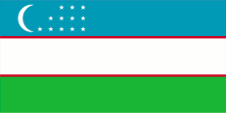
seit 2001,
National-, Staats-, und Handelsflagge,
Seitenverhältnis = 1:2,
Quelle, nach: Flags of the World


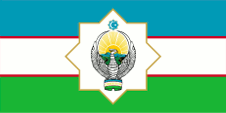
Flagge des Präsidenten,
Seitenverhältnis = 1:2,
Quelle, nach: RainbowSilver2ndBackup,
Public domain, via Wikimedia Commons

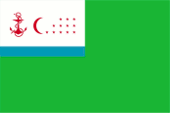
Flagge der Marine (Usbekische Flusspatrouille),
Seitenverhältnis = 2:3,
Quelle, nach: НССPПВУ,
Public domain, via Wikimedia Commons
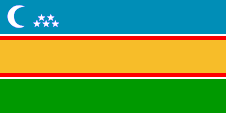
Karakalpakien/Karakalpakistan:
Nationalflagge seit 1990,
Seitenverhältnis = 1:2,
Quelle, nach: Wikipedia (D)
→ Karakalpakistan ←

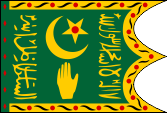
19.–20. Jahrhundert,
Flagge des Khan von Buchara,
Quelle, nach: Flags of the World
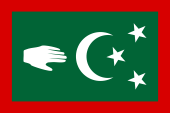
19.–20. Jahrhundert,
Flagge Khanat Buchara (?),
Quelle, nach: Flags of the World
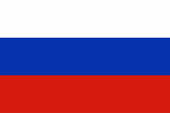
1876–1920,
Flagge Russlands,
Seitenverhältnis = 2:3,
Quelle, nach: Wikipedia (DE)
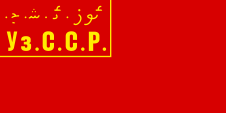
1925–1927,
Flagge der Usbekischen Sozialistischen Sowjetrepublik,
Seitenverhältnis = 1:2,
Quelle, nach: World Statesmen
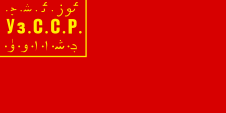
1927–1929,
Flagge der Usbekischen Sozialistischen Sowjetrepublik,
Seitenverhältnis = 1:2,
Quelle, nach: World Statesmen
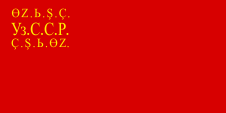
1929–1931,
Flagge der Usbekischen Sozialistischen Sowjetrepublik,
Seitenverhältnis = 1:2,
Quelle, nach: World Statesmen
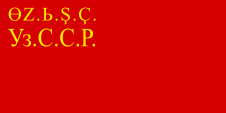
1931–1934,
Flagge der Usbekischen Sozialistischen Sowjetrepublik,
Seitenverhältnis = 1:2,
Quelle, nach: World Statesmen
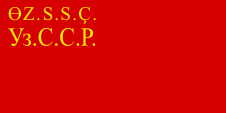
1934–1935,
Flagge der Usbekischen Sozialistischen Sowjetrepublik,
Seitenverhältnis = 1:2,
Quelle, nach: World Statesmen
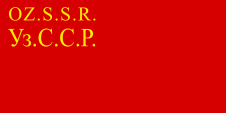
1935–1937,
Flagge der Usbekischen Sozialistischen Sowjetrepublik,
Seitenverhältnis = 1:2,
Quelle, nach: World Statesmen
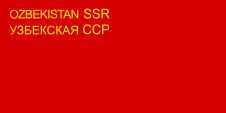
1937–1939,
Flagge der Usbekischen Sozialistischen Sowjetrepublik,
Seitenverhältnis = 1:2,
Quelle, nach: World Statesmen
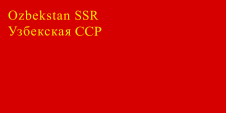
1939–1941,
Flagge der Usbekischen Sozialistischen Sowjetrepublik,
Seitenverhältnis = 1:2,
Quelle, nach: World Statesmen
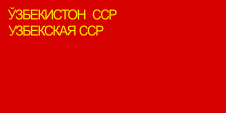
1941–1952,
Flagge der Usbekischen Sozialistischen Sowjetrepublik,
Seitenverhältnis = 1:2,
Quelle, nach: World Statesmen
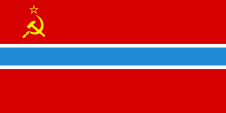
1952–1991,
Flagge der Usbekischen Sozialistischen Sowjetrepublik,
Seitenverhältnis = 1:2,
Quelle, nach: World Statesmen,
Flaggen und Wappen

siehe auch:
• Flaggengeschichte der Sowjetrepubliken der UdSSR
• Karakalpakistan (Karakalpakien)
Die heutige Flagge von Usbekistan wurde am 18.11.1991, nach anderen Quellen am 30.09.1991, eingeführt. Sie zeigt drei waagerechte Streifen in Hellblau, Weiß und Grün, mit dazwischen liegenden schmalen, roten Trennstreifen. Im hellblauen Streifen, nahe am Mast, ein Weißer Halbmond und zwölf weiße, fünfzackige Sterne. Der Halbmond und die Sterne stehen für den Islam. Die Sterne formen, stark stilisiert, das Wort "Allah" in arabischen Buchstaben. Der Halbmond steht aber auch als Sinnbild für die Geburt einer neuen Nation und die Sterne stehen für Spiritualität und Göttlichkeit und für den traditionellen 12-Tiere-Kalender. Die Farbe Blau symbolisiert den Himmel und klares Wasser, es erinnert an die Fahnen Timurs (Tamerlan), und verweist auf die Abstammung des Volkes, denn Blau ist Farbe der türkischen und mongolischen Nationen. Weiß ist das traditionelle usbekische Symbol für Frieden und Glück. Die grüne Farbe ist ein Symbol für Natur, neues Leben und gute Ernten. Rot hingegen steht für die Lebenskraft. Die Farbtöne der Farben der Flagge scheinen definiert zu sein, zumindest lassen sich folgende Farbangaben finden, zumindest als Farbwerte im Hex-Farbspektrum: Blau = #009AB6, Rot = #CF0921, Grün = #18B637. Daraus lassen sich folgende Pantone-Farbwerte ableiten: Blau = Pantone 632 c, Rot = Pantone 1795 c und Grün = Pantone 361 c. Die Flaggen, die zu Sowjet-Zeiten verwendet wurden, entsprachen alle dem immer gleichen Schema, wie es für Sowjetische Republiken vorgesehen war: oft nur ein einfabiges rotes Flaggentuch mit einer goldenen Inschrift, die den Landesnamen zeigte. Manchmal nur als Abkürzung, manchmal mit vollem Namen, manchmal nur in Russisch oder auch mehrsprachig. Ab etwa 1937 wurden manchmal noch Hammer, Sichel und Stern ergänzt. Ab etwa der Mitte der 50-er Jahre wurden mehrfarbige Flaggen für die Republiken der Sowjetunion eingeführt, deren Strickmuster die untergeordneten Autonomen Sowjetrepubliken zu übernehmen hatten.
Quelle:
Flags of the World,
Wikipedia (TR),
Wikipedia (DE),
Volker Preuß
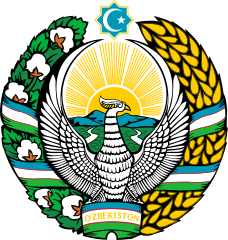
seit 1992,
Wappen von Usbekistan,
Quelle, nach: See page for author,
Public domain, via Wikimedia Commons

1978–1991,
Wappen der Usbekischen Sozialistischen Sowjetrepublik,
Quelle: Jam123, CC0, via Wikimedia Commons
Das Wappen Usebekistans wurde am 02.07.1992 eingeführt. Es zeigt den legendären, silbernen Vogel "Khumo" mit gestreckten Flügeln. Er steht für das Glück und die Sehnsucht nach Freiheit. Er trägt auch die Namen "Daulat-ku-i" → "Staatsvogel" und "Kultubulgan" → "Sonnenvogel" genannt. Im Hintergrund eine Sonnenaufgangsszene in einem grünen Gebirge, mit silbernen Flüssen und und einen blühenden Tal. Dies alles ist von einer Baumwollstaude und goldenen Getreideähren umgeben, beides von Bändern in den Farben der Flagge umwunden. Oberhalb ein blaues, golden umrandetes Achteck mit goldenem Halbmond und goldenem Stern in der Mitte. Es symbolisiert die Stärkung und Festigung der Republik. Unterhalb ein Spruchband in den Farben der Flagge, mit dem Staatsnamen in lateinischen Buchstaben auf dem weißen Feld. Bis Mitte der 90-er Jahre wurden hier ausschließlich kyrillische Buchstaben verwendet. Derzeit sind im Lande beide Schriftsysteme in Gebrauch.
Quelle: Flaggen und Wappen der Welt,
Wikipedia (DE),
Volker Preuß

Flugzeugkokarde,
Quelle/Source, nach/by: Wikipedia (EN)
Lage:
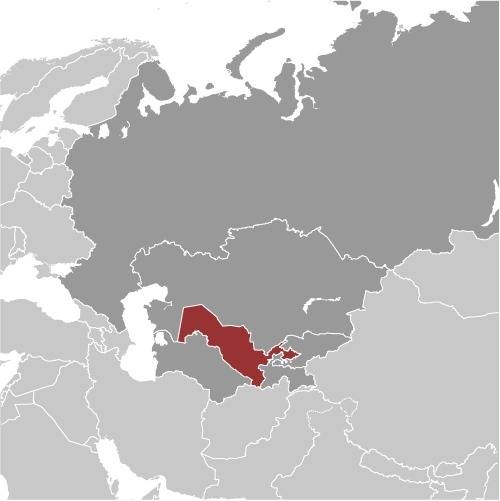
Quelle: CIA World Factbook
Landkarte des Landes:
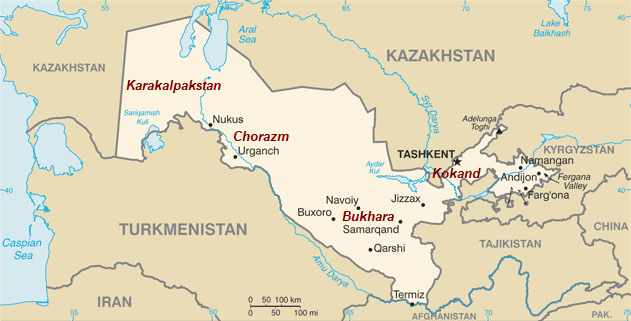
ergänzte, klickbare geographische Bezeichnungen erscheinen in Dunkelrot
Quelle/Source: CIA World Factbook, modyfied by: Volker Preuß
Fläche: 448.978 km²
Einwohner: 36.000.000 (2022), davon 71% Usbeken, 5% Russen, 5% Tadschiken, 4% Karakalpaken, 3% Kasachen, 3% Tataren, 2,5% Koreaner, ferner Turkmenen, Uiguren, Deutsche (ca. 8.000), Armenier, Mescheten, Aserbaidschaner und Kurden
Religionen: 90% Moslems (meist Sunniten), 8% Russisch-Orthodoxe
Bevölkerungsdichte: 80 Ew./km²
Hauptstadt: Taschkent, 2.571.668 Ew. (2020)
Amtssprache: Usbekisch, in Karakalpakistan auch Karakalpakisch
sonstige Sprachen: Tadschikisch, Russisch
Währung: 1 Som (UZS) = 100 Tiyin
Zeitzone: MEZ + 4 h
Quelle:
Wikipedia (DE)
6. Jhd. v.Chr. · Land Choresmien (zum Mederreich) und Land Sogdien (später Maverannah, Buchara)
6. Jhd. v.Chr. · die gesamte Region gehört zum Perserreich
4. Jhd. v.Chr. · die gesamte Region gehört zum Reich Alexanders des Großen
3. Jhd. v.Chr. · Sogdien gehört zum Griechisch-Baktrischen Reich
5. Jhd. · Einwanderung von Turkvölkern: Kirgisen, Turkmenen
8. Jhd. · Islamisierung durch eindringende Araber, Choresmien und Sogdien (Maverannah) werden Teil des Arabischen Kalifats
10.–11. Jhd. · Choresmien ist Teil des Ghasnawidenreiches, Maverannah ist Teil des Karachanidenreiches
1089 · Eroberung durch die Seldschuken, Teil des Seldschukenreichs
12. Jhd. · Maverannah kommt unter den Einfluss von Choresmien und dem Reich der Karakitai
1221 · Eroberung durch die Mongolen, zum Reich des Dschingis Khan, nach Zerfall seines Reiches kommt Choresmien zum Reich des Goldenen Horde, Maverannah wird Teil des Reiches des Tschagatai
1370–1405 · zum Reich des Timur Lenk (Tamerlan)
15. Jhd. · Staat Maverannah (einschl. Choresmiens)
15. Jhd. · Einwanderung der Usbeken (benannt nach Ösbek Khan, einem Herrscher der Goldenen Horde) unter Abulkhair Khan
1500 · Schaibani Khan (Enkel von Abulkhair) erobert Buchara und Samarkand und übernimmt die Herrschaft in Maverannah, Etablierung des Khanats Buchara
1511 · Eroberung von Choresmien durch die Usbeken unter Ilbars Khan, Entstehung des Khanats Choresm (Chiwa)
ca. 1710 · der Usbeke Shah-Rukh gründet das Khanat Kokand, durch Abtrennung des Fergana-Tals vom Khanat Buchara
1865–1876 · schrittweise russische Eroberung, Gründung des Gouvernements Turkestan
1868 · Eroberung des Khanats Kokand durch russische Truppen, Kokand wird Vasall Russlands
März–Mai 1873 · Eroberung von Chiwa durch Russland
19.02.1876 · Russland annektiert Kokand, Eingliederung in das Generalgouvernement Turkestan
1917 · Bolschewistischer Putsch in Russland
April 1918 · Bolschewisten proklamieren die Turkestanische Autonome Sowjetrepublik
1918–1923 · Bürgerkrieg
24.09.1920 · proklamation der Turkestanischen Autonomen Sozialistischen Sowjetrepublik
30.12.1922 · die Turkestanische Autonome Sozialistische Sowjetrepublik wird als Bestandteil Sowjet-Russlands Teil der Sowjetunion
27.10.1924 · Auflösung der Turkestanischen Autonomen Sozialistischen Sowjetrepublik, Aufteilung in die Sowjetrepubliken Kirgisien, Usbekistan und Turkmenistan, Gebietsabtretungen an die Kasachische ASSR – somit Gründung Usbekistans als Usbekische Sozialistische Sowjetrepublik (Usbekische SSR)
1925 · die Usbekische SSR wird Mitglied der Union der Sozialistischen Sowjetrepubliken (Sowjetunion)
05.12.1929 · Abtrennung Tadschikistans von Usbekistan als eigene Sozialistische Sowjetrepublik
1936 · die Karakalpakische Autonome Sozialistische Sowjetrepublik (Karakalpakische ASSR), wird von der RSFSR (Sowjet-Russland) abgetrennt und wird der Usbekischen Sozialistische Sowjetrepublik angeschlossen
20.06.1990 · Usbekistan erklärt seine Souveränität
31.08.1991 · Proklamation der Republik Usbekistan
21.12.1991 · Beitritt Usbekistans zur GUS, endgültiges Ende der Sowjetunion, faktisch Unabhängigkeit für Usbekistan
1993–1996 · bewaffnete Unruhen im Fergana-Tal
2005 · bewaffnete Unruhen im Fergana-Tal
Quelle:
Atlas zur Geschichte,
Wikipedia (D),
World Statesmen,
Discovery '97,
Volker Preuß
Die Usbeken und die benachbarten Kasachen haben gemeinsame Wurzeln; sie waren ein Turkvolk aus turko-mongolischen Stämmen das aus Westsibirien nach Mittelasien wanderte. Im 14. Jahrhundert gehörte dieses Volk zum Reich der Goldenen Horde, das in seiner Endphase unter einem Ösbek Khan, einem Nachfahren des Dschingis Khan, noch einmal eine Blütezeit erlebte. Die Stämme einigten sich unter seinem Namen. Der Usbeke Abulkhair Khan versuchte um 1430 die Stämme der Usbeken zu einigen und einen eigenen Staat zu gründen. Anhänger der Nachfahren des Dschingis Khan lehnten das ab und gründeten als Kasachen ein eigenes Reich. Erst Schaibani Khan, der Enkel von Abulkhair Khan, etablierte erfolgreich das Reich der Usbeken, in dem er Buchara und Samarkand eroberte und das Khanat Buchara gründete.
Quelle: Handbuch der geographischen Namen, Die Völker der Erde, Volker Preuß