

- Neu York
- Bundesstaat der USA
- New York
- federal state of the USA
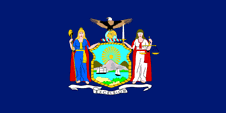


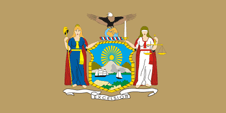

Bedeutung/Ursprung
der Flagge:Meaning/Origin of the Flag:leather coloured / buff:
In den Staatsflaggen von Delaware und Neu Jersey sowie in den früheren Staatsflaggen von Neu York (1896–1901) bzw. Maine (1901–1909) wird der Farbton "lederfarben" bzw. "buff" beschrieben. Dieser Farbton ist heutzutage in Großbritannien und den USA genormt, und zwar als "Pantone 465". Dennoch fällt der Farbton in der Praxis sehr unterschiedlich aus, weil der jeweils überlieferte Farbton des Leders von der Art, der Rasse, dem Geschlecht, dem Alter und dem Gesundheitszustand des Tieres bestimmt wurde. Der anglo-amerikanische Buff-Farbton beruht auf der Farbe des Wamses, das die leichte Kavallerie – die Arkebusierreiter der parlamentarischen Seite im Englischen Bürgerkrieg – Oliver Cromwells "The Ironsides", getragen haben. Dieses ist in Berichten als "gelbstichig-senffarben" überliefert. Die leichte Miliz-Kavallerie von Massachusetts (Massachusetts Militia Light Horse) brachte genau dieses "buff" mit in die Neue Welt. In England und dann Großbritannien trug das 3. Regiment der Linieninfanterie zum roten Uniformrock Lederzeug und Patronentaschen aus farblich unbehandeltem Leder, nicht wie sonst üblich in weiß. Außerdem trug es "buff" als Abzeichenfarbe. Spitzname und dann offizieller Beiname des Regiments war "The Buffs". Als Oberbefehlshaber der Kontinentalarmee trug George Washington die Uniform, die er bis dato getragen hatte, die eines Offiziers der selbstständigen Miliz-Kompanie von Fairfax-County/Virginia: dunkelblauer Rock, Abzeichen, Weste und Hose in "buff". Dies wurde - zumindest theoretisch - die vorschriftsmäßige Kleidung der amerikanischen Generalität im Unabhängigkeitskrieg. Die kontinentalen Infanterie-Regimenter der Neu Yorker und der Neu Jersey-Linie trugen "buff" für mindestens zwei Jahre als Abzeichenfarbe am blauen Uniformrock – ein Ideal, das nur für eine Minderheit galt. Mindestens die Hälfte der Kontinental-Armee trug – zumindest zeitweilig – das Jagdhemd oder zivile Jagd-Textil-Röcke. Die Miliz von Maine und Delaware trug bevorzugt buff-farbene Westen und Hosen. Das 14. kontinentale Infanterie-Regiment (Linie von Massachusetts) trug buff-farbene Uniformröcke. Es bestand überwiegend aus Binnenschiffern, Fischern und Matrosen. Es ermöglichte der Kontinental-Armee die Überquerung des Delaware, auf welche die Schlacht von Trenton folgte. Das bekannte Gemälde "Washington überquert den Delaware" zeigt dabei noch eine falsche US-Flagge, nämlich die "Betsy-Ross"-Flagge. Richtig wäre die "Grand Union"-Flagge mit dem kleinen "Union Jack" in der Oberecke gewesen. Zeitgenössische Farbillustrationen, Gemälde und Beschreibungen zeigen etliche Buff-Variationen: beige / senf / gelblich / hell-, mittel-, und dunkelbeige / hell-, mittel, und dunkelbraun, bis hin zu stumpfem Weiß. Zur Lederfarbe "buff" kommt noch die Textilfarbe "buff" aus Pflanzenfarben hinzu, verbunden mit derselben Farbvielfalt. Im US-Bürgerkrieg wurde sie "Butternut" genannt. Die Abzeichenfarbe und die Farbe der Schärpen für konföderierte Generäle war "buff" (als sozusagen die Farbe George Washingtons), mehrheitlich wurde von ihnen aber ein stumpfes Weiß bevorzugt. Dieses "Grauweiß" der konföderierten Armee wird noch heute nicht einfach nur als "grey" bezeichnet, sondern als "gray", und es Umfasst Schattierungen von fast Weiß bis Schwarz-Grau.
In the state flags of Delaware and New Jersey, as well as in the former state flags of New York (1896–1901) and Maine (1901–1909) is described the colour tone "buff". This colour is now standardized in the United Kingdom and the USA, as "Pantone 465". However, in practice the hue is very different, because the down passed colour of the leather was determined by the type, breed, sex, age and health of the animal. The Anglo-American buff colour is based on the colour of the tambour, which the light cavalry – the arquebus cavalry of the parliamentary side in the English Civil War, Oliver Cromwells "The Ironsides" –had clothed with. This is passed down in reports as "yellow-tinted and mustardlike colours". The light militia cavalry of Massachusetts (Massachusetts Militia Light Horse) brought exactly this "buff" into the New World. In England and then in Great Britain, the 3rd Regiment of the Line Infantry weared in addition of the red uniform skirt some leather stuff and patron pockets made of untreated leather, not as usual in white. Furthermore the regiment wore "buff" as a badge colour. Nickname and then official name of the regiment was: "The Buffs". As the commander-in-chief of the continental army, George Washington wore that uniform, he had worn to date, the uniform of an officer of the independent militia company of Fairfax-County / Virginia: dark blue skirt, badge, vest, and trousers in "buff". This became – at least theoretically – the prescribed dress of the american generality in the independence war. The continental infantry regiments of the New York and New Jersey line wore "buff" for at least two years as a badge colour on the blue uniform skirt – an ideal that was only real for a minority. At least nearly the half of the continental army wore – at least temporarily – a hunting skirt or civil textile hunting skirts. The militia of Maine and Delaware preferred to weare buff-coloured vests and pants. The 14th Continental Infantry Regiment (Massachusetts Line) wore buff-coloured uniforms. It consisted mainly of inland skippers, fishermen and sailors. It enabled the continental army to cross the Delaware, followed by the Battle of Trenton. The well-known painting "Washington crosses the Delaware" shows a false US-flag, the "Betsy Ross" flag. The "Grand Union" flag with the small "Union Jack" in the upper corner would have been right. Contemporary coloured illustrations, paintings and descriptions show a few buff variations: beige / mustard / yellowish / light, medium and dark biscuit/ light, medium and dark brown toward grey white. Futhermore comes to the "buff" as leather "buff" from plant colours, with the same color variety. In the US civil war that was called "butternut". The badge color and the color of the sashes for Confederate generals was "buff" (as the colour of George Washington), but the majority of them preferred a grey white. That "gray-white" of the Confederate Army is until today not simply called as "gray", it is "gray", and it includes shades from almost white to black-gray.
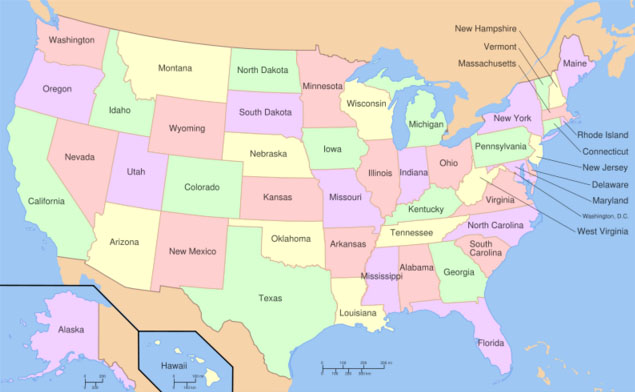
Quelle/Source: Printyble
Maps
Geschichte:History:
Ursprung des Landesnamens:Origin of the Country's Name: