|
|
| Übersicht Contents: | |
| Flaggen Flags: |
| historische Flaggen historical Flags: | ||
|
||
|
||
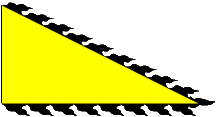
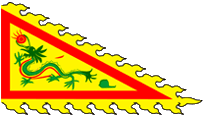
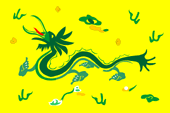
| Die Flagge von Vietnam geht auf das seit 1789 wieder in Annam (Mittelvietnam) herrschende Haus Nguyen zurück. Dessen Hausfarbe war gelb. So wurden in "Dai Viet Quoc", wie das Land damals hieß, gelbe Flaggen mit verschiedenen Erscheinungsformen verwendet, oftmals mit schwarzen oder roten "Flammen" am Rand der Flagge, manchmal auch mit roten chinesischen Schriftzeichen in der Mitte. | The flag of Vietnam has its roots in the since
1789 in again Annam (central Vietnam) ruling Nguyen ruling house. Its corporate color was
yellow. So there were in use in "Dai Viet Quoc", as now was the name of the country, yellow flags in various forms, often with black or red "flames" on the edge of the flag, sometimes even with red Chinese characters in the middle. |
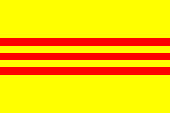
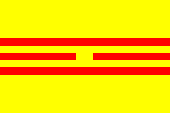
| Kaiser Gia Long führte im Jahre 1804 für "Viet Nam Quoc", wie das Land jetzt hieß, eine gelbe Flagge ein, welche drei schmale rote horizontale Streifen in der Mitte zeigte, der mittele Streifen war in der Mitte unterbrochen. Die roten Linien bildeten so das chinesische Symbol (Trigramm) für "Süden". Vietnam war noch immer von China abhängig, und bildete das "Südreich". | Emperor Gia Long in 1804, introduced for "Viet Nam Quoc", as now was the name of the country, a yellow flag, which showed three narrow red horizontal stripes in the middle, the middle stripe was suspended in the middle. The red lines formed in this way the Chinese symbol (trigram) for "south". Vietnam was still dependent from China as the "Southern Realm". |
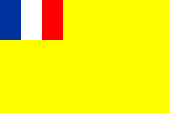
| Als Annam französisches Protektorat wurde, wurde offiziell eine einfarbig gelbe Flagge mit der französischen Trikolore in der Oberecke eingeführt. | As Annam became a French protectorate was officially introduced a single-coloured yellow flag with the French tricolor into the upper corner of the flag. |
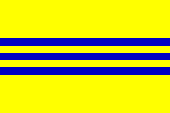
| Die Japaner besetzten im Zeiten Weltkrieg ganz Indochina und herrschten indirekt in der Region, oftmals über französische Behörden. Jedoch wurde eine Art Scheinselbstständigkeit gewährt, die sich in einer durch Japaner für ganz Indochina eingeführte Flagge äußerte. Sie war einfarbig gelb und zeigte drei schmale blaue horizontale Streifen in der Mitte. | The Japanese occupied in the 2nd World War whole Indochina and ruled indirectly in the region, often through French authorities. However, a kind of apparent independence has been granted, which was expressed by one by Japan for whole Indochina introduced flag. It was single-coloured yellow and showed three narrow blue horizontal stripes in the middle. |
| Anfang März 1945 beendete Japan die französische Herrschaft, und Kaiser Bao Dai von Annam proklamierte das Kaiserreich Vietnam unter Einschluss von Annam, Tongking und Kotschinchina. Das wurde in einer neuen Flagge zum Ausdruck gebracht. Sie blieb zwar einfarbig gelb, jedoch stand die Farbe nun für das vietnamesische Volk und seine Hautfarbe. Die Unterbrechung in der mittleren der drei waagerechten roten Linien entfiel, und die drei Streifen standen nun für die drei Landesteile. | Japan abolished the French rule in March 1945,
and Emperor Bao Dai of Annam proclaimed the Empire of Vietnam, including Annam, Tonkin and
Cochin China. This fact became exressed in a new flag. It retained as single-coloured yellow, but now the color stood for the Vietnamese people and their skin colour. The interruption in the middle of the three horizontal red lines was abolished, and the three stripes stood now for the three parts of the country. |
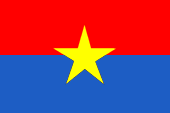
| Bao Dai dankte im August 1945 als Kaiser ab, jedoch wurde er von den Franzosen im Oktober 1949 als Präsident des von den kommunistischen Viet Minh unbesetzten Vietnam eingesetzt. Die Flagge wurde beibehalten, und am 26.10.1955 von der Republik Vietnam übernommen. Am 30.04.1975 kapitulierte Südvietnam und die Viet Cong übernahmen die Herrschaft im Land. Bis zum Anschluss Südvietnams an Nordvietnam am 02.07.1976 wurde die Flagge der Viet Cong verwendet. | Bao Dai resigned in August 1945 as emperor, but he was installed as President of the by the communist Viet Minh unoccupied Vietnam by the French in October 1949. The flag became retained and taken over on 26th of October in 1955 by the Republic of Vietnam. On 30th of April in 1975 South Vietnam surrendered and the Viet Cong took control in the country. Until the annexation of South Vietnam to North Vietnam, on 2nd of July in 1976, the flag of the Viet Cong was used. |
| Die gelbe Flagge der Republik Vietnam gilt außerhalb Vietnams, bis heute, als eigentliche Flagge von Vietnam und genießt weltweit hohes Ansehen. | The yellow flag of the Republic of Vietnam is outside Vietnam and until today seen as the true flag of Vietnam and enjoys high reputation worldwide. |
| Wappen Coat of Arms: | ||
|
||
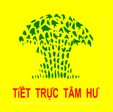
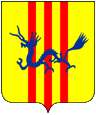
| Das hier gezeigte Wappen wurde 1963 nach dem Tod von Präsident Diem eingeführt und bis 1975 verwendet. Es zeigt ein einfarbiges gelbes Schild mit drei senkrechten roten Linien, ähnlich der Flagge. In der Mitte des Schildes erscheint ein blauer Drache, vielleicht eine Anspielung auf das Haus Nguyen, dessen Symbol der Drache ist, oder auf den großen Kaiser und Gründer des modernen Vietnam, Gia Long, dessen Name übersetzt "Haus des Drachens" heißt. Von 1955 bis 1963 wurde als Wappen die Abbildung eines Bambusstrauches benutzt. | The emblem shown here was introduced in 1963
after the death of President Diem and was in use until 1975. It shows a single-coloured
yellow shield with three red vertical lines, nearly similar to the flag. In the middle of
the shield appears a blue dragon, perhaps an allusion to the house of Nguyen, whose symbol
is the dragon, or to the great emperor and founder of modern Vietnam, Gia Long, whose name
means translated "House of the Dragon". From 1955 to 1963 was used as a crest
the image of a bamboo bush. |
| Landkarte Map: |
|
| Zahlen und Fakten Numbers and Facts: | |
|
|
|
|
|
|
|
|
|
|
|
|
|
|
|
|
| 257207 v.Chr. ·
vietnamesisches Königreich Au Lac, Hervorgegangen aus dem Königreich Van Lang 207196 v.Chr. · Königreich Nam Viet 196 v.Chr.111 v.Chr. · Nam Viet ist chinesischer Vasall 111 v.Chr.938 n.Chr. · Vietnam gehört zu China 679 · China gründet das Protektorat An Nam 939 · Vietnam löst sich unter Ngo Quyen von China, Unabhängigkeit 15581787 · Teilung des Landes zwischen zwei Herrscherdynastien, Trinh in Tongking, Nguyen in Annam und Kotschinchina, das ganze Land wird China tributpflichtig 1802 · China etabliert das Protektorat "Dai Viet Quoc" in Annam und Tongking 1804 · "Dai Viet Quoc" wird umbenannt in "Viet Nam Quoc" 1839 · "Viet Nam Quoc" wird umbenannt in "Dai Nam Quoc" 1858 · Frankreich besetzt Da Nang 1859 · Frankreich besetzt Saigon 1862 · Frankreich erwirbt das südliche Annam 1867 · Kotschinchina wird an Frankreich abgetreten 1873/1874 · Frankreich besetzt Haiphong und Hanoi 1874 · Tongking wird französisches Protektorat 1883 · Annam wird französisches Protektorat 1884 · Frankreich erwirbt Tongking 1885 · China verzichtet auf seine Rechte in Tongking und Annam 17.10.1887 · Gründung von Französisch-Indochina (Kambodscha, Kotschinchina, Annam und Tonking 1893 · Laos wird französisch Indochina angeschlossen September 1940 · französisch-japanische Militärkonvention, japanische Truppen besetzen das Land 09.03.1945 · Japan beseitigt die französische Kolonialherrschaft 11.03.1945 · der vietnamesische Kaiser Bao-Dai erklärt die Unabhängigkeit des Landes von Frankreich 15.08.1945 · Kapitulation der japanischen Truppen 25.08.1945 · der vietnamesische Kaiser Bao-Dai dankt ab 02.09.1945 · Ho Chi Minh proklamiert die Demokratische Republik Vietnam September 1945 · Nordvietnam wird von chinesischen Truppen besetzt, Südvietnam wird von britischen Truppen besetzt, Ziel: Entwaffung und Repatriierung der japanischen Truppen Januar 1946 · die chinesischen Truppen verlassen das Land März 1946 · die britischen Truppen verlassen das Land 06.03.1946 · Frankreich erkennt die Unabhängigkeit der Demokratische Republik Vietnam an, jedoch nur im Norden Vietnams, und nur als autonomes Gebiet innerhalb Französisch-Indochinas 08.11.1946 · französische Truppen besetzen Hanoi, Beginn des Widerstandskampfes Oktober 1949 · Bildung einer Regierung unter Bao-Dai in den französisch kontrollierten Gebieten 1950 · die Demokratische Republik Vietnam (Nordvietnam), wird international teilweise anerkannt, insbesondere vom sozialistischen Lager 07.05.1954 · Schlacht von Diên Biên Phu, Niederlage der französischen Truppen 21.07.1954 · Genfer Indochinakonferenz, Frankreich zieht sich aus Indochina zurück, Vietnam wird geteilt, der Norden wird den kommunistischen Viet-Minh überlassen, der Süden verbleibt als zunächst freies und demokratisches Vietnam 05.10.1954 · die französischen Truppen verlassen das Land 26.10.1955 · Gründung der Republik Vietnam im Süden 20.12.1960 · Gründung der Nationalen Front für die Befreiung Südvietnams (NFB, FNL oder Viet Cong) 02.08. und 04.08.1964 · Auseinandersetzungen zwischen Kriegsschiffen Nordvietnams und der USA 19651968 · Luftangriffe der USA in Nordvietnam Dezember 1966 · der Viet Cong errichtet eine Ständige Vertretung in Hanoi 01.11.1968 · Einstellung aller Kampfhandlungen zwischen Nordvietnam und den USA 29.01.1969 · Pariser Gespräche, Verhandlungen zwischen USA, Nordvietnam, Südvietnam und Viet Cong 06.06.1969 · Bildung einer Provisorischen Revolutionären Regierung des Viet Cong in Südvietnam April 1972 · Luftangriffe der USA in Nordvietnam Januar bis März 1973 · Pariser Konferenz über die Beendigung des Krieges, die US-Truppen verlassen das Land 05.03.1975 · Offensive der Viet Cong 30.04.1975 · Saigon wird von den Viet Cong erobert, Kapitulation Südvietnams 02.05.1975 · Südvietnam ist vollständig von Truppen der Viet Cong besetzt 02.07.1976 · Südvietnam wird nach zwanzig Jahren Krieg mit Nordvietnam zur "Sozialistischen Republik Vietnam" vereinigt, in Südvietnam kommunistische Umgestaltung der Gesellschaft mit harten Zwangsmitteln |
| weitere Geschichte Vietnams: siehe Vietnam |
| 257 B.C.207 B.C.
· Vietnamese Kingdom of Au Lac, emerged from the Kingdom of Van Lang 207 B.C.196 B.C. · Kingdom of Viet Nam 196 B.C.111 B.C. · Viet Nam is Chinese vassal 111 B.C.938 A.D. · Vietnam is part of China 679 · China establishes the Protectorate of An Nam 939 · Vietnam separates under Ngo Quyen from China, independence 15581787 · dividing of the land between two dynasties, Trinh in Tonkin, and Nguyen in Annam and Cochin China, the whole country has to pay tributes to China 1802 · China establishes the Protectorate of "Dai Viet Quoc" in Annam and Tonkin 1804 · "Dai Viet Quoc" becomes renamed "Viet Nam Quoc" 1839 · "Viet Nam Quoc" becomes renamed "Dai Nam Quoc" 1858 · France occupies Da Nang 1859 · France occupies Saigon 1862 · France acquires the southern Annam 1867 · Cochin China is ceded to France 1873/1874 · France occupies Haiphong and Hanoi 1874 · Tonkin becomes a French protectorate 1883 · Annam becomes a French protectorate 1884 · France acquires Tonkin 1885 · China gave up its rights in Tonkin and Annam 17th of October 1887 · formation of French Indochina (Cambodia, Cochin China, Annam and Tonkin 1893 · Laos has to join French Indochina September 1940 · French-Japanese military agreement, Japanese forces occupy the country 9th of March 1945 · Japan abolishes the French colonial rule 11th of March 1945 · the Vietnamese emperor Bao-Dai declares the independence of the country from France 15th of August 1945 · surrender of Japanese troops 25th of August 1945 · the Vietnamese Emperor Bao Dai abdicates 2nd of September 1945 · Ho Chi Minh proclaimes the Democratic Republic of Vietnam September 1945 · North Vietnam is occupied by Chinese troops, South Vietnam is occupied by British troops, goal: disarmament and repatriation of Japanese troops January 1946 · the Chinese troops leave the country March 1946 · the British troops leave the country 6th of March 1946 · France recognizes the independence of the Democratic Republic of Vietnam, but only in the north of Vietnam, and only as an autonomous territory within French Indochina 8th of November 1946 · French troops occupy Hanoi, start of the resistance October 1949 · formation of a government headed by Bao-Dai in the French-controlled areas 1950 · the Democratic Republic of Vietnam (North Vietnam), becomes internationally partially recognized, in particular from the socialist camp 7th of May 1954 · Battle of Dien Bien Phu, defeat of the French troops 21st of July 1954 · Geneva Indochina Conference, France withdraws from Indochina, Vietnam becomes divided, the north will be left to the communist Viet Minh, the south remains initially as free and democratic Vietnam 5th of October 1954 · the last French troops leave the country 26th of Octobrer 1955 · Founding of the Republic of Vietnam in the South 20th of December 1960 · founding of the National Front for the Liberation of South Vietnam (NFB, NLF or Viet Cong) 2nd and 4th of August 1964 · clashes between war-vessels of North Vietnam and the USA 19651968 · US-airstrikes in North Vietnam December 1966 · the Viet Cong establish a permanent diplomatic representation in Hanoi 1st of November 1968 · cessation of all hostilities between North Vietnam and the USA 29th of January 1969 · Paris Talks, negotiations between the United States, North Vietnam, South Vietnam and the Viet Cong 6th of June 1969 · establishment of a provisional revolutionary government of the Viet Cong in South Vietnam April 1972 · US-airstrikes in North Vietnam January to March 1973 · Paris Conference for an ending the war, the US troops leave the country 5th of March 1975 · offensive by the Viet Cong 30th of April 1975 · Saigon is conquered by Viet Cong troops, capitulation of South Vietnam 2nd of May 1975 · South Vietnam is fully occupied by troops of the Viet Cong 2nd of July 1976 · South Vietnam becomes united with North Vietnam, after twenty years of war, to the "Socialist Republic of Vietnam", in South Vietnam communist transformation of the society with harsh coercive measures |
| further history of Vietnam: see Vietnam |
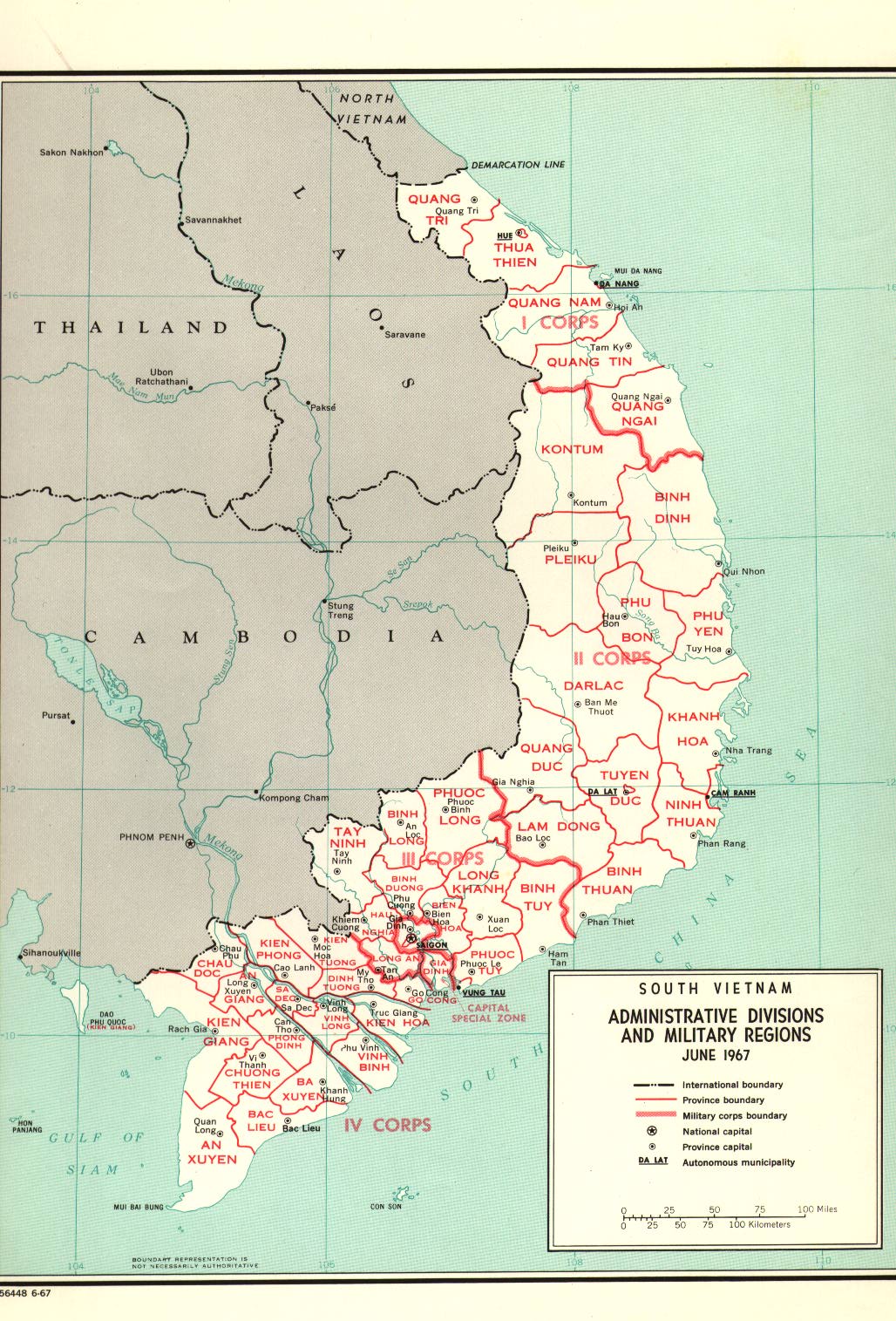
| Das Wort "Viêt Nam" heißt übersetzt "Südland". In seiner langen Geschichte trug das Land der Vietnamesen verschiedene Namen: "Dai Viet Quoc" (Großes Vietnamesisches Reich), "Viet Nam Quoc" (Südreich), "Dai Nam Quoc" (Großes Süd-Reich). Das vietnamesische Urland war Annam, in Mittelvietnam (Trung Bo), mit der Hauptstadt Hue. Tongking (Bac Bo) in Nordvietnam, mit der Hauptstadt Hanoi (Thang Long), stand lange unter starkem chinesischen Einfluss. Kotschinchina in Südvietnam (Nam Bo, auch Khmer Krom), mit der Hauptstadt Saigon, gehörte über viele Jahre zu Kambodscha. | The word "Viêt Nam" means "southern land". In its long history the land of the Vietnamese had different names: "Dai Viet Quoc" (Great Viet Realm), "Viet Nam Quoc" (Southern Realm), "Dai Nam Quoc" (Great Southern Kingdom). The Vietnamese Country of origin was Annam in central Vietnam (Trung Bo), with its capital Hue. Tonkin (Bac Bo) in northern Vietnam, with the capital Hanoi (Thang Long), stood for long timnes under strong Chinese influence. Cochin China in southern Vietnam (Nam Bo, also Khmer Krom), with its capital Saigon, belonged for many years to Cambodia. |