|
|
| Übersicht Contents: | |
| Flagge Flag: |
| historische Flaggen historical Flags: |
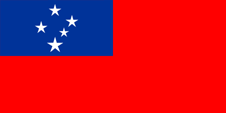
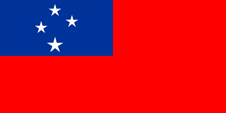
| Die heutige Flagge von Samoa wurde am 26.05.1948 im Zusammenhang mit der Annahme einer neuen Verfassung als Flagge des damaligen Westsamoa offiziell eingeführt. Sie wurde von König Malietoa Tanumafili a Tupu Tamasese Mea'ole entworfen und zeigt ein einfarbiges rotes Grundtuch mit einer blauen Oberecke, darin fünf Sterne, das "Kreuzes des Südens". Bis 1949 waren es nur vier Sterne. Die Flagge wurde bei der Erreichen der Unabhängigkeit im Jahre 1962 beibehalten. | The today's flag of Samoa was
officially introduced on 26th of May in 1948 in occasion of the adoption of a new
constitution as the flag of the then Western Samoa. It was designed by King Malietoa
Tanumafili a Tupu Tamasese Mea'ole and shows a single-coloured red bunting with a blue
upper corner, in it five stars, forming the "Southern Cross". Until 1949 there were only four stars. The flag was kept at the achievement of independence in 1962. |
| Rot steht für Mut und Tapferkeit, Weiß für Reinheit, Blau für Freiheit. Blau symbolisiert aber auch den Himmel und das Meer. Das "Kreuz des Südens" findet sich auch in anderen Flaggen der südlichen Hemisphäre, ist also ein Symbol von hoher regionaler Bedeutung. | Red stands for courage and valor, white for purity, blue for freedom. But also symbolizes the blue heaven and the sea. The "Southern Cross" is also to found in other flags of the southern Hemisphere, is indubitable a symbol of great regional significance. |
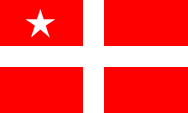
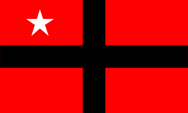
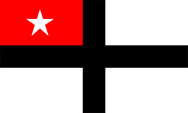
| Die erste Flagge Samoas wurde am 02.10.1873 eingeführt. Sie zeigte ein rotes Grundtuch mit einem durchgehenden weißen Kreuz und einem weißen Stern in der Oberecke. Die Könige der ab 1879 regierenden Malietoa-Dynastie nahmen sich dieser Flagge an. Andere Dynastien (Tamasese, Tuiaana) verwendeten nach dem gleichen Grundmuster gestaltete Flaggen, jedoch mit einem schwarzen Kreuz, oder einem weißen Grundtuch. | The first flag of Samoa was
introduced on 2nd of October in 1873. It showed a red bunting with an until the border of
the flag reaching white cross and a white star in the upper corner. The kings of the since 1879 reigning Malietoa dynasty took care of this flag. Other dynasties (Tamasese, Tuiaana) used by the same basic pattern designed flags, but with a black cross, or a white bunting. |
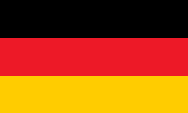
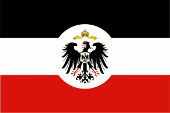
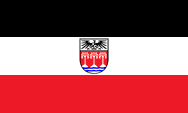
| In der Zeit als deutsche Kolonie wurde die Flagge des Kolonialamts verwendet. Im Jahr 1913 wurde versucht eine eigene Flagge für Deutsch Samoa einzuführen. Sie würde drei horizontale Streifen in Schwarz, Weiß und Rot gezeigt haben mit dem Wappen der Kolonie in der Mitte des weißen Streifens. Dieses zeigte einen stilisierten Paradiesvogel auf grünem Grund. Aber der Erste Weltkrieg verhinderte dieses Vorhaben. Deutsch-Neuguinea wurde 1914 von britisch-australischen Truppen besetzt, und eine britische Verwaltung eingerichtet. | In the times as a German colony
there was in use the flag of the colonial office. In 1913 there was planned to introduce an own flag for German Samoa. It would have shown three horizontal stripes in black, white and red with the scutcheon of the colony in the middle of the white stripe. That showed a stylized Paradise Bird on green ground. But the First World War hindered this propose. German New Guinea was occupied in 1914 by British-Australian troops and a British administration was installed. |
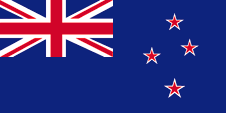
| Nachdem die Inseln von Neuseeland besetzt worden waren, wurde die Flagge Neuseelands verwendet. Neuseeland ersuchte die Admiralität Großbritanniens im Jahre 1921 um die Genehmigung für einen eigenen blauen und roten Ensign. | After the islands had been
occupied by troops of New Zealand, there was only in use the flag of New Zealand. New Zealand asked the British Admiralty in 1921 for approval of an own Blue and Red Ensign. |
Großbritannien hatte in Jahr
1864 ein Flaggensystem eingeführt, in dem:
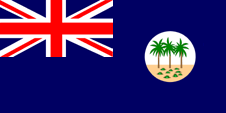
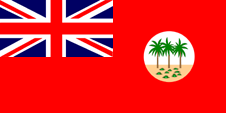
Seit 1865 durften Schiffe von Kolonialregierungen einen Blue Ensign mit einem Badge (Abzeichen) im fliegenden Ende führen. Die jeweiligen Regierungen sollten entsprechene Bagdes zur Verfügung stellen. Handelsschiffe und seefahrende Privatpersonen aus Kolonien dürfen nur dann einen Red Ensign mit Badge führen, wenn von der britischen Admiralität eine entsprechende Erlaubnis für die Kolonie erteilt wurde. |
Great Britain introduced a flag
system in 1864 in which:
Since 1865 ships of colonial governments were permitted to fly the Blue Ensign with a badge in the flying end of the flag. The respective governments were asked to design appropriate badges. Merchant ships and seafaring persons from colonies were only permitted to use the Red Ensign with a badge, then also named Civil Ensign, if permission has been given to the respective colony by the British admiralty. |
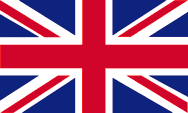
| Diese Erlaubnis wurde erteilt, so dass ein "Red Ensign", ein rotes Flaggentuch mit dem britischen Union Jack in der Oberecke und dem Badge der Kolonie als Handelsflagge verwendet werden konnte. Das Badge von Samoa zeigte drei Palmen, eine Symbolik, die bis auf die Zeit als deutsche Kolonie zurückreicht. | This permission was given, and it was possible to use a "Red Ensign", a red bunting with the British Union Jack in the upper staff quadrant and the badge of the colony as merchant flag. The badge of Samoa showed three palm trees, a symbolism that goes back to the time as a German colony. |
| Die Flaggen nach dem Muster britischer Kolonien wurden bis zur Unabhängigkeit im Jahre 1962 verwendet. | The flags, basing on the model
of British colonies were used until independence in 1962. |
| Wappen Coat of Arms: | ||
|
||
| historisches Wappen historical Coats of Arms: | ||
|
||
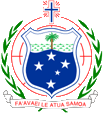
| Das heutige Staatswappen wurde am 12.04.1951 eingeführt, als Samoa (damals Westsamoa) noch ein Treuhandgebiet der UNO war. Aus diesem Grund hat man den Wappenschild des Landes über das rot gefärbte Emblem der Vereinten Nationen gelegt. Der Schild zeigt in der Mitte eine blaue Fläche, darin das "Kreuz des Südens", im Schildhaupt grüne Wellenlinien und eine Palme. Das Design symbolisiert die Lage Samoas im Ozean und seine Landesnatur. Oberhalb des Schildes erscheint ein christliches Kreuz. Das Kreuz und auch das Moto des Landes, das unterhalb des Wappenschildes in einem weißen Banner erscheint ("Fa' avaeile atua Samoa" => "Gott möge das Fundament Samoas sein") repräsentieren den Einfluss des Christentums. Die beiden grünen Olivenzweige, links und rechts, sind Friedenszeichen und gehören zur Symbolik des UNO-Emblems. | Today's national emblem was introduced on 12.04.1951, when Samoa (then Western Samoa) was a Trust Territory of the United Nations. For this reason, they have put the escutcheon of the country over the red-colored emblem of the United Nations. The shield displays in the middle of a blue surface, is the "Southern Cross", in the main plate and a wavy green palm tree. The design symbolizes the situation of Samoa in the ocean and its natural state. Above the shield appears a Christian cross. The Cross and the moto of the country which appears below the escutcheon in a white banner ( "Fa 'avaeile atua Samoa" => "May God be the foundation of Samoa") represent the influence of Christianity. The two green olive branches, left and right are peace signs and belong to the symbolism of the UN emblem. |
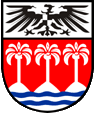
| In der Zeit als deutsche Kolonie
wurde ein Wappen verwendet, dass neben dem Reichsadler im Schildhaupt drei weiße
stilisierte Palmen vor blauen Wellenlinien auf rotem Grund zeigte. |
In the era as a German colony, was used a coat of arms, which showed in addition to the imperial eagle in the head of the shield three stylized palm trees in front of white-blue wavy lines on a red ground. |
| Landkarten Maps: |
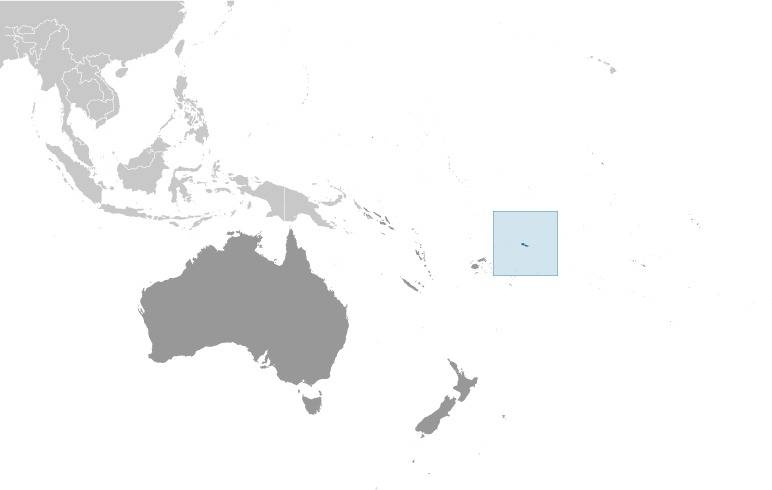
Die Lage Samoas position of
Samoa: |
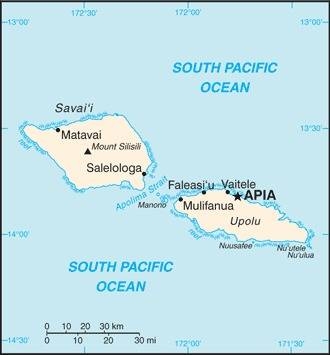
Samoa: |
| Zahlen und Fakten Numbers and Facts: | |
|
|
|
|
|
|
|
|
|
|
|
|
|
|
| 13.06.1722 · der
niederländische Seefahrer Jacob Roggeveen entdeckt die Samoa-Inseln und gibt ihnen den
Namen "Baumannsinseln" (Baumanns
Eilanden) 05.05.1768 · der französische Seefahrer Louis-Antoine de Bougainville besucht die Inseln und gibt ihnen den Namen "Schifferinseln" (Îles Navigateurs) 1787 · der französische Seefahrer Jean-François de Galaup, Comte de Lapérouse besucht die Inseln 1791 · der britische Seefahrer Edwards besucht die Inseln 1824 · der russische Seefahrer Otto von Kotzebue besucht die Inseln 1847 · Großbritannien errichtet ein Konsulat 1853 · die USA errichten ein Konsulat 1861 · Preußen errichtet ein Konsulat 02.11.1871 · Neuseeland fordert die Inbesitznahme der Inseln durch Großbritannien 1872 · die USA errichten einen Schiffahrtsstützpunkt in Pago Pago 1873/1874 · die Samoaner schaffen eine eigene zentrale Regierung, die Herrschaft der "Taimuna und Faipule", eine Art Häuptlings- und Volksversammlung 1878 · Freundschaftsvertrag der USA mit den Inseln Tutuila and Aunu'u 1879 · das Deutsche Reich errichtet einen Schiffahrtsstützpunkt in Saluafuta auf Upolu 1879 · Häuptling Malietoa Talavou wird König von Samoa 1880 · Malietoa Laupepa wird König von Samoa 1884 · König Malietoa Laupepa und Vizekönig Tupua Tamasese Titiamaea wünschen die Inbesitznahme der Inseln durch Großbritannien 1887 · Tupua Tamasesse wird König von Samoa, Widerstand der Anhänger von Ex-König Malietoa Laupepa, Malietoa wird durch deutsche Truppen gefangen genommen und vorübergehend nach Kamerun gebracht 1888 · die Anhänger von Ex-König Malietoa Laupepa proklamieren Häuptling Malietoa To'oa Mata'afa zum König, Bürgerkrieg 1889 · Sturz von König Tupua Tamasesse, Malietoa To'oa Mata'afa wird König von Samoa, Bürgerkrieg, Großbritannien, USA und das Deutsche Reich senden Truppen zu Wiederherstellung der Ordnung 14.06.1889 · Berliner Samoa-Konferenz, Abkommen von Berlin, Samoa wird als Königreich anerkannt, wird jedoch ein Protektorat der drei Mächte Großbritannien, USA und Deutsches Reich 1889 · Malietoa Laupepa wird erneut König, Unruhen 1898 · Malietoa To'oa Mata'afa wird erneut König, Bürgerkrieg 1899 · Malietoa Tanumafili wird König, Bürgerkrieg 10.06.1899 · provisorische Regierung der Konsuln der drei Mächte 01.03.1900 · Samoa-Vertrag, die Inseln werden zwischen den USA (Amerikanisch-Samoa) und dem Deutschen Reich (Deutsch-Samoa) geteilt, die Ansprüche Großbritanniens werden mit anderen pazifischen Inseln entschädigt 29.10.1914 · Erster Weltkrieg, neuseeländische Truppen besetzen Deutsch-Samoa 1920 · Versailler Diktat, das Deutsche Reich verliert alle seine Kolonien, Deutsch-Samoa wird ein Mandatsgebiet des Völkerbundes unter Mandat Neuseelands, Umbenennung in Westsamoa 1947 · Bildung des UNO-Treuhandgebiets Westsamoa unter Verwaltung Neuseelands 01.01.1962 · Unabhängigkeit als Unabhängiger Staat Westsamoa 1970 · Westsamoa wird Mitglied des Commonwealth of Nations 04.07.1997 · Umbenennung in Unabhängiger Staat Samoa |
| 13th of June 1722
· the Dutch navigator Jacob Roggeveen discoveres the islands of Samoa, and gives them the
name "Bauman Islands" (Baumanns Eilanden) 5th of May 1768 · the French navigator Louis-Antoine de Bougainville visits the islands and gives them the name "Navigator Islands" (Îles Navigateurs) 1787 · the French navigator Jean-François de Galaup, Comte de Lapérouse visits the islands 1791 · the British navigator Edwards visits the islands 1824 · the Russian navigator Otto von Kotzebue visits the islands 1847 · Great Britain establishes a consulate 1853 · the USA establish a consulate 1861 · Prussia establishes a consulate 2nd of November 1871 · New Zealand calls for the seizure of the islands by Great Britain 1872 · the USA establish a shipping base in Pago Pago 1873/1874 · the Samoans make their own central government, the rule of "Taimuna and Faipule", a kind of chiefs and people's assembly 1878 · friendship treaty of the USA with the islands of Tutuila and Aunu'u 1879 · the German Empire establishes a shipping base in Saluafuta on Upolu 1879 · chief Malietoa Talavou becomes King of Samoa 1880 · Malietoa Laupepa becomes King of Samoa 1884 · King Malietoa Laupepa and Viceroy Tupua Tamasese Titiamaea want the occupation of the islands by Gread Britain 1887 · Tupua Tamasesse becomes King of Samoa, opposition from the followers of ex-King Malietoa Laupepa, Malietoa becomes captured by German troops and temporarily brought to Cameroon 1888 · the followers of ex-King Malietoa Laupepa proclaim chief Malietoa To'oa Fiame Mata'afa for King, civil war 1889 · overthrow of King Tupua Tamasesse, Malietoa To'oa Fiame Mata'afa becomes King of Samoa, Civil War, Great Britain, USA and the German Empire send troops to restore the order 14th of June 1889 · Berlin Samoa Conference, Berlin agreements, Samoa is recognized as a kingdom, but it is a protectorate of the three powers, Great Britain, USA and German Empire 1889 · Malietoa Laupepa becomes king again, unrests 1898 · Malietoa To'oa Fiame Mata'afa becomes king again, civil war 1899 · Malietoa Tanumafili becomes king, civil war 10th of June 1899 · provisional government of the consuls of the three powers 1st of March 1900 · Samoa Treaty, the islands divided between the USA (American Samoa) and the German Empire (German Samoa), the claims of Great Britain become compensated with other islands in the Pacific 29th of October 1914 · First World War, troops from New Zealand occupy German Samoa 1920 · Versailles Dictate, the German Empire loses all its colonies, German Samoa becomes a Mandate Territory of the League of Nations under New Zealand mandate, rename in Western Samoa 1947 · formation of the UN trust territory of Western Samoa under New Zealand administration 1st of January 1962 · independence, as the "Independent State of Western Samoa" 1970 · Western Samoa becomes a member of the Commonwealth of Nations 4th of July 1997 · rename in "Independent State of Samoa" |
| Die Bedeutung des Wortes "Samoa" ist nicht bekannt. Von den Europäern wurden sie "Baumannsinseln" oder "Schifferinseln" genannt. Nach der kolonialen Aufteilung gab es ein Ostsamoa (Amerikanisch-Samoa) und ein Westsamoa. Westsamoa wurde 1962 unabhängig und nennt sich seit 1997 nur noch "Samoa". | The meaning of the word
"Samoa" is not known. The Europeans called them "Bauman Islands" or
"Navigator Islands". After the colonial division, there was an Eastern Samoa
(American Samoa) and a Western Samoa. Western Samoa became independent in 1962 and calls
itself only "Samoa" since 1997. |