mobile Ansicht, to the English Version tap the flag

- ehemaliger Autonomer Kreis der Korjaken
- 1977–2007
- ehemaliger föderaler Bestandteil der Russischen Föderation (Russland)
- Eigenbezeichnung: Korjakski awtonomny okrug
- heute 'Korjakischer Bezirk', Bestandteil der Region Kamtschatka
• Flagge
• Bedeutung/Ursprung der Flagge
• Wappen
• Landkarte
• Zahlen und Fakten
• Geschichte
• Ursprung des Landesnamens
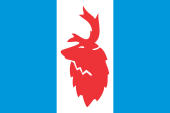
1998–2007,
Flagge des Kreises und des Bezirks der Kojaken,
Seitenverhältnis = 2:3,
Quelle, nach: Flags of the World


Die 1998 angenommene Flagge solle die Lage Korjakiens zwischen dem Ochotskischen Meer und dem Beringmeer symbolisieren. Der Rentierkopf weist auf den wichtigsten Wirtschaftszweig der Korjaken, die Rentierzucht.
Quelle:
Volker Preuß

Wappen,
Quelle: Unknown. Author of vectorization can be found at Vector-images.com. [Public domain], via Wikimedia Commons
geographische Lage in Russland:
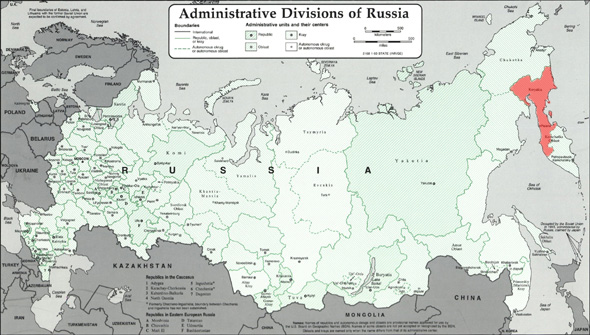
Quelle: Freeware, russiamap.org, modyfied by: Volker Preuß
vergrößern – hier klicken
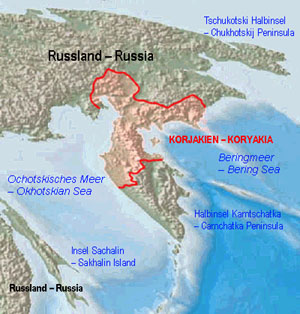
Quelle/Source: Freeware, University of Texas Libraries, modyfied by: Volker Preuß
Fläche: 292.600 km²
Einwohner: 22.580 (2007), davon 50% Russen, 27% Korjaken, 1% Tschuktschen, 1% Itelmenen
Bevölkerungsdichte: 0,077 Ew./km²
Hauptstadt: Palana, 3.155 Ew. (2010)
Amtssprache: Russisch
sonstige Sprachen: Korjakisch
Währung: russische Währung
Zeitzone: MEZ + 11 h
Quelle: Wikipedia (DE)
1648 · Semjon Iwanow Deschnew durchstreift das Gebiet der Korjaken
1649 · teilweise Angliederung an Russland
1691 · Entdeckung der Halbinsel Kamtschatka
1697–1699 · A. Atlassow durchstreift Kamtschatka
1706 · Angliederung von Kamtschatka an Russland
1922 · Errichtung der Sowjetdiktatur
1930 · Einrichtung des Nationalen Kreises der Korjaken, später Erhebung zum Autonomen Kreis
1991 · Proklamation der Korjakischen Republik
31.12.1991 · die Sowjetunion löst sich auf, die Verfassung der Russischen Sozialistischen Föderativen Sowjetrepublik (RSFSR, Russland), ein ehemaliger Teilstaat der Sowjetunion bleibt vorerst in Kraft
25.12.1993 · eine neue Verfassung für Russland (Russische Föderation) tritt in Kraft, das Verhältnis zu den Gliedern der Föderation wird damit neu geregelt
2005 · Volksabstimmung über die Auflösung des Landes und den Anschluss an die russische Region Kamtschatka
01.07.2007 · Umwandlung des 'Autonomen Kreises der Korjaken' in den 'Korjakischen Bezirk' und Anschluss an die russische Region Kamtschatka
Quelle:
Atlas zur Geschichte,
World Statesmen,
Russiatrek,
Die Völker der Erde,
Wikipedia (D)
Der Name Korjakien geht natürlich auf das Volk der Korjaken zurück, das in dieser entlegenen Gegend Russlands bis ins 19. Jahrhundert hinein in der Mehrzahl war. Die Korjaken nennen sich selbst Nymylan, was "Bewohner" heißt. Die Bezeichnung "Korjaken" ist russischen Ursprungs und wenig schmeichelhaft, denn das Wort hat seine Wurzel in dem Adjektiv "korjavij", was "verwachsen" oder "krumm" bedeutet.
Quelle: Die Völker der Erde, Volker Preuß
Surftipp: