mobile Ansicht, to the English Version tap the flag


- Pitcairn und Dependenzen
- Außenbesitzung Großbritanniens
- Eigenbezeichnung: Pitcairn and Dependencies
• Flagge
• historische Flagge
• Bedeutung/Ursprung der Flagge
• Wappen
• Bedeutung/Ursprung des Wappens
• Landkarte
• Zahlen und Fakten
• Geschichte
• Ursprung des Landesnamens
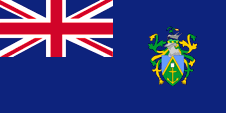
seit 1984,
Nationalflagge,
Seitenverhältnis = 1:2,
Quelle, nach: Flaggen Enzyklopädie



1838–1984,
Flagge von Großbritannien,
Seitenverhältnis = 1:2,
Quelle, nach: Wikipedia (EN)


Die Nationalflagge von Pitcairn warde am 02.04.1984 angenommen. Es ist ein sogenannter "Blue Ensign", ein dunkelblaues Flaggentuch mit einer Flaggendarstellung – dem britischen Union Jack – in der Oberecke. In den Jahren zuvor war an Land und zu diesem Zweck ausschließlich der britische Union Jack zu verwenden. Der Union Jack weißt auf die Verbindungen zu Großbritannien hin. Großbritannien hatte in Jahr 1864 ein Flaggensystem eingeführt, in dem:
• Kriegsschiffe einen sogenannten "White Ensign" (Marineflagge), eine weiße Flagge oft mit durchgehendem roten Georgskreuz und mit dem Union Jack in der Oberecke,
• Handelsschiffe einen "Red Ensign" (auch "Civil Ensign" → Bürgerflagge genannt, die eigentl. Handelsflagge), eine rote Flagge mit dem Union Jack in der Oberecke, und
• Dienstschiffe einen "Blue Ensign" (Regierungsflagge → die eigentl. Staatsflagge), eine blaue Flagge mit dem Union Jack in der Oberecke führten.
Seit 1865 durften Schiffe von Kolonialregierungen einen Blue Ensign mit einem Badge (Abzeichen) im fliegenden Ende führen. Die jeweiligen Regierungen sollten entsprechene Bagdes zur Verfügung stellen. Handelsschiffe und seefahrende Privatpersonen aus Kolonien dürfen nur dann einen Red Ensign mit Badge führen, wenn von der britischen Admiralität eine entsprechende Erlaubnis für die Kolonie erteilt wurde. Pitcairn hat sehr spät von dieser Möglichkeit Gebrauch gemacht. Die heutige Flagge wurde erst am 1984 eingeführt. Ein solches Badge war oft eine auf einer Scheibe platzierte regionale landschaftliche Darstellung, zeigte oft Schiffe, historische Begebenheiten oder konnte auch nur eine Art Logo sein. Sehr oft zeigte ein Badge zusätzlich den Namen des Landes oder auch einen Wahlspruch. Einige Besitzungen hatten aber auch schon von Anfang an ein Wappen, bzw. erhielten über die Jahre eine eigenes Wappen und das Badge wurde abgeschafft. Um ein weitgehend einheitliches Erscheinungsbild im fliegenden Ende der Flaggen zu gewährleisten, wurden Wappen und auch andere Symbole auf einer weißen Scheibe in der Größe der früheren Badges dargestellt. Es gab hier aber auch Ausnahmen, denn einige Kolonien verwendeten diese weiße Scheibe nicht, und platzierten ihr Wappen oder auch nur das Wappenschild - manchmal auch vergrößert - direkt auf das Flaggentuch. Schon in den 40-er Jahre wurde dazu übergegangen die weiße Scheibe zu entfernen und das Wappen direkt zu platzieren oder vergrößert dazustellen. Dieser Umstellungsprozess erfolgte allmählich, nirgendwo gleichzeitig und vollständig. In einigen britischen Besitzungen sind bis heute Flaggen mit der weißen Scheibe in Gebrauch, in anderen nicht mehr und in einigen Gebieten gibt es beide Varianten nebeneinander.
Quelle: Flags of the World,
Die Welt der Flaggen,
Flaggen Enzyklopädie
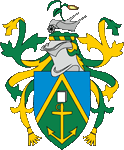
Wappen von Pitcairn,
Quelle, nach:
Flags of the World
Das Wappen wurde der Insel am 04.11.1969 verliehen. Das Wappenschild zeigt eine grüne Spitze mit goldenem Rand auf blauem Grund. Es soll die Insel Pitcairn symbolisieren, die als steiler Felsen aus dem Meer ragt. In der grünen Spitze sind ein Anker (der Anker der "Bounty") und ein Buch (die Bibel der "Bounty") platziert. Das Wappenschild ist umgeben von einer üppigen Helmzier in den Farben Gold und Grün. Auf dem Helm eine Schubkarre (Erinnerung an die ersten Siedler) mit einem "Portiabaum" (Thespesia populnea). Er ist für die folkloristischen Schnitzarbeiten der Insulaner wichtig.
Quelle: Wikipedia (EN),
Flaggen Enzyklopädie
Lage:
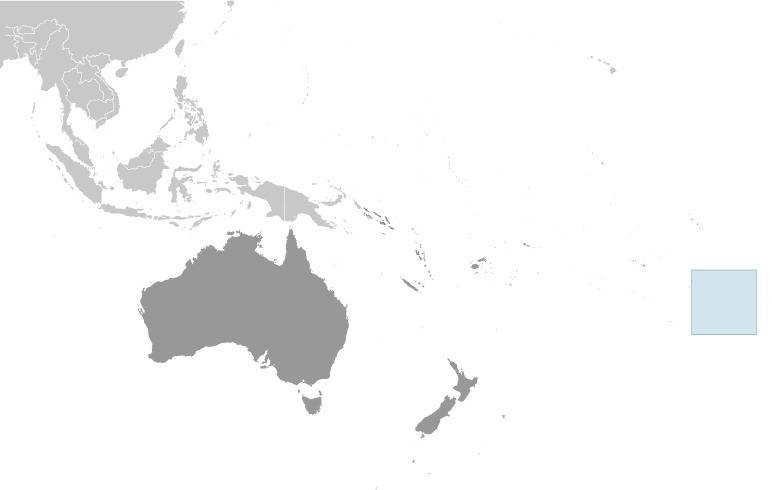
Quelle: CIA World Factbook
Landkarte des Landes:
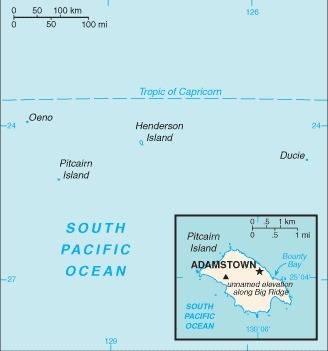
Quelle: CIA World Factbook
Fläche: 48 km², davon Pitcairn 4,5 km²,
und die Dependenzen:
Henderson 32 km², unbewohnt,
Ducie-Atoll 6,5 km², unbewohnt,
Oeno 5 km², unbewohnt
Einwohner (ausschließlich auf Pitcairn): 47 (2021)
Bevölkerungsdichte (nur Pitcairn): 10 Ew./km²
Hauptort: Adamstown
Verwaltungssitz: Auckland (Neuseeland)
Amtssprachen: Pitkern, Englisch
Währung: Neuseeländischer Dollar (NZ$) = 100 Cents
Zeitzone: MEZ – 9 h
Quelle: Wikipedia (DE),
Wikipedia (EN)
Pitcairn
Mittelalter · Besiedlung durch Polynesier, aber wahrscheinlich nicht ständig bewohnt und bald wieder verlassen
02.07.1767 · der britische Seefahrer Philip Carteret entdeckt die Insel, und benennt sie nach seinem Fähnrich Robert Pitcairn, der die Insel als erster gesichtet hatte, die Position wurde falsch berechnet, so dass die Insel später nicht mehr wiederzufinden war
15.01.1790 · die Meuterer der "Bounty" finden die verschollene Insel zufällig, landen auf ihr und gründen mit Eingeborenen aus Tahiti eine Siedlung
1808 · der US-amerikanische Seefahrer und Walfänger Mathew Folger entdeckt als erster die Meuterer der "Bounty", von deren ursprünglicher Besatzung nur noch John Adams lebte
17.09.1814 · Ankunft von zwei britischen Kriegsschiffen, nach Betrachtung der kleinen und friedvollen Gemeinschaft kehren sie unverrichteter Dinge wieder um
1823 · ein neuer europäischer Siedler lässt sich auf Pitcairn nieder
1828 · ein weiterer neuer europäischer Siedler lässt sich auf Pitcairn nieder
1831 · alle Einwohner von Pitcairn werden nach Tahiti umgesiedelt, viele Todesfälle durch Krankheiten unter den Pitcairnern
September 1831 · 65 Pitcairner kehren auf die Insel zurück
30.11.1838 · die Pitcairner unterzeichnen die Inselverfassung an Bord des britischen Walfangschiffs Fly, die Insel wird damit zwar britische Kolonie, untersteht aber dem Schutz durch das Britische Reich
1845 · Pitcairn hat 156 Einwohner
1856 · Pitcairn hat 194 Einwohner
08.06.1856 · wegen befürchteter Hungersnöte werden die Pitcairner auf die Norfolkinsel umgesiedelt (hier werden sie künftig "Islanders" genannt)
1858 · 16 Pitcairner kehren von Norfolk auf ihre Insel zurück
1864 · vier weitere Pitcairner-Familien kehren von Norfolk auf ihre Insel zurück
Zweiter Weltkrieg · die britische Marine stationiert Funkbeobachter
2004 · "Pitcairn-Vergewaltigungs-Prozess", die Hälfte aller Männer der Insel wird schuldig gesprochen, der Strafvollzug jedoch aufgeschoben, da die Existenz der Inselgemeinschaft dadurch auf dem Spiel steht
Henderson
Mittelalter · Besiedlung durch Polynesier, aber wahrscheinlich nicht ständig bewohnt und bald wieder verlassen
29.01.1606 · der portugiesische Seefahrer Pedro Fernandez de Quiros entdeckt die Insel und nennt sie "San Juan Bautista", ihre Position geriet jedoch wieder in Vergessenheit
17.01.1819 · der britische Seefahrer James Henderson entdeckt die Insel erneut, die Insel erhält seinen Namen
1820–1821 · Schiffbrüchige des US-amerikanischen Walfängers "Essex" leben mehr als 100 Tage auf der Insel
ca. 1890–1910 · Versuch von Phosphatabbau
1902 · die Insel Henderson wird zusammen mit der Insel Oeno und dem Ducie-Atoll offiziell von Großbritannien in Besitz genommen und in das Britische Reich eingegliedert
Oeno
1819 · der britische Seefahrer James Henderson entdeckt die Insel
26.01.1824 · der US-amerikanische Seefahrer und Walfänger George B. Worth landet mit seinem Schiff "Oeno" auf der Insel, die Insel erhält den Namen des Schiffes
1858 · Schiffbrüchige des US-amerikanischen Schiffes "Wild Wave" leben mehr als 200 Tage auf der Insel
1902 · die Insel Oeno wird zusammen mit der Insel Henderson und dem Ducie-Atoll offiziell von Großbritannien in Besitz genommen und in das Britische Reich eingegliedert
Ducie-Atoll
(bestehend aus Acadia Island, Westward Island, Pandora Island und Edwards Island)
1606 · der portugiesische Seefahrer Pedro Fernandez de Quiros entdeckt das Atoll und nennt es "Encarnacion" (nach anderen Quellen "Luna Puesta"), seine Position geriet jedoch wieder in Vergessenheit
1791 · der britische Seefahrer Edward Edwards mit seinem Schiff "Pandora" entdeckt auf der Suche nach den Meuterern von der "Bounty" das Atoll erneut, er nennt es nach Thomas Moreton Reynolds dem zweiten Lord Ducie of Tortworth
1881 · Schiffbrüchige des britischen Schiffes "Acadia" landen kurz auf jener Insel, die seitdem den Namen des Schiffes trägt
1902 · das Ducie-Atoll wird zusammen mit den Inseln Henderson und Oeno offiziell von Großbritannien in Besitz genommen und in das Britische Reich eingegliedert
Quelle: Wikipedia DB Sonderband, Frühjahr 2005
Der Name "Pitcairn" geht auf den Fähnrich Robert Pitcairn von der Schaluppe "Swallow" unter dem Kommando des Kapitäns Philip Carteret zurück. Robert Pitcairn erblickte die Insel als erster. Er entstammte einer in Schottland lebenden Kaufmannsfamilie, die ursprünglich aus Memel in Ostpreußen kam.
Quelle: Wikipedia DB Sonderband, Frühjahr 2005