|
|
| Übersicht Contents: | |
| Flagge Flag: |
| historische Flagge historical Flag: |
| Die Flagge von Alabama wurde am 18.02.1895 eingeführt. Sie zeigt ein weißes Flaggentuch mit einem roten Diagonalkreuz (Andreaskreuz). Die Gestaltung der Flagge soll an die Battle-Flag der Südstaaten (CSA) erinnern. Auch darum ist sie quadratisch. In der Praxis wird die allerdings in den Proportionen 2:3 verwendet. | The flag of Alabama was
introduced on 18th of February in 1895. It shows a white buniting with a red diagonal
cross (St. Andreas cross). The design of the flag should remember the battle flag of the
South (CSA). Even that's why, it is square. In practice, however, it is used in the 2:3
ratio. |
| Die erste Flagge Alabamas wurde anlässlich der Unabhängigkeit von den USA am 11.01.1861 gehisst. Sie ging auf eine Privatinitiative zurück und wehte nur für ein paar Wochen. Sie war einfarbig blau und zeigte in der Mitte die allegorische Figur der Freiheit mit einem Schwert in der Hand, darüber das Motto: "Independent now and forever" => "Unabhängig jetzt und für immer". | The first flag of Alabama was
introduced on the the occasion of the Independence from the United States on 11th of
January in 1861. It went back to a private initiative and blew only for a few weeks. It
was single-colored blue and showed in the middle the allegorical figure of liberty with a
sword in her hand, above the slogan: "Independent now and forever". |
| Während des Bürgerkrieges wurden angeblich einfarbige blaue Flaggen mit einem goldenen Stern in der Mitte verwendet. | During the Civil War had been ostensibly used single-colored blue flags with a golden star in the middle. |
| Zahlen und Fakten Numbers and Facts: | |
|
|
|
|
|
|
|
|
|
|
|
|
|
|
| Landkarte
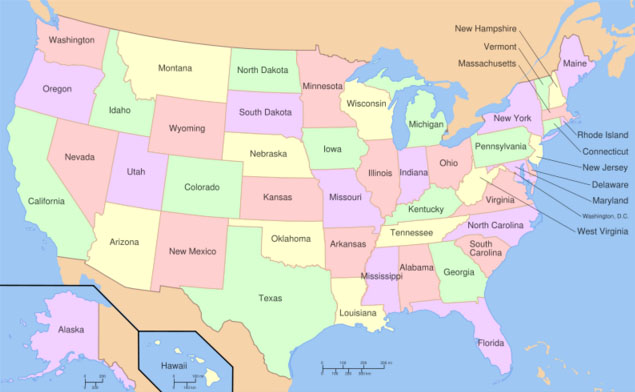
der Bundesstaaten der USA Map of the federal states of the USA: interaktiv interactive |
|
| ca. 7000 v.Chr. · Besiedlung
durch Indianer (Cherokee, Chickasaw, Choctaw, Muskogee) 1519 · der spanische Entdecker Alonso Alvarez de Pineda landet an der Küste (Mobile Bay) 1541 · der spanische Entdecker Hernando de Soto erreicht die Gegend auf dem Landweg 1699 · französische Kolonisierung an der Küste 1763 · britische Eroberung 1779 · spanische Eroberung des Küstenstreifens 1798 · Alabama wird Teil des Mississippi-Territoriums der USA 1817 · Bildung des Alabama-Territoriums 1819 · Anschluss von Teilen von Spanisch-Westflorida, Alabama wird 22. Bundesstaat der USA 1836 · Umsiedlung der Muskhogee-Indianer nach Oklahoma (damals: Indianerterritorium) 1839 · Umsiedlung der Irokesen-Indianer nach Oklahoma 11.01.1861 · Alabama verlässt die USA und schließt sich den CSA an (Südstaaten Konföderation) 18611865 · Bürgerkrieg: der Norden Alabamas wird bis 1864 von Truppen der USA erobert 09.04.1865 · Kapitulation der CSA-Armee, Ende des Bürgerkrieges 18651877 · "Rekonstruktion", erzwungene Rückkehr der CSA-Staaten in die USA |
| ca. 7000 B.C. · Settlement by
Indians (Cherokee, Chickasaw, Choctaw, Muskogee) 1519 · the Spanish explorer Alonso Alvarez de Pineda lands at the coast (Mobile Bay) 1541 · the Spanish explorer Hernando de Soto reached the area by land 1699 · French colonization on the coast 1763 · British conquest 1779 · Spanish conquest of the coastal strip 1798 · Alabama is part of the Mississippi Territory of the USA 1817 · formation of the Alabama territory 1819 · incorporation of parts of Spanish West Florida, Alabama becomes 22nd state of the USA 1836 · relocation of the Muskhogee Indians to Oklahoma (then Indian Territory) 1839 · relocation of the Iroquois Indians to Oklahoma 11th of January 1861 · Alabama leaves the U.S. and join the CSA (Southern Confederation) 18611865 · civil war: the north of Alabama will be invaded by troops of the United States to 1864 9th of April 1865 · capitulation of the CSA-army, end of the civil war 18651877 · "Reconstruction", forced return of the CSA states in the USA |
| Der Name "Alabama" hat seine Wurzeln in der Sprache der einst im Süden des Landes lebenden Muskogee-Indianer und bedeutet "Siedlung des Stammes". Es geht auf den Spruch "alibamo" zurück, was übersetzt heißt: "hier bleiben wir". | The name "Alabama" has its roots in the language of the once in south of the country living Muskogee Indians and means "settlement of the tribe". It goes back to the saying "alibamo" which means translated "we stay here". |