mobile Ansicht, to the English Version tap the flag
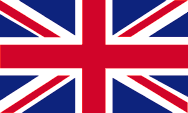

- kanadisches Territorium
- Eigenbezeichnungen:
– Englisch: Yukon (Territory)
– Französisch: (Territoire du) Yukon
- indianische Eigenbezeichnung: Kwichpak
• Flagge
• historische Flaggen
• Bedeutung/Ursprung der Flagge
• Wappen
• Bedeutung/Ursprung des Wappens
• Landkarte
• Zahlen und Fakten
• Geschichte
• Ursprung des Landesnamens
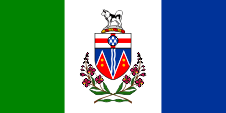
Flagge des Yukon Territoriums,
Seitenverhältnis = 1:2,
Quelle, nach: Wikipedia (D)


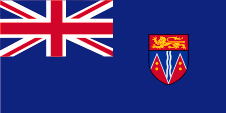
1934–1956,
Flagge der Regierung (Staatsflagge),
Seitenverhältnis = 1:2,
Quelle, nach:
World Statesmen

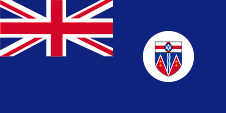
1956–1967,
Flagge der Regierung (Staatsflagge),
Seitenverhältnis = 1:2,
Quelle, nach:
World Statesmen,
Wikipedia (D)
Die heutige Flagge des Yukon-Territoriums wurde am 01.12.1967 eingeführt zeigt drei vertikale Streifen in Grün, Weiß und Blau. Der weiße Streifen trägt das Wappen des Territoriums in der Mitte. Das Grün steht für die Wälder, das Weiß für das Eis und den Schnee, und das Blau für die Gewässer. Das Yukon-Territorium war 1898 durch Ausgliederung aus den Nordwest-Territorien gegründet worden. Bis 1922 hätte von den Dienststellen der Territorien offiziell der britische Union Jack, die sogenannte Royal Union Flag, verwendet werden müssen, oder aber (ab 1922 im Prinzip nur noch) die kanadische blaue Dienstflagge, der typische Britische Blue Ensign, mit dem Wappenschild Kanadas im wehenden Ende. Wahrscheinlich hat man sich im Yukon-Territorium an die Regeln gehalten, zumal ein Territorium direkt der kanadischen Regierung untersteht. Dennoch hatten die Behörden der Territorien eigene Siegel und später auch Wappen, die eigenmächtig im wehenden Ende auf der blauen Dienstflagge platziert wurden. Für dieses Verfahren hätte eine Genehmigung der britischen Behörden vorliegen müssen, was jedoch nicht der Fall war, aber toleriert wurde. So begann man um 1934 Blue Ensigns zu verwenden, die das Wappen des Territoriums im wehenden Ende zeigten. 1956 wurde das Wappen etwas abgeändert, was sich auch auf der Flagge bemerkbar machte. Zusätzlich wurde das Wappen inmitten einer weißen Scheibe im wehenden Ende der Flagge platziert. Privatpersonen hatten den Union Jack zu verwenden und ab 1892 den sog. Red Ensign, die rote Version der kanadischen Flagge mit dem Union Jack in der Oberecke und dem Wappen Kanadas im wehenden Ende. Im Zuge der allmählichen Trennung Kanadas von Großbritannien verlor der Blue Ensign als amtliches, britisches Kennzeichen seine Bedeutung und man ersetzte ihn durch neue Provinzflaggen, die von Behörden und Dienststellen der Provinzen und auch von Privatpersonen verwendet werden dürfen. So führte das Yukon-Territorium 1967 die heutige Flagge ein.
Quelle:
Flaggen Enzyklopädie,
World Statesmen,
Wikipedia (D)
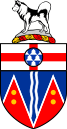
Wappen des Yukon-Territoriums,
Quelle, nach:
Wikipedia (D)
Das Wappen des Yukon-Territoriums zeigt im oberen Teil des Wappenschildes ein Georgskreuz, welches in der Mitte durch eine blau-weiß gefehte Scheibe überdeckt ist. Der untere Teil des Wappenschildes ist blau mit einer senkrechten weiß abgesetzten blauen Wellenlinie in der Mitte, in den von unten zwei rote Keile hineinragen. Die Keile tragen je zwei goldene Punkte an der Spitze. Die Wappenkrone wird gebildet von einer goldenen Wulst, auf der sich ein Schneehügel befindet, auf dem wiederum ein Alaskan Malamute Hund steht. Das Wappen wird unterhalb durch lokale Pflanzen begrenzt. Die roten Keile mit den goldenen Punkten stellen die goldhaltigen Gebirge dar, und die Wellenlinie die zahlreichen Flüsse des Landes. Die goldenen Punkte stehen für die reichen Goldfunde, die hier gemacht wurden.
Quelle:
Wikipedia (D)
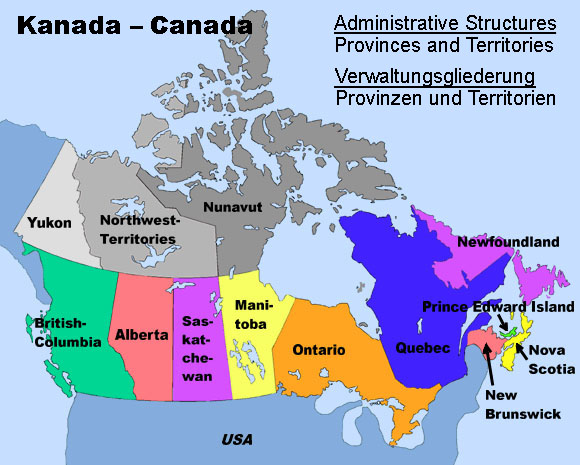
Landkarte/Map:
Volker Preuß
Fläche: 482.443 km²
Einwohner: 42.986 (2016), davon 21% Indianer
Bevölkerungsdichte: 0,09 Ew./km²
Hauptstadt: Whitehorse, 25.085 Ew. (2016)
Amtssprachen: Englisch, Französisch
Währung: kanadische Währung
Zeitzone: MEZ – 8 h
Quelle:
Wikipedia (D)
1670 · englische Pelzhändler gründen die Hudson's Bay Company (HBC), die HBC kolonisiert in der Folgezeit ganz Kanada zwischen Neufrankreich den Rocky Mountains, Labrador und dem Nordrand der Hudson-Bucht
1842 · Pelzhändler der HBC durchstreifen das Gebiet
1869 · die Hudson's Bay Company (HBC) überträgt alle ihre territorialen und Hoheitsrechte an das britische Dominion Kanada, das Gebiet des heutigen Yukon-Territoriums gehört zunächst zu den Nordwest-Territorien
1880 · erste Goldfunde in Yukon
1886 · Yukon, im äußersten Nordwesten, wird ein eigener Distrikt innerhalb der Nordwest-Territorien
1887 · Gründung der Stadt Dawson (später Hauptstadt)
1895 · Bildung des Yukon-Territoriums durch Herauslösung des Distrikts aus den Nordwest-Territorien
1896 · Entdeckung großer Goldvorkommen bei Bonanz Creek am Klondike-Fluss
1905 · Ende des Goldbooms im Yukon-Territorium
1952 · die Stadt Whitehorse wird anstelle von Dawson Hauptstadt des Yukon-Territoriums
2003 · Umbenennung in "Yukon"
Quelle:
Atlas zur Geschichte,
World Statesmen,
Wikipedia (D),
Discovery '97
Der Name des Territoriums geht auf den gleichnamigen Fluss zurück, der zentral durch das Land fließt. In der Sprache der Gwich'in-Indianer (auch: Gwitchin, Kutchin) heißt er "yu-kun-ah", was als "großer Fluss" übersetzt werden kann. Im Jahre 2003 wurde das "Yukon Territory" in "Yukon" umbenannt.
Quelle:
Wikipedia (D)