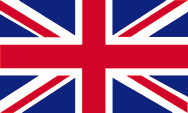
Quelle, nach:
Corel Draw 4, Flags of the World


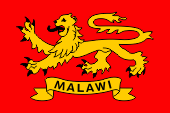
Flagge des Präsidenten,
Seitenverhältnis = 2:3,
Quelle: Flags of the World


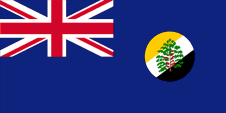
1893–1914,
British Central Africa Protectorate,
Flagge der Regierung (Staatsflagge),
Seitenverhältnis = 1:2,
Quelle, nach: Flags of the World
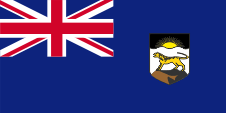
1914–1953,
Njassaland / Nyasaland,
Flagge der Regierung (Staatsflagge),
Seitenverhältnis = 1:2,
Quelle, nach: Flags of the World
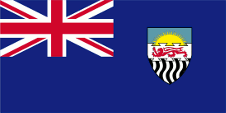
1953–1963,
Federation of Rhodesia and Nyasaland,
Flagge der Regierung (Staatsflagge),
Seitenverhältnis = 1:2,
Quelle, nach: Flags of the World
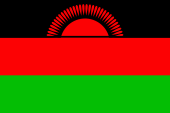
1964–2010,
Nationalflagge,
Seitenverhältnis = 2:3,
Quelle, nach:
Corel Draw 4, Flags of the World
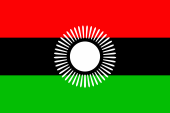
2010–2012 (Mathurika),
Nationalflagge,
Seitenverhältnis = 2:3,
Quelle, nach:
Flags of the World
Die anlässlich der Unabhängigkeit Malawis am 06.07.1964 eingeführte Flagge zeigt drei waagerechte Streifen in Schwarz, Rot und Grün, mit einer aufgehenden roten Sonne im schwarzen oberen Streifen. Die Sonne hat 31 Strahlen, ein Hinweis darauf, das Malawi als 31. Staat Afrikas unabhängig wurde. Diese Flagge wurde am 01.06.2012 erneut gehisst. Sie war schon einmal in Verwendung, und zwar vom 06.07.1964 bis 31.07.2010. Präsident Bingu wa Mathurika hatte zwischenzeitlich – und ohne besonderen Grund – eine andere Flagge eingeführt, die jedoch in der Bevölkerung keine Akzeptanz gefunden hat. Als Mathurika im April 2012 starb, sah man keine Veranlassung mehr die "Mathurika-Flagge" zu verwenden, und man kehre am 01.06.2012 zur alten Flagge von 1964 zurück. Die "Mathurika-Flagge" basierte auf der im Jahre 1964 anlässlich der Unabhängigkeit eingeführten Flagge, zeigte jedoch einige Änderungen, wobei die Bedeutung der Farben und die Symbolik beibehalten wurden. Sie zeigte drei waagerechte Streifen in Rot, Schwarz und Grün, und in der Mitte der Flagge erschien eine weiße Sonne mit 45 Strahlen. Rot steht für das für die Unabhängigkeit vergossene Blut, Schwarz für den afrikanischen Kontinent, Grün für die Wälder und Felder von Malawi. Die Sonne symbolisiert die Hoffnung auf eine neue und erfolgreiche Entwicklung in Afrika. Sie drückt damit den Gedanken des "Kwacha" aus, der Dämmerung eines neuen Zeitalters. Mit den Farben der Flagge von Malawi hat es – außer beim Schwarz – so seine Schwierigkeiten. Die Farbtöne werden in "British Standard Colours" angegeben, die sich nicht ohne weiteres in andere Farbsysteme übertragen lassen. Die Flaggendarstellungen auf dieser Seite orientieren sich von daher farblich an den Farben der Flagge, die auf der Webseite des UNO-Botschafters von Malawi verwendet worden sind. Die heutige Nationalflagge von Malawi basiert auf der Flagge der Malawi-Kongress-Partei (MCP), die seit der Erlangung der Unabhängigkeit bis 1994 die einzige Partei des Landes war. Die Parteiflagge der MCP geht auf die von Marcus Garvey erfundene schwarze Befreiungsflagge zurück, und wurde 1953 eingeführt. Die Präsidentenflagge ist rot mit einem goldenen (britischen) Löwen, ähnlich dem im Mittelteil des Wappens. Auf einem goldenen Schriftband darunter der Landesname: "MALAWI". Die Farbenkomination aus Rot, Schwarz und Grün wird Garvey-Farben genannt. Es sind die Farben, die Markus Garvey 1917 für die Flagge der United Negro Improvement Association schuf und die in diesen Farben gestreift war. Er war ein Befürworter der "Zurück nach Afrika"-Bewegung und sah in diesen Farben diejenigen eines Staates für Schwarze, der in Afrika entstehen sollte. Die Farben wurden dann aber in den USA und der Karibik als diejenigen der Black-Power-Bewegung bekannt, fanden aber in Afrika nur wenig Zuspruch. Trotzem wird auch diese Farbenkombination manchmal als panafrikanische Farben bezeichnet.
Quelle:
Die Welt der Flaggen,
Flaggen Wappen Hymnen,
Flaggen-Atlas Erde,
Wikipedia (EN),
Flags of the World,
UNO,
www.touring-afrika.de
seit 1964,
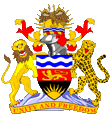
Wappen von Malawi,
Quelle:
Corel Draw 4
Das Staatswappen von Malawi wurde am 30.06.1964 von Königin Elisabeth II. verliehen. Es zeigt auf dem Schild die Sonne aus dem Wappen der einstigen Kolonie Njassaland, einen Löwen als Vertreter der Tierwelt und der ehemaligen Kolonialmacht, und Wellenlinien als Symbol für den Malawisee. Als Schildhalter fungieren ein Löwe und ein Leopard. Auf dem Helm, der das Wappen krönt, ein Adler als weiterer Vertreter der Fauna des Landes. Das Schild ruht auf einem Gebirge, dem Mlanjemassiv. Unterhalb ein Schriftband mit dem Motto des Landes: "Unity and Freedom" → "Einheit und Freiheit".
Quelle:
Die Welt der Flaggen,
Flaggen Wappen Hymnen,
Wikipedia (DE)

Flugzeugkokarde,
Quelle/Source, nach/by: Wikipedia (EN)
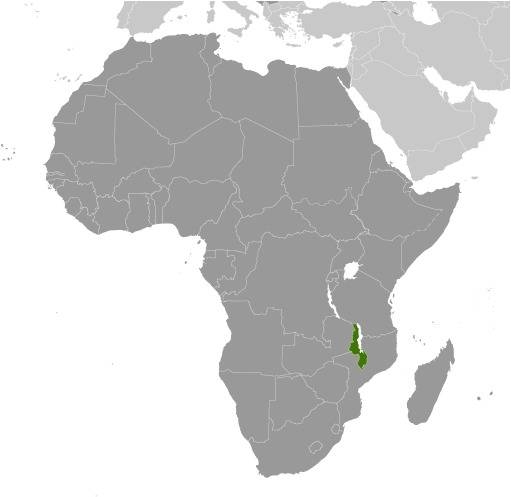
Lage:
Quelle/Source: CIA World Factbook
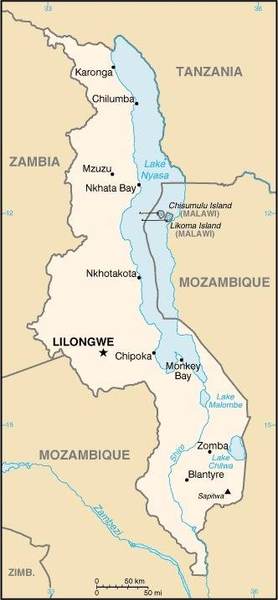
Landkarte des Landes:
Quelle/Source: CIA World Factbook
Fläche: 118.484 km²
Einwohner: 20.900.000 (2020), davon 49% Maravi, 18% Lomwe, 13% Yao, 11% Ngoni
Religionen: 83% Christen, 13% Moslems
Bevölkerungsdichte: 176 Ew./km²
Hauptstadt: Lilongwe, 989.318 Ew. (2018)
Amtssprachen: Chichewa, Englisch
Amtssprachen: Chinyanja, Chiyao, Chitumbuka und weitere Bantu-Sprachen
Währung: 1 Malawi-Kwacha (MWK, MK) = 100 Tambala
Zeitzone: MEZ + 1 h
Quelle:
Wikipedia (DE)
16./17. Jahrhundert · Königreich Maravi
1875 · Einrichtung schottischer Missionsstationen, Beginn der Kolonialisierung durch Großbritannien
1891 · Errichtung des britischen Protektorats (Nyasaland Districts)
1893 · Umbenennung in "British Central Africa Protectorate" (Britisch-Zentralafrika)
1907 · offizielle Einführung des Namens Njassaland
1953 · Bildung der Zentralafrikanischen Föderation (Föderation Rhodesien und Njassaland) zusammen mit Rhodesien (heute Sambia und Simbabwe)
1963 · Aufhebung der Zentralafrikanischen Föderation
1959 · antikoloniale Unruhen, Verfassung
1962 · innere Autonomie
06.07.1964 · Unabhängigkeit
1966 · Umbenennung in Malawi, Proklamation der Republik, Einführung des Einparteiensystems
1971 · Präsidialdiktatur
1992 · Unruhen
1993 · nach Volksentscheid Einführung des Mehrparteiensystems
Quelle:
Wikipedia (DE)
Der Name "Malawi" geht auf das mittelalterliche "Königreich Maravi" zurück. Der frühere Name "Njassaland" bezieht sich auf das Yao-Wort "nyasa", was "See" heißt, womit der Malawisee / Njassasee gemeint war.
Quelle:
Volker Preuß,
Wikipedia (DE)