mobile Ansicht, to the English Version tap the flag

- Islamische Republik Mauretanien
- präsidiale Republik
- Eigenbezeichnungen:
Arabisch: Al-Jumhuriya al-Islamiya al Muritaniya
Französisch: République Islamique de Mauritanie
• Flagge
• historische Flaggen
• Bedeutung/Ursprung der Flagge
• Wappen
• Bedeutung/Ursprung des Wappens
• Flugzeugkokarde
• Landkarte
• Zahlen und Fakten
• Geschichte
• Ursprung des Landesnamens
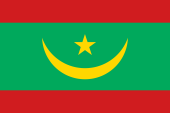
seit 2017,
Nationalflagge,
Seitenverhältnis = 2:3,
Quelle, nach: Wikipedia (EN)


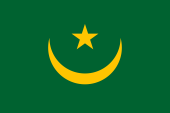
1959–2017,
Nationalflagge,
Seitenverhältnis = 2:3,
Quelle, nach: Wikipedia (EN)
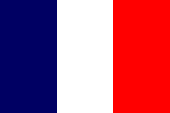
1903–1959,
Flagge Frankreichs,
Seitenverhältnis = 2:3,
Quelle, nach: Corel Draw 4

Die heutige Flagge Mauretaniens wurde am 17.08.2017 eingeführt. Sie ist grün mit zwei schmaleren roten Streifen oben und unten und zeigt in der Mitte der grünen Fläche Halbmond und Stern in Gelb. Die Spitzen des Halbmondes zeigen nach oben. Die roten Streifen wurden der Flagge beigefügt, um dem Erscheinungsbild der Flagge ein mehr afrikanisches Aussehen zu geben. Die Farbe Grün steht ferner für den Islam, Rot für Opferbereitschaft und Gelb ist Farbe des Sandes. Die Farben der Flagge scheinen heute folgendermaßen definiert zu sein, und zwar hexadezimal: Grün = #00A95C, was Pantone Hexachrome Green entsprechen würde, Rot = #D01C1F, was Pantone 1795 entsprechen würde und Gelb = #FFD700, was Pantone 109 entsprechen würde. Die Farbkombination von Grün, Gelb und Rot in der heutigen Flagge sind die Panafrikanischen Farben: Etwa 1900 setzte die Panafrika - Bewegung ein, die Gemeinsamkeiten aller Menschen mit schwarzer Hautfarbe hervorheben wollte. Für die politische Einheit Afrikas steht der Farbendreiklang Grün-Gelb-Rot, den viele afrikanische Staaten nach Erlangung ihrer Unabhängigkeit in ihre Flaggen übernahmen. Das erste Land war Ghana im Jahr 1957. Als Ursprung gelten die Landesfarben von Athiopien (Abessinien, dem ältesten unabhängigen Staat Afrikas. Die erste Flagge Mauretaniens wurde am 01.04.1959 eingeführt. Sie zeigte ein einfarbiges grünes Flaggentuch mit dem islamischen Symbolismus von Halbmond und Stern in Gelb. Die Spitzen des Halbmondes zeigten nach oben. Das Grün stand für Wohlstand und für die Hoffnung auf eine bessere Zukunft. Gelb ist nicht nur die Farbe des Sandes in der Wüste, sondern sie steht auch für die Bodenschätze des Landes. Der islamische Symbolismus, in Form von Halbmond und Stern, geht auf das Osmanische Reich zurück. Der letzte Kalif (aus dem Haus der Abbasiden) war 1258 hingerichtet worden. Der Kalif, Nachfolger Mohammeds, war religiöses und weltliches Oberhaupt des "Islamischen Reichs". Um 1460 wurde das Kalifat vom Herrscher des Osmanischen Reichs wiederbelebt. Diese Funktion wurde besonders wichtig als die Türken im Jahre 1517 die Stadt Mekka eroberten, und die Funktion der obersten Hüter und Bewahrer der heiligen Stätten übernahmen. Die Kontrolle über die heiligen Stätten ging während des Ersten Weltkriegs verloren (Mekka 1916, Medina 1918). Das Kalifat wurde 1924 von der türkischen Nationalversammlung abgeschafft. So haben sich Halbmond und Stern als Symbole des Islam in der ganzen Welt verbreitet. Die Verbindung dieser Symbole mit grünen Flaggen hat ihren Ursprung im osmanischen Panislamismus. Als es in Teilen des Osmanischen Reiches zu Unabhängigkeitsbewegungen kam, setzte Abdul Hamid II. diesen Bewegungen erfolgreich das einigende Band des Panislamismus entgegen. Zum Symbol des Panislamismus machte er eine grüne Flagge (Farbe des Mantels des Propheten Mohammed), und setzte das türkische Wappen darauf. Die Flagge des Islam war erschaffen.
Quelle:
Flaggen Wappen Hymnen,
Die Welt der Flaggen,
Flaggen und Wappen der Welt,
Wikipedia (EN),
Volker Preuß
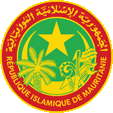
seit 2017,
Siegel Mauretaniens,
Quelle: Jelloud Najem, Public domain, via Wikimedia Commons
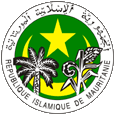
1960–2017,
Siegel Mauretaniens,
Quelle: Corel Draw 4
Mauretanien benutzt, wie viele ehemalige französische Kolonien, als Staatswappen ein Siegel. Es wurde am 03.08.1960 eingeführt. Am 17.08.2017 wurde auch das Wappen – wie die Flagge – farblich modifiziert. Die Umrandung des Siegels wurde rot eingefärbt und strikt auf die Verwendung der Farben Rot, Gelb und Grün geachtet. Das Siegel zeigt in der Mitte im Hintergrund auf einer grünen Scheibe das Motiv der Flagge, Halbmond und Stern. Im Vordergrund eine Dattelpalme und Hirsepflanzen. Die Inschrift rings um das Siegel zeigt in arabischer und französischer Sprache den Namen des Landes. Es gibt auch einfarbige Versionen des Siegels, wobei Grün zu Schwarz wird, und Gelb zu Weiß, beziehungsweise wird der gesamte Wappenhintergrund schwarz sowie das Gelb und die die Inschrift sind weiß. Die selten verwendete Rückseite des Wappens zeigt zwischen Palmwedeln und Olivenzweigen in arabischer und französischer Sprache des Motto des Landes: "Ehre, Bruderschaft, Gerechtigkeit"
Quelle:
Flaggen Wappen Hymnen,
Flaggen und Wappen,
Flaggen und Wappen der Welt
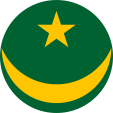
Flugzeugkokarde,
Quelle, nach: Wikipedia (EN)
Lage:
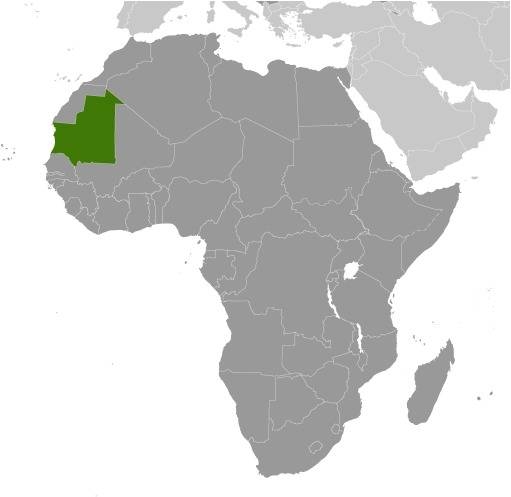
Quelle: CIA World Factbook
Landkarte des Landes:
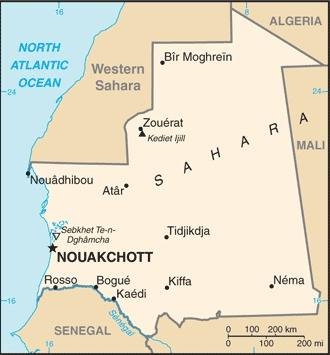
Quelle: CIA World Factbook
Fläche: 1.030.700 km²
Einwohner: 4.600.000 Ew. (2020), 40% Haratin (Mauren + Schwarzafrikaner), 30% Mauren (Araber + Berber), 30% Wolof, Tukolor, Soninke
Religionen: 99% Moslems
Bevölkerungsdichte: 4 Ew./km²
Hauptstadt: Nouakchott, 1.116.700 Ew. (2017)
Amtssprache: Arabisch
sonstige Sprachen: Französisch, Wolof, Tukolor, Soninke
Währung: 1 Ouguiya (MRU, UM) = 5 Khoums
Zeitzone: MEZ – 1 h
Quelle:
Wikipedia (D),
CIA World Factbook
1076 · die marokkanische Almorawiden-Dynastie erobert das Reich Ghana (heutiges Süd-Mali und Süd-Mauretanien) und errichtet ein Großreich (heutiges Spanien, Marokko, Westsahara, Mauretanien), Islamisierung und später auch Arabisierung des heutigen Mauretanien, vor allem im Norden des heutigen Mauretanien erkennen die Stämme der Schengit die Oberhoheit Marokkos bis in die Neuzeit hinein an
1902–1910 · Eroberung des Wüstengebietes durch Französische Truppen
1903 · Errichtung des Französischen Protektorats
1920 · Angliederung an Französisch-Westafrika
1946 · Mauretanien wird Französische Überseeprovinz
28.11.1958 · Autonomie
28.11.1960 · Frankreich entlässt Mauretanien in die Unabhängigkeit → Marokko erkennt Mauretanien zunächst nicht an, stellt territoriale Forderungen und nimmt keine diplomatischen Beziehungen zu Mauretanien auf
1964 · Einparteiensystem
1966 · Rassenunruhen
1970 · Aufnahme diplomatischer Beziehungen zu Marokko
1974 · Verstaatlichung des Bergbaus (Eisenerz)
1975 · Spanien verzichtet auf seine Rechte in Westsahara, das Selbstbestimmungsrecht von Westsahara wird international anerkannt, Marokko und Mauretanien marschieren in Westsahara ein
1976 · Marokko und Mauretanien teilen Westsahara untereinander auf
1978 · Militärputsch
1979 · Mauretanien gibt seinen Teil der Westsahara zugunsten der Westsahara-Befreiungsfront "POLISARIO" auf, Marokko annektiert auch dieses Gebiet
1984 · Militärputsch
1989 · in Folge von Rassenunruhen Konflikte mit Senegal
1991 · neue Verfassung, Mehrparteiensystem
1992 · Präsidentschafts- und Parlamentswahlen
1999 · Konflikte mit Mali
2005 · Militärputsch
2006 · Wahlen
2008 · Militärputsch
2009 · Wahlen
2014 · Militärputsch
Quelle:
Atlas zur Geschichte,
Weltgeschichte,
Wikipedia (D)
Der Name "Mauretanien" leitet sich von den Mauren ab, der berberischen Urbevölkerung des Maghreb. Schon in der Antike wurde Name "Mauretanien" für das heutige Marokko verwendet. Heute bezeichnet man die islamische berberisch-arabische Mischbevölkerung des Maghreb als Mauren. Das Wort "Mauren" hat seinen Ursprung wahrscheinlich in dem phönizischen Wort für "dunkel" bzw. "finster".
Quelle:
Volker Preuß,
Handbuch der geographischen Namen