• Flagge
• historische Flaggen
• Bedeutung/Ursprung der Flagge
• Wappen
• Bedeutung/Ursprung des Wappens
• Flugzeugkokarde
• Landkarte
• Zahlen und Fakten
• Geschichte
• Ursprung des Landesnamens
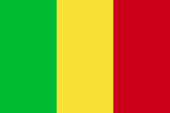
Nationalflagge,
Seitenverhältnis = 2:3,
Quelle, nach: Flags of the World


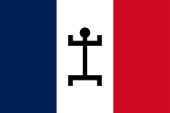
1958–1959,
Flagge der Autonomen Republik Sudan,
Quelle, nach: Flags of the World

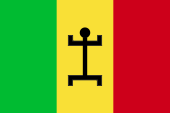
1959–1961,
Flagge der Mali-Föderation und Nationalflagge von Mali,
Quelle, nach: Flags of the World
Die heutige Flagge Malis wurde am 01.03.1961 (nach anderen Quellen am 20.01.1961) eingeführt. Sie wurde nach dem Vorbild der französischen Trikolore in den panafrikanischen Farben Grün, Gelb und Rot gestaltet. Die Flaggen vieler französischer Kolonien in Afrika, die um die gleiche Zeit die Unabhängigkeit erlangt haben, ähneln sich. Die Farben werden speziell für Mali folgendermaßen gedeutet: Grün steht für die Vegetation, Gelb für die Reinheit und die Bodenschätze, Rot für die Tapferkeit und das für die Erlangung der Unabhängigkeit vergossene Blut. Die Farben der Flagge scheinen folgendermaßen definiert zu sein: Grün = Pantone 2271, Gelb = Pantone 115 und Rot = Pantone 3546. Mobido Keita, der ehemalige Präsident von Mali, trat für Kwame Nkrumahs Idee einer Union afrikanischer Staaten ein, und drückte dies durch die Verwendung der Farben Rot, Gelb, Grün und Schwarz nach Vorbild der Flagge von Ghana aus. Die erste Flagge von Mali wurde am 04.04.1959 für die Föderation von Mali und Senegal eingeführt. Sie wurde nach dem Vorbild der französischen Trikolore mit drei senkrechten Streifen in den panafrikanischen Farben Grün, Gelb und Rot gestaltet und enthielt ferner die schwarze Abbildung eines stilisierten Menschen, einen sogenannten Kanaga, wie ihn Leopold Senghor der Staatschef von Senegal vorgeschlagen hatte. Der Kanaga ist ein bedeutendes Symbol für die Weltanschauung und Philosophie der Menschen dieses Teils von Afrika. Nach der Trennung von Senegal behielt Mali dieses Symbol bei, jedoch nur bis zum 01.03.1961, denn die 85% Moslems im Lande lehnten dieses Symbol ab. Senegal ersetzte das Kanaga durch einen grünen Stern. Die Farben Grün, Gelb und Rot sind die panafrikanischen Farben. Etwa 1900 setzte die Panafrika-Bewegung ein, die Gemeinsamkeiten aller Menschen mit schwarzer Hautfarbe hervorheben wollte. Der Farbendreiklang Grün-Gelb-Rot, den viele afrikanische und auch amerikanische Staaten nach Erlangung ihrer Unabhängigkeit in ihre Flaggen übernahmen, steht für die politische Einheit Afrikas, ja aller Schwarzen. Das erste Land war Ghana im Jahr 1957. Als Ursprung gelten die Landesfarben von Athiopien (Abessinien), dem ältesten unabhängigen Staat Afrikas.
Quelle:
Die Welt der Flaggen,
Flaggen Wappen Hymnen,
Flags of the World,
Wikipedia (EN),
Volker Preuß
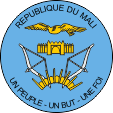
seit 1973,
Wappen von Mali,
Quelle:
Corel Draw 4
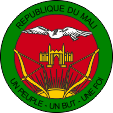
1961–1973
Wappen von Mali,
Quelle:
Corel Draw 4
Das Staatswappen von Mali ist ein Siegel. Bis 1973 war es in seiner farbigen Ausführung – es gibt bei Siegeln immer auch eine schwarz-weiße Version – in den Farben der Flagge gehalten. Das Siegel ist kreisrund und zeigte bis 1973 eine rote, grün umrandete Scheibe. In dem grünen Rand der Name des Staates und das Staatsmotto: "Republique du Mali – un peuple, un but, une foi" → "Republik Mali – Ein Volk, ein Ziel, ein Glaube". Im oberen Teil der roten Scheibe eine silberne Taube (Symbol für den Frieden) darunter eine stilisierte goldene Darstellung einer Stadt (Symbol für das alte Reich Mali), zwei nach links und rechts gespannte goldene Bögen und ganz unten eine aufgehende goldene Sonne (Symbol für Hoffnung). Im Jahr 1973 wurde das Siegel geändert. Die Scheibe ist jetzt einfarbig blau. Die Taube ist jetzt golden, das Stadtsymbol wurde ein wenig verändert, die Bögen sind jetzt silbern und die aufgehende Sonne wurde weitestgehend stilisiert. Der Schriftzug blieb unverändert.
Quelle:
Flaggen Wappen Hymnen,
Flaggen und Wappen der Welt,
Wikipedia (DE),
Flags of the World

Flugzeugkokarde,
Quelle/Source, nach/by: Wikipedia (EN)
Lage:
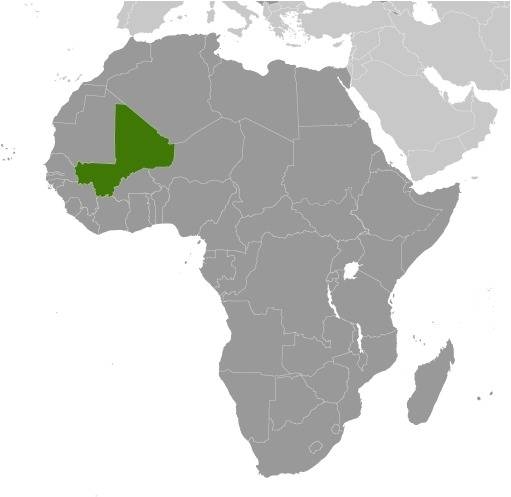
Quelle/Source: CIA World Factbook
Landkarte des Landes:
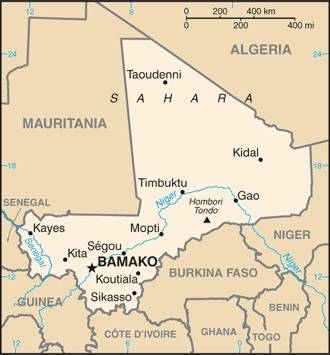
Quelle/Source: CIA World Factbook
Fläche: 1.240.192 km²
Einwohner: 19.550.000 (2020), davon 35% Bambara (Mande), 10% Fulbe, 9% Senufo (Volta), 8% Sarakolle (Sudan), 7% Songhai (Sudan), 6% Tuareg, 5% Malinke (Mande), 5% Dogon (Sudan), 2% Bwa/Bobo (Volta), 3% Mauren
Religionen: 90% sunnitische Moslems, 5% Katholiken
Bevölkerungsdichte: 16 Ew./km²
Hauptstadt: Bamako, 1.809.106 Ew. (2009)
Amtssprache: Französisch
sonstige Sprachen: Bambara, Fulbe, ... Arabisch
Währung: CFA-Franc BCEAO (XOF, F) = 100 Centimes
Zeitzone: MEZ – 1 h
Quelle:
Wikipedia (DE)
ca. 4.–9. Jhd. · Ghana-Reich im Nordwesten
1076–1077 · Eroberung durch die Almoraviden, Zerfall des Ghana-Reiches, Islamisierung
1100 · Gründung von Timbuktu durch das Volk der Tuareg
1235–ca. 1465 · Mali-Reich
ca. 1465–1591 · Songhai-Reich
1591 · marokkanische Eroberung
1760 · die Tuareg übernehmen das Land
1883–1898 · französische Eroberung, Bildung der Kolonien Obersenegal und Niger (später Französisch-Sudan)
1895 · Bildung des Generalgouvernements Französisch-Westafrika
1902 · Bildung der Kolonialföderation Französisch-Westafrika bestehend aus:
1. Mauretanien – Französisch-Sudan – Niger-Kolonie – Obervolta
2. Senegal
3. Dahomey
4. Elfenbeinküste
5. Französisch-Guinea
28.11.1958 · Ausrufung der Republik Sudan, Autonomie innerhalb der Französischen Gemeinschaft
17.01.1959 · Zusammenschluss mit Senegal zur Mali-Föderation (Sudan und Senegal)
22.11.1960 · Zerfall der Mali-Föderation, Unabhängigkeit von Frankreich, Sudan nimmt den Namen Mali an
1961 · Bildung der "Union Afrikanischer Staaten" (Mali, Ghana und Guinea)
1963 · Auflösung der "Union Afrikanischer Staaten"
1964 · Wahlen
19.11.1968 · Militärputsch
1969 · Leutnant Moussa Traoré wird Ministerpräsident
1979 · Gründung der Einheits-Partei UDPM, Einparteiensystem, Moussa Traoré wird Staatspräsident
1985 · Militärische Auseinandersetzungen mit Obervolta (Burkina Faso)
1990 · nach Rebellion Ausnahmezustand im Tuareggebiet
1991 · Unruhen
26.03.1991 · Sturz des Ministerpräsidenten Traoré
1992 · Volksabstimmung über eine neue Verfassung
1995 · Ende der Tuaregrebellion
2012 · im Januar Ausbruch eines erneuten Tuareg-Aufstands, im März werden Kidal und Gao von der MNLA-Miliz (Movement Nationale de Libération de l'Azawad) und der Islamischen Ansar-Dine-Miliz erobert, am 01.04.2012 folgt Timbuktu
06.04.2012 · Azawad erklärt seine Unabhängigkeit von Mali, die Islamische Ansar-Dine-Miliz, erkennt Azawad nicht an, und vertreibt in den Folgetagen die MNLA aus Timbuktu
Mai bis Dezember 2012 · Vormarsch der Ansar-Dine-Miliz und anderer islamischer Gruppen in Richtung Bamako, die Regierung von Mali bittet um internationale Hilfe
Januar 2013 · Einmarsch französischer und afrikanischer Truppen, Gegenoffensive, die islamischen Gruppen werden in Richtung Norden abgedrängt
2020 · Militärputsch
2021 · Militärputsch
2022 · Abzug der französischen Truppen
Quelle:
Atlas zur Geschichte,
Wikipedia (D),
Discovery '97,
World Statesmen
Der Name "Mali" geht auf das historische Mali-Reich (1235–1465) zurück. Das Staatsvolk waren das Volk der Malinke, die das Land "Manden Kurufa" nannten, in ihrer Sprache Mandinka. Das Wort Mali geht also auf die Malinke zurück. Die letzten Mali-Könige residierten im 16. Jahrhundert zurückgezogen am Oberlauf des Flusses Niger, während das Songhai-Reich an Bedeutung gewann. Als die Franzosen begannen das Gebiet des heutigen Mali zu erschließen, benannten sie den Lebensraum beiderseits des Flusses Niger nach diesem Fluss, also "Niger". Das spätere Französisch-Westafrika wurde 1902 administrativ aufgegliedert, wobei die östlich gelegene Fluss-Region den Namen Niger behielt (bis heute), und die westlich gelegene Fluss-Region den Namen Französisch-Sudan erhielt. Der Name "Sudan", aus dem Arabischen von "Bilād as-Sūdān" → Land der Schwarzen, stammt aus dem arabisch-islamischen Kulturkreis und meinte ursprünglich den gesamten christianisierten Bereich der südlich der Wüste Sahara gelegenen Savannenzone. Nach der Unabhängigkeit hieß das Land nicht mehr Französisch-Sudan, sondern folgerichtig nur noch "Sudan". Allerdings war das Land Teil der Mali-Föderation mit Senegal. Nachdem sich beide Länder getrennt hatten, wurde der Name "Mali" auf das Land übertragen, oder wenn man so will, beibehalten.
Quelle: 1.) Wikipedia (D), 2.) Wikipedia (D),Volker Preuß