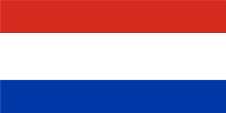
1842–1954,
Nationalflagge, Rückseite,
Seitenverhältnis = 2:3,
Quelle, nach: Flags of the World


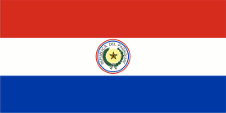
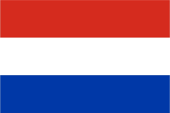
1854–1988,
Nationalflagge, Vorderseite,
Seitenverhältnis = 1:2,
Quelle, nach: Flags of the World
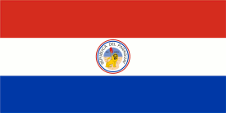
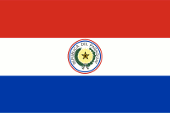
1854–1988,
Nationalflagge, Rückseite,
Seitenverhältnis = 1:2,
Quelle, nach: Flags of the World
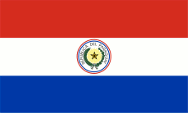
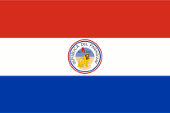
1988–1990,
Nationalflagge, Vorderseite,
Seitenverhältnis = 3:5,
Quelle, nach: Flags of the World
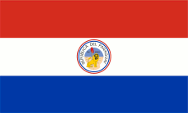
1988–1990,
Nationalflagge, Rückseite,
Seitenverhältnis = 3:5,
Quelle, nach: Flags of the World
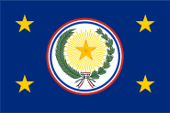
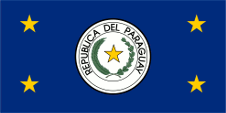
bis 1990,
Flagge des Präsidenten,
Seitenverhältnis = 2:3(?),
Quelle, nach: Flags of the World,
Flaggenbuch 1939
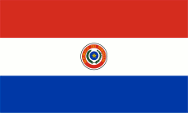
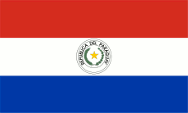
1990–2013,
Nationalflagge, Vorderseite,
Seitenverhältnis = 3:5,
Quelle, nach: Flags of the World


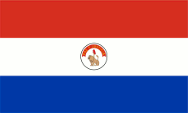
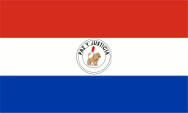
1990–2013,
Nationalflagge, Rückseite,
Seitenverhältnis = 3:5,
Quelle, nach: Flags of the World
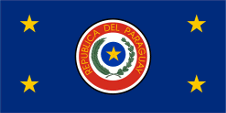
1990–2013,
Flagge des Präsidenten,
Seitenverhältnis = 1:2,
Quelle, nach: Flags of the World

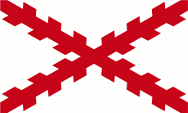
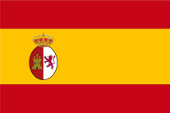
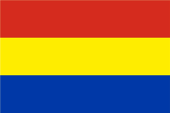
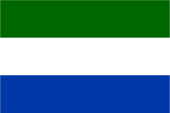
Die heutige Flagge Paraguays wurde am 27.11.1842 offiziell eingeführt, und in den Jahren 1954, 1988, 1990 und 2013 lediglich im Format oder in dem in der Mitte der Flagge angebrachten Siegel abgeändert. Sie ist eine der wenigen Flaggen der Welt, bei der sich Vorder- und Rückseite unterscheiden. Die Flagge zeigt drei waagerechte Streifen in Rot, Weiß und Blau. In der Mitte des weißen Streifens befindet sich auf der einen Seite der Flagge das Staatswappen (Siegel) und auf der anderen Seite das Siegel des Finanzministeriums. Die Farben der Flagge sind per Gesetz von 1842 festgelegt, allerdings nur als als Rot, Weiß und Blau, ohne genauer zu spezifizieren. Die heutigen Farben scheinen aus der Praxis heraus definiert zu sein: Rot = HEX #D52B1E, was Pantone 1795 entsprechen würde, Blau = HEX #0038A8, was Pantone 661 entsprechen würde. Am 25.05.1810, war in La Plata (zu dem Paraguay damals gehörte) der spanische Vizekönig gestürzt worden. Es war ein trüber und wolkiger Tag, an dem plötzlich die Wolkendecke aufriss und die Sonne zu scheinen begann. Dieses Wunder wurde im späteren Argentinien als "Sol de Mayo" (Maisonne) berühmt und auf der Flagge dieses Landes verewigt. Die Verkündung Unabhängigkeit Paraguays sollte ursprünglich auf den 14.05.1811 fallen. Ein Datum in Mai! Fast ein Jahr nach den Ereignissen in Argentinien! Um auch in Paraguay ein "Wunder" wirken zu lassen, wurde für die Nacht vor dem 14.05.1811 ein hell leuchtender Stern prophezeit. Jedenfalls wurde am 14.05.1811 für das unabhängige Paraguay eine einfarbige blaue Flagge mit einem weißen sechszackigen Stern in der Oberecke gehisst. Dieser Stern wurde nun als "Estrella de Mayo" (Maistern) bekannt. Die tatsächliche Unabhängigkeit von Spanien (und auch von La Plata) wurde jedoch erst am 17.06.1811 verkündet, als sich der Kongress erstmals konstituierte. Dabei wurden eine Vielzahl von Flaggen gezeigt, gehisst und verwendet. Es waren meist Flaggen mit drei horizontalen Streifen in den Farben Grün, Weiß und Blau oder Rot, Gelb und Blau (Farben Spaniens ergänzt um Blau). Der Patriot, Freiheitskämpfer und spätere Staatschef Dr. José Rodríguez Gaspar da Francia bevorzugte eine Flagge in den Farben Rot, Weiß und Blau. Er hatte die Farben Frankreichs ganz bewusst als revolutionäres Vorbild ausgewählt und eine horizontal gestreifte Flagge in diesen Farben wurde am 15.08.1812 als Flagge von Paraguay angenommen. Der weiße Streifen war verbreitert, wahrscheinlich um genügend Raum für ein später zu platzierendes Wappen zu haben. Im Jahre 1826 reaktivierte Dr. Francia die einfarbig blaue Flagge mit dem Stern in der Oberecke, angeblich in Hellblau, allerdings wird das zum Färben von Blau verwendete Indigo das getan haben, was es immer macht, es wird ausgewaschen sein. Was das Motiv zum Wiedereinführen der Flagge von 1811 war, ist unbekannt. Die rot-weiß-blaue Flagge wurde aber ebenfalls weiterverwendet und mit dem Flaggengesetz von 1842 mit gleich breiten Streifen, schließlich wieder als alleinige Flagge von Paraguay bestätigt. Das Gesetz, das im Prinzip heute noch gilt, schrieb dann vor, das Siegel des Staates in der Mitte des weißen Streifens zu platzieren, jedoch auf der Rückseite der Flagge das Siegel der Finanzverwaltung zu verwenden. Das das Siegel im Gesetz nur beschrieben und nicht abgebildet war, gab es, bis sich allmählich ein Standard herausarbeitete, viele unterschiedliche Versionen.
Quelle:
Flaggen Wappen Hymnen,
Flaggen und Wappen der Welt,
Die Welt der Flaggen,
Volker Preuß
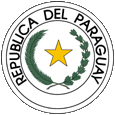
seit 2013,
Wappen (Siegel) von Paraguay,
Quelle, nach:
Wikipedia (DE)
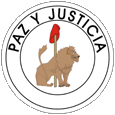
seit 2013,
Siegel des Finanzministeriums,
Quelle, nach:
Wikipedia (DE)
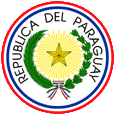
1842–1990,
Wappen (Siegel) von Paraguay,
Quelle:
Corel Draw 4,
Wikipedia (DE)
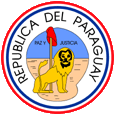
1842–1990,
Siegel des Finanzministeriums,
Quelle:
Corel Draw 4,
Wikipedia (DE)
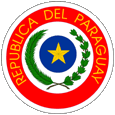
1990–2013,
Wappen (Siegel) von Paraguay,
Quelle:
Wikipedia (DE)
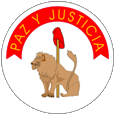
1990–2013,
Siegel des Finanzministeriums,
Quelle:
Wikipedia (DE)
Das Staatswappen von Paraguay ist eigentlich ein Siegel. Es geht auf das von Dr. José Rodríguez Gaspar da Francia verwendete Siegel zurück. Dieses zeigte zwei gekreuzte Palmwedel. Im Jahre 1821 wurde der "Maistern" in das Siegel aufgenommen und ein Palmwedel durch einen Ölzweig ersetzt. Die beiden Zweige stehen für Frieden und Ehre. Ebenso erscheint auch der Name des Landes ("REPUBLICA DEL PARAGUAY") im Siegel. Im Jahr 1990 wurde das Siegel ein wenig verändert. Der "Maistern" wurde auf eine blaue Scheibe gelegt und die Strahlen des Sterns wurden entfernt. Ebenso das rot-weiß-blaue Band, welches die Zweige bis dato zusammengehalten hatte. Der Name des Landes wurde in Gold auf ein rotes umlaufendes Band gesetzt. Die äußereste Umrandung ist nicht mehr in den Farben Rot, Weiß und Blau gehalten, sondern ist eine einfache schwarze Linie. Das Siegel des Finanzministeriums, das auf der Rückseite der Landesflagge angebracht ist, zeigt einen Löwen der eine phrygische Mütze bewacht. Diese Symbole stehen für Frieden und Gerechtigkeit und für deren Verteidigung. Auch dieses Siegel wurde im Jahre 1990 abgeändert. Der farbige Hintergrund und die Landesbezeichnung wurden entfernt, und der Löwe schaut nun in die andere Richtung. Das Motto "Paz y Justicia" (Frieden und Gerechtigkeit) wurde auf ein in der oberen Hälfte verlaufendes rotes Band gelegt. Das Siegel des Staates und des Ministeriums für Finanzen wurden im Juli 2013 erneut abgeändert.
Quelle:
Flaggen Wappen Hymnen,
Flaggen und Wappen der Welt,
Die Welt der Flaggen,
Wikipedia (ES),
Volker Preuß

Flugzeugkokarde,
Quelle/Source, nach/by: Wikipedia (EN)
Lage:
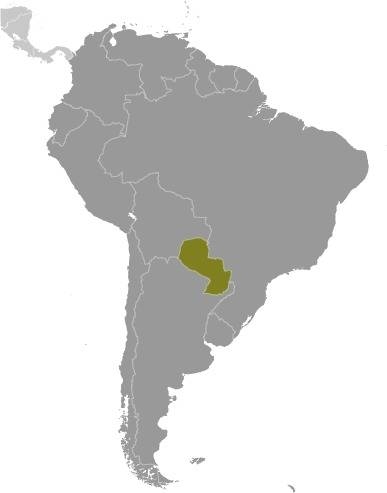
Quelle/Source: CIA World Factbook
Landkarte des Landes:
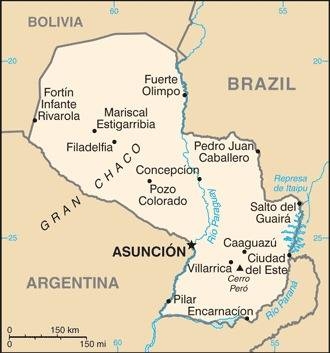
Quelle/Source: CIA World Factbook
Fläche: 406.752 km²
Einwohner: 7.100.000 (2020), davon 74% Mestizen, 20% Europäer (darunter ca. 500.000 Deutsche und Deutschstämmige), 3% Mulatten, 2% Indianer (Guaraní), 0,5% Asiaten
Religionen: 90% Katholiken, 7% Protestanten, 1% andere Christen
Bevölkerungsdichte: 17 Ew./km²
Hauptstadt: Asunción, 525.000 Ew. (2016)
Amtssprachen: Spanisch, Guaraní
sonstige Sprachen: Portugiesisch, Deutsch, Englisch, Indianersprachen
Währung: 1 Guaraní (PYG, G) = 100 Céntimos
Zeitzone: MEZ – 5 h
Quelle:
Wikipedia (D),
Wikipedia (ES)
Steinzeit · indianische Besiedlung des heutigen Paraguay, im Osten Tupí-Guaraní-Stämme, im Westen (Chaco) Aruak, Guaicurú, Mataco-Mataguayo, Chamacoco, Angaite und Lengua
1524 · Entdeckung des heutigen Paraguay durch Alejo García bei einer Durchquerung des Chaco, eines unwirtlichen Flachlandes
1526 · Expedition des Sebastiano Caboto, eines italienischen Seefahrers in englischem Dienst, entlang des Flusses Paraná, Gründung einer Siedlung
1537 · Gründung des Forts Asunción durch spanische Eroberer, Bildung der spanischen Kolonie Río de la Plata, Zug des Eroberers Juan de Ayola nach Osten
1542 · Zug des Eroberers Irala von Buenos Aires über Asunción nach Osten
1543 · Zug des Eroberers Cabeza de Vacas nach Osten
1588 · der Jesuitenorden gründet im Süden des heutigen Paraguay einen christlich-theokratischen Indianerstaat
1617 · das heutige Paraguay wird von der Kolonie Río de la Plata abgetrennt und als Provinz dem spanischen Vizekönigreich Peru angeschlossen
1725/1733 · Proteste spanischer Grundbesitzer gegen den Jesuitenorden
1750 · Vertrag von Madrid, Abtretung des Indianerstaats der Jesuiten an Brasilien
1753–1756 · Guaraní-Kriege, von des Jesuiten unterstützte Erhebung der Guaraní-Indianer gegen Brasilien und Spanien
1767 · Vertreibung der Jesuiten aus Paraguay durch Spanien
1776 · Gründung des spanischen Vizekönigreichs Río de la Plata (heutiges Bolivien, Paraguay, Uruguay, Nordargentinien, Nordchile, und der brasilianische Bundesstaat Rio Grande do Sul) durch Abtrennung vom Vizekönigreich Peru
17.06.1811 · Erklärung der Unabhängigkeit von Spanien
12.10.1813 · Proklamation der Republik, damit endgültige Unabhängigkeit von La Plata (Argentinien)
1842 · die Unabhängigkeit von Paraguay wird von Spanien und Argentinien anerkannt
1864–1870 · Krieg Argentiniens, Brasiliens und Uruguays (mit Unterstützung von Frankreich und Großbritannien) gegen Paraguay, Niederlage von Paraguay, Verlust von 4/5 der Bevölkerung und riesigen Teilen seines Territoriums
1932–1935 · Chaco-Krieg Paraguays gegen Bolivien, 130 000 Todesopfer, Bolivien tritt den Chaco zu 2/3 an Paraguay ab
1940 · Errichtung der Militärdiktatur durch Estigarribia und Morínigo
1947 · Bürgerkrieg
1948 · präsidiale Verfassung
1954 · Errichtung der Militärdiktatur durch Alfred Stroessner
1989 · Militärputsch durch Rodriguez
1991 · präsidiale Verfassung
1996 · Putschversuch von General Oviedo Silva
2000 · Putschversuch von Anhängern des Generals Oviedo Silva
Quelle:
Atlas zur Geschichte,
Weltgeschichte,
Wikipedia (D)
Das Land Paraguay hat seinen Namen von dem gleichnamigen Fluss übernommen. Dieser fließt von Nord nach Süd durch das Land und mündet an der Grenze zu Argentinien in den Fluss Paraná. Der Name des Flusses Paraguay ist indianischen Ursprungs, wobei "para" soviel wie "Wasser" heist, und "gua" bedeutet "groß". "Paraguay" lässt sich also mit "größer werdendes Wasser" übersetzen. Wahrscheinlich eine Anspielung auf die im Mündungsgebiet des Flusses vorkommenden Sümpfe.
Quelle: Handbuch der geographischen Namen