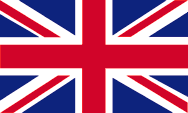
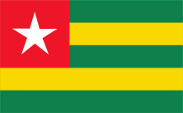
Quelle, nach: Flags of the World


Deutsch-Togo:
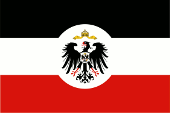
1893–1914,
Deutsches Reich,
Dienstflagge Kolonialamt / Auswärtiges Amt,
Seitenverhältnis = 2:3,
Quelle, nach: Flags of the World

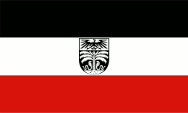
1914,
geplante Flagge für Deutsch-Togo,
Quelle, nach: Flags of the World,
Flag Reconstruction following Mark Sensen (Feb 98)
based on traditional interpretation
from Afrika-Nachrichten article 1933
Französisch-Togo:
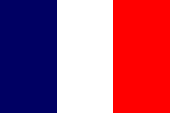
1922–1956,
Nationalflagge Frankreichs,
Seitenverhältnis = 2:3,
Quelle, nach: Corel Draw 4

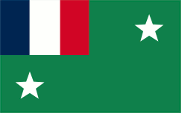
1956–1958,
Nationalflagge,
Seitenverhältnis = 5:8,
Quelle: Flags of the World
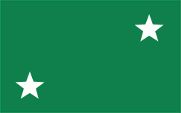
1958–1960,
Nationalflagge,
Seitenverhältnis = 5:8,
Quelle, nach: Flags of the World
Britisch-Togo:
ab 1956 Bestandteil der Goldküste
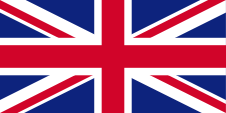
1922–1957,
Union Flag → quasi Nationalflagge,
Flagge Großbritanniens,
Seitenverhältnis = 1:2,
Quelle, nach: Flags of the World
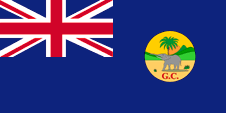
1956–1957, Goldküste,
Flagge der Regierung (Staatsflagge),
Seitenverhältnis = 1:2,
Quelle, nach:
Flags of the World
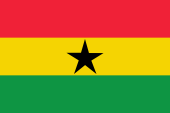
seit 1957,
Flagge von Ghana,
Seitenverhältnis = 2:3,
Quelle, nach: Wikipedia (D)
Die heutige Flagge Togos wurde am 23.04.1960 eingeführt und am 27.04.1960 – am Tag der Unabhängigkeit – offiziell gehisst. Die Seitenverhältnisse entsprechen, weltweit einmalig, dem "Goldenen Schnitt", also 1:1,618. In der Praxis wird jedoch häufig 2:3 oder 3:5 verwendet. Die Flagge zeigt fünf waagerechte Streifen in Grün, Gelb, Grün, Gelb und Grün mit einem weißen, fünfzackigen Stern in einer roten Oberecke. Rot steht für Nächstenliebe, Treue und Patriotismus, Grün steht für die Hoffnung, die Landwirtschaft und den fruchtbaren Boden, Gelb steht für Arbeit und die Bodenschätze des Landes. Der weiße Stern repräsentiert Freiheit, Fortschritt, Reinheit und Aufgeschlossenheit. Die Farbtöne der Flagge scheinen definiert zu sein, jedenfalls lassen sich folgende unverbindliche hexadezimalen Farbwerte finden: Rot #EE0000, Gelb #FFD700 und Grün #2E8B57. Daraus lassen sich folgende Pantone-Farbtöne ableiten: Rot = Pantone 1788 c, Gelb = Pantone 109 C und Grün = Pantone 348 c. Grün, Gelb und Rot sind auch als die "Panafrikanischen Farben" bekannt: Etwa 1900 setzte die Panafrika-Bewegung ein, die Gemeinsamkeiten aller Menschen mit schwarzer Hautfarbe hervorheben wollte. Der Farbendreiklang Grün-Gelb-Rot, den viele afrikanische und auch amerikanische Staaten nach Erlangung ihrer Unabhängigkeit in ihre Flaggen übernahmen, steht für die politische Einheit Afrikas, ja aller Schwarzen. Das erste Land war Ghana im Jahr 1957. Als Ursprung gelten die Landesfarben von Athiopien (Abessinien), dem ältesten unabhängigen Staat Afrikas. Als deutsche Kolonie verwendete das Land keine besondere Nationalflagge. Es galten die Farben des Deutschen Reiches: Schwarz, Weiß und Rot. Behörden verwendeten die Flagge des Kolonialamtes sowie Abarten davon. Diese war zwar schwarz, weiß und rot waagerecht gestreift und zeigte in der Mitte eine weiße Scheibe mit dem Reichsadler. Ab 1913 wurde überlegt, für die Kolonien eigene Hoheitszeichen zu schaffen. Erste Entwürfe lagen 1914 vor, jedoch wurde das Projekt wegen des Ausbruchs des Ersten Weltkriegs und wegen des Verlusts der Kolonien nicht mehr realisiert. Die Flagge der autonomen Republik zeigte zwischen 1956 und 1960 ein grünes Grundtuch mit zwei weißen fünfzackigen Sternen in den Ecken (manchmal werden sie auch gelb dargestellt) und zwischen 1956 und 1958 zusätzlich die französische Trikolore in der Oberecke. Die Bedeutung der beiden Sterne ist nicht bekannt, vielleicht standen sie für den französischen und den britischen Landesteil, oder für Togo diesseits und jenseits der Fazao-Berge (Nord- und Südtogo).
Quelle:
Flags of the World,
Wikipedia (D),
Die Welt der Flaggen,
Flaggen Wappen Hymnen,
Flaggen-Atlas Erde,
Volker Preuß
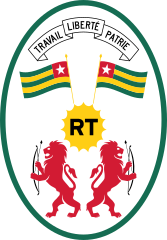
seit 1962,
Emblem von Togo,
Quelle: Edem Fiadjoe,
CC BY-SA 4.0, via Wikimedia Commons
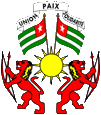
80-er/90-er Jahre,
falsche Variante des Emblems von Togo,
Quelle, nach: Corel Draw 4
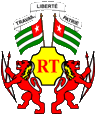
80-er/90-er Jahre,
falsche Variante des Emblems von Togo,
Quelle, nach: Wappen und Flaggen aller Nationen
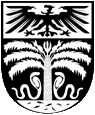
1914,
geplantes Wappen von Deutsch-Togo,
Quelle, nach: Flags of the World,
Flag Reconstruction following Mark Sensen (Feb 98)
based on traditional interpretation
from Afrika-Nachrichten article 1933
Das erste Wappen für das unabhängige Togo zwischen 1960 und 1962 war ein Wappenschild, darauf das Bild der Flagge. Das heutige Staatswappen von Togo wurde am 14.03.1962 eingeführt. Es zeigt in der Mitte ein sonnenförmiges goldenes Schild mit den Buchstaben "RT" (= Republique Togolaise), darunter nach links und nach rechts blickend, je ein roter Löwe mit Pfeil und Bogen. Oberhalb des Sonnenschildes sind zwei zwei Nationalflaggen platziert und ganz oben ein Spruchband mit dem Motto "Travail, Liberté, Patrie" → "Arbeit, Freiheit, Vaterland". Um das Aussehen des Wappens kam es in den 80-er und 90-er Jahren des 20. Jahrhunderts zu Verwirrungen, weil auch durch Behörden des Landes falsche Versionen in Umlauf gebracht wurden. So wurde ein anderes Motto in das Spruchband eingesetzt. "Union, Paix, Solidarité" → "Einheit, Frieden, Solidarität", oder der Sonnenschild bekam die Form eines Wappenschilds, oder die Schwänze der Löwen wurden nach innen gebogen. Das Land war einst eine deutsche Kolonie. Die deutschen Kolonien unterstanden – Kiautschou ausgenommen – dem Reichskolonialamt. Entsprechend verwendeten Behörden dessen Siegel, Flaggen und das Reichswappen. Ab 1913 wurde überlegt, für die Kolonien eigene Hoheitszeichen zu schaffen. Erste Entwürfe lagen 1914 vor, jedoch wurde das Projekt wegen des Ausbruchs des Ersten Weltkriegs und wegen des Verlusts der Kolonien nicht mehr realisiert. Das gedachte Aussehen der Wappen und Flaggen konnte in den 20er und 30er Jahren des 20. Jahrhunderts anhand von Fragmenten lediglich rekonstruiert werden. Die meisten Rekonstruktionen beziehen sich auf einen Artikel der Zeitung "Afrika-Nachrichten" von 1933 und die daraus folgenden Rekonstruktionen des niederländischen Vexillologen Mark Sensen vom Februar 1998, die auch auf diesen Seiten berücksichtigt werden. Die Wappen selbst sollten oberhalb des Wappenschilds noch die Kaiserkrone tragen, jedoch nicht auf den Flaggen, wenn man der Rekonstruktion von Mark Sensen folgt. Die Wappenschilde zeigten immer den gleichen Aufbau: Ein horizontal zweigeteiltes Schild, dessen Schildhaupt auf weiß den Reichsadler mit dem Brustschild des Hauses Hohenzollern zeigte. Im Hauptteil eine stilisierte Darstellung von Pflanzen, Tieren oder Landschaften, die je nach Land unterschiedlich gefärbt waren. Das geplante Wappen von Deutsch-Togo zeigte eine weiße Palme und zwei Schlangen auf schwarzem Grund.
Quelle:
Flaggen und Wappen der Welt,
1.) Wikipedia (D),
2.) Wikipedia (DE),
Volker Preuß
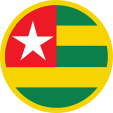
Flugzeugkokarde,
Quelle, nach: Wikipedia (EN)
Lage:
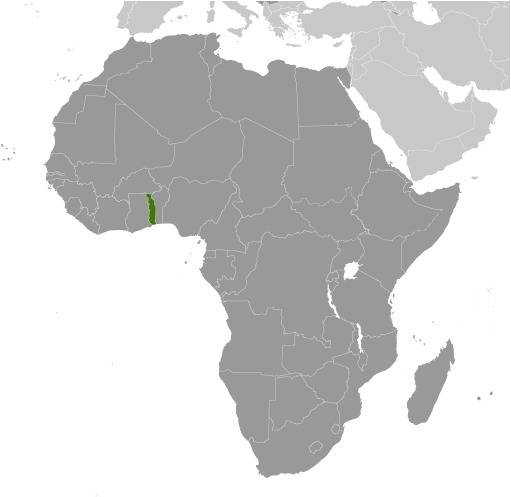
Quelle/Source: CIA World Factbook
Landkarte des Landes:
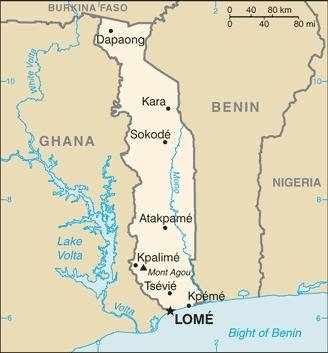
Quelle/Source: CIA World Factbook
Fläche: 56.785 km²
Einwohner: 8.500.000 (2021), davon 40 % Ewe, 16 % Kabiyé (Kabre), 13 % Akebu, 10 % Gurma, 7 % Yoruba
Religionen: 33 % Animisten, 28 % Katholiken, 20 % Moslems, 9 % Protestanten, 5 % andere Christen
Bevölkerungsdichte: 150 Ew./km²
Hauptstadt: Lomé, 1.708.000 Ew. (2017)
Amtssprache: Französisch
sonstige Sprachen: Ewe, Kabiyé usw., auch Deutsch
Währung: CFA-Franc BCEAO (XOF) = 100 Centimes
Zeitzone: MEZ – 1 h
Quelle:
Wikipedia (DE),
Wikipedia (EN)
1471/1473 · Entdeckung der Küste des heutigen Togo durch portugiesische Seefahrer
16. Jhd. · Beginn der Erschließung der Küste durch Europäer; afrikanische Stämme wandern aus dem Norden und später auch aus dem Osten ein
ca. 1850 · die Norddeutsche Missionsgesellschaft beginnt ihre Arbeit
1856–1865 · Einrichtung französischer Handelsposten in Agu, Anecho und Porto Seguro
1870–1880 · Einrichtung deutscher Handelsposten an der Küste
Juli 1884 · Landung des deutschen Kanonenbootes "Möve", Gustav Nachtigal, deutscher Generalkonsul für Westafrika, erklärt nach Verhandlungen die Küste des heutigen Togo am 05.07.1884 zum deutschen Schutzgebiet
24.12.1885 · Frankreich erkennt das deutsche Protektorat an
1897/1899 · Grenzverträge mit Frankreich und Großbritannien ergeben ein deutsches Schutzgebiet Togoland von ca. 87.200 km²
1905 · Umbenennung von Togoland in Deutsch-Togo
1914–1918 · Erster Weltkrieg (August 1914 Eindringen britischer und französischer Truppen, 25.08.1914 Sprengung der Funkstation Kamina durch die Besatzung, 27.08.1914 Kapitulation der deutschen Polizeitruppe, deren Angehörige später nahezu alle in der Kriegsgefangenschaft sterben)
1920 · Versailler Diktat, das Deutsche Reich verliert alle seine Kolonien, Togo wird ein Mandatsgebiet des Völkerbundes unter Mandat Frankreichs und Großbritanniens, Vertreibung der wenigen Deutschen (ca. 300 Personen)
1922 · Togo wird in Französisch-Togoland (2/3 der Landesfläche im Osten und die gesamte Küste) und Britisch-Togoland (1/3 der Landesfläche im Westen) aufgeteilt
1946 · Togo wird Treuhandgebiet der UNO, Französisch-Togoland wird ein mit Frankreich assoziiertes Territorium
1955 · Französisch-Togoland wird als "Togo" eine autonome Republik innerhalb der Französischen Gemeinschaft (Communauté Française)
1956 · nach einer Volksabstimmung wird Britisch-Togoland der Britischen Kolonie Goldküste (Ghana) angeschlossen, Aufhebung der britischen UN-Treuhandschaft
1958 · Wahlen in Togo (ehem. Französisch-Togoland)
27.04.1960 · Unabhängigkeit für Togo
1963 · Militärputsch, Machtübernahme durch Nicolas Grunitzky
1967 · Rücktritt von Nicolas Grunitzky, Machtübernahme durch die Armee unter Oberstleutnant Etienne Gnassingbé Eyadéma
1969 · Einparteiensystem unter der Einheitspartei RPT, Vorsitzender: Etienne Gnassingbé Eyadéma
1974 · Verstaatlichung der Phosphatminen
1986 · Putschversuch, Einmischung durch Frankreich
1990 · Unruhen
1991 · zögerliche Demokratisierung
05.02.2005 · Tod von Etienne Gnassingbé Eyadéma
24.04.2005 · Wahl von Faure Gnassingbé Eyadéma, Sohn von Etienne Gnassingbé Eyadéma, zum Präsidenten von Togo
April/Mai 2005 · Unruhen mit über 500 Toten, tausende Flüchtlinge
Quelle:
Atlas zur Geschichte,
World Statesmen,
Discovery '97,
Wikipedia (D)
Zum Ursprung des Landesnames gibt es mindestens zwei Erklärungen: Der Name "Togo" geht auf den ca. 100 km² großen Togo-See zurück, der vier Kilometer hinter der Küste liegt. Das Wort Togo bedeutet in der Sprache des Kabiyé-Volkes (Kabre) "Wasserkante". Der Name wurde wahrscheinlich von der Ortschaft "Togokomé" (Togodorf, Togoville) auf den See übertragen. Eine zweite Erklärung sucht den Ursprung des Namens in der Sprache der Ewe, in der "togo" angeblich "hinter dem Fluss" heißen soll. Der amtliche Name des Landes ist "République togolaise", also "Togolesische Republik".
Quelle: Handbuch der geographischen Namen,
Wikipedia (EN)