mobile Ansicht, to the English Version tap the flag

- Autonome Region Bougainville
- separatistischer Staat "Republik Meekamui"
- seit 1990 de facto unabhängig von Papua-Neuguinea
• Flagge
• Bedeutung/Ursprung der Flagge
• Landkarte
• Zahlen und Fakten
• Geschichte
• Ursprung des Landesnamens
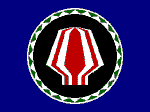
Nationalflagge,
Seitenverhältnis = 2:3,
Quelle, nach:
UNPO


Die Flagge von Bougainville ist einfarbig blau und zeigt in der Mitte eine schwarze Scheibe mit einem weißen grün-gezackten Rand. In der Mitte der schwarzen Scheibe die stilisierte Darstellung eines Ritual-Hutes. Blau ist die Farbe des Ozeans, Grün steht für die üppige Vegetation, Schwarz für die Menschen und ihre Hautfarbe. Die weiße Umrandung repräsentiert eine bestimmte Art von Muscheln, die auf der Insel früher als Zahlungsmittel verwendet wurden. Der Ritual-Hut wird von männlichen Jugendlichen getragen, wenn sie in die Reihen der Erwachsenen aufgenommen werden.
Quelle: Flags of the World
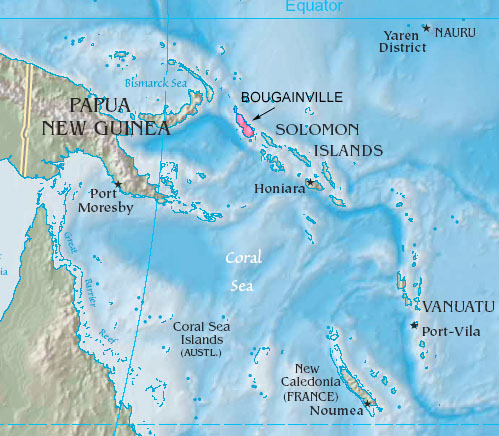
Quelle: Freeware, University of Texas Libraries, modyfied by: Volker Preuss
Fläche: 8.800 km²
Einwohner: 249.358 (2011)
Bevölkerungsdichte: 28 Ew./km²
Hauptstadt: Buka
Sprachen: Englisch, Melanesische, Polynesische
Währung: vermutlich die Währung von Papua-Neuguinea
Zeitzone: MEZ + 10 h
Quelle:
Wikipedia (D)
1568 · Inbesitznahme durch Spanien, keine Kolonisierung
1768 · Wiederentdeckung durch den französichen Seefahrer Antoine de Bougainville
1884 · Inbesitznahme durch die Deutsche Neuguinea-Kompanie
1899 · Übernahme durch das Deutsche Reich
1921 · Verwaltung durch Australien
1942–1944 · im Zweiten Weltkrieg von Japan besetzt
1975 · Angliederung an Papua-Neuguinea als North Solomons Province
seit 1974 · starke Umweltzerstörung durch die Mine Panguna
1979 · erste Unruhen wegen Panguna
1980 · Straßenkämpfe
1988 · Bürgerkrieg (Befreiungsarmee von Bougainville, BRA, Bougainville Revolutionary Army)
1990 · Unabhängigkeit
1990 · Stillegung von Panguna
1990 · Blockade durch Papua-Neuguinea fordert 15 000 Menschenleben
1994 · Waffenstillstand
1996 · Erneute Angriffe von Papua-Neuguinea
1997 · Waffenstillstand
1998 · vorläufiger Friedensvertrag mit Papua-Neuguinea
2001 · Friedensvertrag, Papua-Neuguinea gewährt offiziell Autonomie als Autonome Region Bougainville
2005 · Wahlen zur Provinzregierung, vom Widerstand teilweise boykottiert
Dezember 2019 · ein Referendum egibt 98 % für die Unabhängigkeit
Quelle: Atlas zur Geschichte,
Wikipedia (D)
Die Insel Bougainville ist benannt nach Louis Antoine de Bougainville (1729–1811), einen französischen Seefahrer. Er umsegelte (auf der Route von Magellan) als erster Franzose zwischen 1766 und 1769 die Welt. Dabei entdeckte er im Jahre 1768 die Inselgruppe der Salomonen wieder, deren Lage in Vergessenheit geraten war. Die Insel Bougainville ist die nördlichste Insel der größeren Inseln der Inselgruppe der Salomonen.
Quelle: Handbuch der geographischen Namen